


Products
News
- ▶ How liquid surge affects a single-compartment oil tanker truck
- ▶ How to clean a stainless steel oil tanker before changing cargo
- ▶ Choosing compartment sizes for a 45 m³ five-compartment steel fuel tanker
- ▶ How heat loss is calculated for a 38 m³ insulated stainless palm oil tanker
- ▶ Checking vapor recovery on a 45 m³ six-compartment painted aluminum tanker
How liquid surge affects a single-compartment oil tanker truck
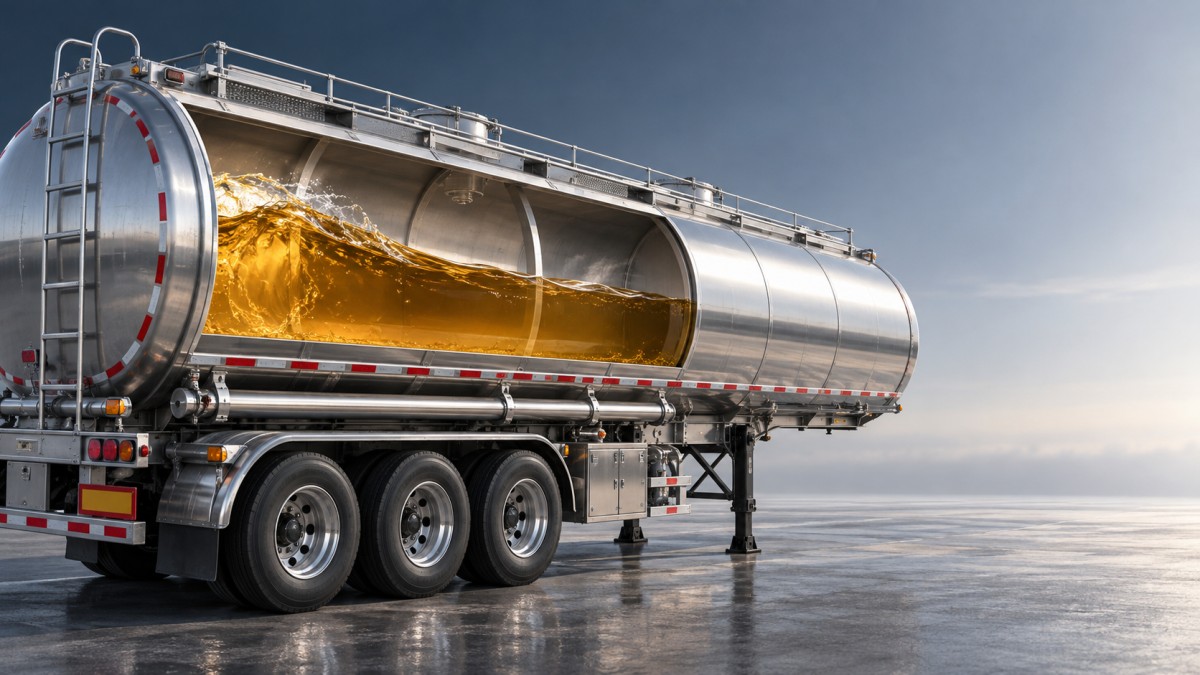
Liquid surge is a critical consideration when evaluating a 45 m3 Single-CompartmentStainless Steel Oil Tanker Truck. As the vehicle accelerates, brakes or turns, fuel movement can shift the load and affect braking response, directional stability and rollover risk. These effects can be particularly pronounced at partial fill levels. Understanding surge behavior is essential when assessing tank design, operating limits and vehicle suitability for demanding fuel transport routes.
The issue is not simply that the liquid moves. It is that the liquid can continue moving after the vehicle has changed speed or direction, transferring forces through the tank, its supports, the suspension and the tractor connection. A tanker that looks acceptable in a static loading calculation still needs to be assessed as a moving system.
What changes when a tank is partially filled?
In a partially filled tank, the free surface allows fuel to move relative to the shell. During braking, liquid tends to move forward; during acceleration, it moves rearward. A turn produces lateral movement toward the outside of the curve. Road gradients, uneven pavement and steering corrections can add to the motion.
The resulting forces are not always synchronized with the driver’s inputs. After a braking event, fuel can move forward and then rebound. The driver may feel a push or a change in vehicle response even after brake pressure has been reduced. Repeated inputs can make the motion harder to predict, particularly where the timing of the vehicle movement and liquid motion interact.
A near-full tank generally has less free space for large surface movement, but it is not automatically the safest or a permissible loading condition. Thermal expansion space, product properties, tank design and applicable requirements must also be respected. An empty or nearly empty tank presents a different combination of weight, axle loading and handling. There is no universal fill percentage that can be declared safe for every tanker and route.
Braking, cornering and the forces behind the wheel
Under braking, forward liquid movement adds a time-dependent load to the front of the tank and its supporting structure. It can also change the way load is shared through the trailer and tractor. Brake-system performance remains essential, but a passing brake inspection alone does not describe how the complete combination responds to a moving liquid load.
On a downhill approach to a junction, for example, a driver may brake while the vehicle is already subject to a forward component of load. If the road surface is uneven or traction is limited, the available margin for correcting an unexpected response is smaller. Evaluators should consider the whole operating sequence, including approach speed, gradient, braking, release and subsequent steering.
Lateral surge matters most where a turn, ramp, roundabout or evasive maneuver coincides with a high center of gravity. Fuel moving toward one side can increase the overturning moment and add to suspension roll. The vehicle may reach its stability limit without a dramatic steering input, especially if speed, road camber and a sudden correction combine unfavorably.
A wider track, suitable suspension and a lower center of gravity can contribute to stability, but none should be treated as an isolated cure. Tank geometry, liquid density, fill level, axle arrangement, tire condition and tractor compatibility all affect the outcome. Anti-lock braking and electronic stability functions, where fitted, are valuable controls; they do not remove the physical effect of surge or justify exceeding vehicle and route limits.
Single compartment does not necessarily mean unbaffled
A single-compartment tank holds its load in one continuous product space. It may still contain internal baffles: structures with openings that restrict or alter liquid movement without creating separate sealed compartments. The presence of baffles should be confirmed in drawings rather than assumed from the tank’s external appearance.
Baffle spacing, shape, openings and attachment details all matter. Restricting flow can reduce some surge effects, but openings must also support intended filling and discharge, drainage and access for inspection or cleaning. Baffles introduce loads at their connections to the shell, so their effectiveness cannot be assessed separately from structural strength and fatigue design.
Ask the manufacturer what the internal arrangement is intended to control: longitudinal movement, lateral movement or both. A transverse baffle arrangement should not automatically be assumed to provide the same control in a turn as it does under braking. Likewise, a baffle drawing is not proof of a particular rollover threshold unless supporting analysis or test evidence is available for the proposed configuration.
How compartmentation changes the comparison
Separate compartments can limit the length over which liquid moves and allow different products or delivery quantities to be carried. They also introduce bulkheads, additional fittings and a more involved loading plan. A multi-compartment tanker is not automatically free of surge: each partially filled compartment can still contain a moving free surface, and the distribution of product between compartments affects axle loads and stability.
For comparison, the 50 m³ 4-Compartment Carbon Steel Fuel Tanker is a different configuration intended for fuel transport, with four compartments for carrying multiple products. Its stated design uses a 5 mm carbon steel shell, 6 mm carbon steel end plates, three axles and heavy-duty suspension with 70 mm pins. Overall dimensions are subject to approved design drawings. Those details make it a useful point of comparison, not evidence that it will outperform a particular 45 m³ stainless steel single-compartment design in a surge or stability assessment.
The operational question is whether separate loads and delivery sequences justify the added complexity. For a single-product route, a baffled single compartment may be practical; for multi-drop or multi-product work, compartmentation may fit the duty better. Either choice still needs a loading plan that keeps individual axle loads and the complete combination within applicable limits.
Check capacity against payload and axle loads
Tank volume is not the same as legal payload. A nominal capacity of 45 m³ describes volume, while the transported mass depends on the product’s density and the quantity loaded. Temperature can affect volume and density, and different petroleum products need not produce the same mass at the same fill level.
For an initial check, calculate liquid mass from loaded volume and the applicable product density, then add the verified unladen weights of the trailer, tractor and equipment. That establishes a starting point for gross combination mass, not an axle-load approval. The position of the tank, kingpin, axle group and liquid center of gravity determines how the load is distributed.
Request an axle-load calculation for the intended tractor and trailer, including representative full, partial and delivery conditions. A combination can satisfy a gross mass limit while overloading an individual axle or axle group. Changes in tractor wheelbase, fifth-wheel position or equipment weight can make a calculation prepared for another vehicle unsuitable.
What to request in a technical review
A credible review starts with the actual duty rather than a generic capacity label. Define the products, their density range, loading and unloading sequence, expected partial-load operation, road conditions and intended tractor. For routes involving steep grades, rough surfaces or frequent urban deliveries, those details can change the questions asked of the tank designer.
The following documents and clarifications are particularly useful:
- Approved general arrangement and internal drawings showing tank geometry, baffles, openings, supports and access points.
- Material specifications, shell and end-plate thicknesses, welding details and the design basis for the intended products.
- Unladen weight, permitted gross mass, axle ratings, kingpin load and axle-load calculations for the proposed tractor.
- Brake and suspension specifications, including the configuration of any anti-lock or stability-control equipment.
- Available structural, stability or surge assessment evidence, with assumptions clearly stated for fill level, product density and vehicle configuration.
- Inspection, maintenance and repair provisions for internal structures and tank-to-chassis attachments.
Evidence should be read against its scope. A calculation for a different tank geometry, suspension or tractor may be informative but should not be presented as validation of the vehicle under review. If no surge-specific simulation or test is available, establish what engineering assessment supports the design and whether additional analysis is warranted for the planned service.
Standards and operating conditions need local confirmation
Requirements for dangerous-goods tanks, vehicle dimensions, axle loads, braking, inspection and road operation depend on the jurisdiction and the products carried. ADR is one reference framework for the international carriage of dangerous goods by road where it applies; it should not be assumed to govern every domestic route or destination. Check the relevant national rules, route restrictions and contractual requirements before specifying the tank or accepting a compliance claim.
A certificate or report is useful only when its scope matches the equipment, configuration and applicable requirement. Confirm the issuing body, referenced standard and version, vehicle identification where relevant, and any conditions attached to the document. A material certificate, for example, does not by itself establish approval of the assembled tanker.
Operating procedures deserve the same attention as design documents. Drivers need instructions appropriate to the vehicle for following distance, speed selection, smooth braking and corner entry. Loading staff need to know the approved fill and weight limits, the unloading sequence and how to respond when a route requires a prolonged partial load. Inspection should include accessible baffle attachments, shell supports and signs of cracking or damage, with internal entry controlled under appropriate confined-space procedures.
Shandong ORNN Vehicle Co., Ltd. manufactures fuel and chemical liquid tanker trailers alongside other semi-trailers and transport equipment, and has 17 years of industry experience. With customers in East Africa, West Africa and Saudi Arabia, the company’s range illustrates why the intended market and duty must be established before comparing designs. For a proposed 45 m³ unit, the useful next step is to review the internal arrangement, tractor-specific axle calculations and applicable compliance documents against the actual product and route—not to rely on nominal capacity or tank material alone.
Get Quote Form
Please complete the form below, and our product experts will contact you within one business hour. All inquiry details are kept strictly confidential and used solely to provide you with a precise solution.
✅ 24/7 Engineer Online Support | Ready for any technical inquiries.
✅ Full Export Documentation Support | We provide full set of shipping documents to ensure smooth customs clearance.
LOGO
This stunning beach house property is a true oasis, nestled in a serene coastal community with direct access to the beach.
Opening Hours
Monday - Friday : 9AM to 5PM
Sunday: Closed
Closed during holidays
Contact
+18888888888
hezuo@eyingbao.com123 West Street, Melbourne Victoria 3000 Australia
Request a Free Quote Today
Need mainstream models or custom specs? Our engineers are ready.
Contact us today for a lasting partnership!