


Products
News
- ▶ Is a 45 m3 single-compartment tanker suitable for short routes?
- ▶ How to check road weight limits for a 45 m3 oil tanker truck
- ▶ How liquid surge affects a single-compartment oil tanker truck
- ▶ How to clean a stainless steel oil tanker before changing cargo
- ▶ Choosing compartment sizes for a 45 m³ five-compartment steel fuel tanker
Is a 45 m3 single-compartment tanker suitable for short routes?
A 45 m³ single-compartment stainless steel oil tanker truck can work well on short routes when each trip carries one compatible product to a receiving point that can accept a large delivery. It becomes less attractive when legal payload limits prevent the tank from being filled, orders are fragmented, or loading and unloading take up most of the working day.
For a project decision, start with the complete vehicle combination and delivery pattern, not the distance on the map. A short haul can justify a large tanker if the depot can load it efficiently and the destination has sufficient storage. The same vehicle may sit idle between trips if the site can only receive small quantities or if access is restricted.
Start with usable payload, not tank capacity
A 45 m³ tank has a nominal volume of 45,000 litres. That does not mean every route or product allows 45,000 litres to be carried. The permitted load depends on the mass of the product, the unladen mass of the tractor and trailer, applicable vehicle and axle limits, and any restrictions along the route.
Fuel density varies by product and temperature. Calculate the mass of the intended load using the density applicable to the planned operation, then add the operating mass of the complete combination, including the tractor, trailer, driver, equipment and other carried items. Compare the result with the permitted gross combination mass and the relevant axle limits. The lowest applicable limit controls the practical load.
Axle distribution deserves separate attention. A combination can be within its gross limit and still overload an axle group because of the way weight is transferred through the kingpin or distributed along the trailer. Tractor wheelbase, fifth-wheel position, trailer geometry and loading level all affect the result. Use the proposed tractor and approved trailer design when assessing axle loads; the trailer’s nominal axle rating alone is not the payload allowance.
Account for the permitted filling level and expansion space for the product as well. The usable volume is the lower of the volume allowed by the loading requirements and the volume that can be carried within the weight limits. If that figure is consistently far below 45 m³, compare a smaller tanker using actual trip requirements. Paying for unused volume and carrying additional unladen weight may offer little operational benefit.
Does the delivery pattern suit one compartment?
A single compartment is most useful when the full load is one product, or when multiple deliveries can all be made from the same product load. A depot-to-project-site shuttle supplying one fuel grade is a straightforward example: the vehicle can load once, travel to one receiving tank, discharge and return.
The arrangement is less flexible when a route requires different fuel grades on the same run. A single tank cannot segregate those products in the way a multi-compartment tanker can. Separate trips may be needed, and changing products can require a controlled transition or cleaning procedure to protect product quality. The time and availability of cleaning facilities can affect the schedule as much as the driving distance.
Multiple stops carrying the same product are possible, but the receiving tanks must have enough available capacity, and the operator needs a reliable way to measure and document each delivery. Partial discharges also change the volume remaining in the tank as the route progresses. The approved loading conditions, surge-control provisions and operating instructions for the particular tanker should support that pattern of operation.
If orders are usually small, scattered or subject to frequent changes, a smaller tanker may complete deliveries with less scheduling friction. A multi-compartment vehicle may be preferable where product separation matters more than maximizing the volume of one product. Neither choice is automatically better: compare the number of runs, receiving constraints and time spent at each stop.
Short distance does not necessarily mean a fast cycle
On a short route, loading, paperwork, queuing, positioning, discharge and site clearance can take a substantial share of the cycle. Increasing tank capacity only improves throughput if those activities can accommodate the larger load without creating a bottleneck.
Map one complete cycle from the vehicle’s arrival at the loading point to its readiness for the next load. Include realistic waiting periods at both ends, access windows, hose connection and disconnection, delivery documentation, and any required product sampling or safety checks. Then assess how many complete cycles fit within the planned working shift.
For example, a site may consume enough fuel over a day to justify a large tanker but lack storage space for a single large delivery. The vehicle would then need to wait for space to become available, make partial deliveries, or return with product. By contrast, a site with adequate receiving capacity and a dependable unloading point may benefit from fewer vehicle movements.
Check the unloading arrangement before choosing equipment. A gravity discharge, pump-assisted transfer or site connection may suit different tank layouts and receiving conditions. The trailer outlet, hoses, couplings and any pump arrangement must be compatible with the product and the receiving installation. Do not assume that a larger tank will unload at the same rate as a smaller one under the site’s actual conditions.
Can the vehicle reach and operate at the site?
Short-haul work often involves more manoeuvring per kilometre than long-distance transport. A tanker may need to enter a congested depot, reverse into a temporary project compound or turn around on an unpaved surface. Route length says little about whether a tractor and three-axle trailer can do those movements safely.
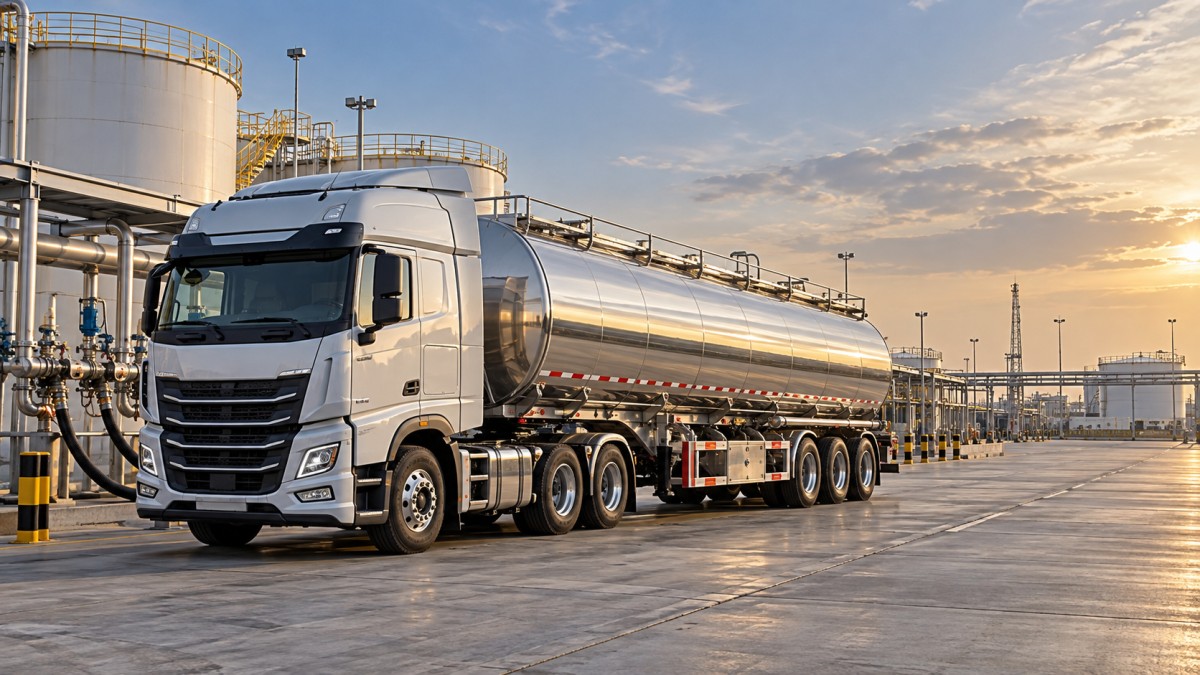
Review the narrowest sections of the route, bridge and road restrictions, gradients, turning space, overhead clearances and the strength of surfaces where the vehicle will stop. At the delivery point, allow space for the tractor-trailer combination, hose routing, safe access to valves and an unobstructed departure. A route survey is especially useful when access roads or site layouts will change during the project.
Ground conditions matter at the loading and discharge positions, not just on the approach road. A fully loaded combination concentrates substantial weight at its tyres, and soft or uneven ground can make positioning and departure difficult. The site also needs a suitable area for any trailer parking or coupling activity, including support for the landing gear where the trailer is disconnected.
Consider the return journey too. A vehicle that enters easily while following a controlled route may still require difficult reversing or an unsuitable turn to leave. If site access requires a smaller rigid tanker or a shorter trailer, the extra trips may be preferable to repeated delays or unsafe manoeuvres.
Compare the 45 m³ option with the volume actually needed
A useful comparison is between the planned 45 m³ tanker and the next smaller capacity that can meet the delivery schedule. Use the same product, tractor assumptions, route and working hours for both. Compare the legal and operational payload per trip, the number of complete cycles required, and whether each vehicle can enter and discharge at the destination.
For reference, the 41 m³ Single-Compartment Stainless Steel Tanker Truck with Vapor Recovery System has a 41,000-litre nominal capacity, one compartment and a 304 stainless steel tank. Its listed configuration includes three 13-ton axles, ABS and a vapor recovery system. It is a useful comparison where a single-product fuel operation does not need the full nominal volume of a 45 m³ tank, but its legal payload and site compatibility still depend on the complete vehicle and operating conditions.
Stainless steel is one material choice, not proof that a tanker is suitable for every liquid. The tank, seals, valves, hoses and other wetted components must be compatible with the specified fuel and operating requirements. The vapor recovery arrangement also needs to match the loading or receiving facility’s connections and procedures; its presence on the trailer does not by itself establish compatibility with a site.
When comparing the two capacities, avoid using nominal volume as the sole measure of productivity. A smaller tanker that can carry close to its permitted load and complete an extra cycle may deliver more during a shift. Equally, if both vehicles can legally carry their intended loads and loading and discharge capacity are available, the larger tank may reduce the number of trips needed.
Turn the operating requirements into a purchase specification
Before requesting a final configuration, define the delivery task in terms the vehicle supplier and site team can both use:
- Product and quantity: identify the fuel, its relevant density, the expected volume per delivery and whether the load will remain the same product between trips.
- Vehicle combination: specify the intended tractor, required payload, route restrictions and applicable gross and axle limits.
- Route and site access: provide turning, clearance and surface constraints for the loading point, destination and any intermediate stops.
- Transfer interfaces: identify the loading and discharge method, connection types, receiving capacity and vapor recovery interface where required by the operation.
- Operating schedule: set out the expected shift, delivery windows, loading queues and any need for partial deliveries or product changes.
Use those details to compare proposals on the same basis, including unladen mass, axle-load distribution and the equipment included in each configuration. Review the approved design drawings and operating instructions with the people responsible for loading, driving and receiving the product. Their input can expose a connection mismatch or access problem before it becomes a delivery delay.
A 45 m³ single-compartment tanker is a sound short-route choice when the load can be carried within the applicable limits, the site can receive it, and the daily delivery volume keeps the vehicle productive. When any of those conditions is missing, a smaller or differently configured tanker may be the more effective project vehicle, even if it needs more trips.
Get Quote Form
Please complete the form below, and our product experts will contact you within one business hour. All inquiry details are kept strictly confidential and used solely to provide you with a precise solution.
✅ 24/7 Engineer Online Support | Ready for any technical inquiries.
✅ Full Export Documentation Support | We provide full set of shipping documents to ensure smooth customs clearance.
LOGO
This stunning beach house property is a true oasis, nestled in a serene coastal community with direct access to the beach.
Opening Hours
Monday - Friday : 9AM to 5PM
Sunday: Closed
Closed during holidays
Contact
+18888888888
hezuo@eyingbao.com123 West Street, Melbourne Victoria 3000 Australia
Request a Free Quote Today
Need mainstream models or custom specs? Our engineers are ready.
Contact us today for a lasting partnership!