


Products
News
- ▶ 304 vs. 316 Stainless Steel for Oil Semi Trailers: Where Each Grade Fits
- ▶ Selecting Stainless Steel Grades for Oil Semi Trailer Tank Applications
- ▶ Can Aluminum Oil Tanker Trailers Withstand Rough Roads and High-Cycle Use?
- ▶ Choosing Aluminum Alloy Grades for Oil Tanker Trailer Shell Construction
- ▶ Aluminum Tanker Trailer Maintenance: Preventing Galvanic Corrosion at Joints
304 vs. 316 Stainless Steel for Oil Semi Trailers: Where Each Grade Fits
For an oil semi-trailer, 304 stainless steel is usually the practical choice when the tank is dedicated to clean petroleum products and operates in a relatively controlled environment. Grade 316 becomes easier to justify when chloride exposure, aggressive cleaning chemistry, coastal service, or cargo uncertainty creates a higher risk of localized corrosion. The higher price of 316 does not automatically produce a better tanker; it buys a more forgiving corrosion margin under specific conditions.
That distinction matters because a stainless steel oil semi trailer is evaluated over years of loading, unloading, washing, parking, and maintenance. The tank material must suit the cargo, but it must also tolerate external exposure, residues around fittings, water trapped at seams, and the operating discipline of the fleet.
Start with the cargo, then examine the operating environment
For refined fuels such as diesel, gasoline, kerosene, and similar petroleum products, both 304 and 316 may provide suitable resistance when the product is clean, the tank is properly specified, and contamination is controlled. Petroleum cargo alone is therefore rarely a sufficient reason to select 316.
The decision changes when the trailer may handle products with corrosive contaminants, mixed liquids, or uncertain cleaning histories. A fleet that dedicates each compartment to a defined fuel grade has a different risk profile from an operator whose equipment is moved between fuel distribution, industrial liquid transport, and cleaning cycles of varying quality.
304 is an austenitic stainless steel with strong general corrosion resistance. Its performance is often appropriate for inland fuel distribution where trailers are regularly maintained, wash water does not remain on the tank or fittings, and the operating area is not heavily affected by salt.
316 contains molybdenum, which improves resistance to pitting and crevice corrosion in chloride-containing environments. That advantage is particularly relevant around manholes, valve areas, weld-adjacent surfaces, drainage points, and external components where salt water, cleaning residue, or trapped moisture can remain in contact with the metal.
It is important to separate “corrosion resistance” from “corrosion proof.” Neither grade compensates for poor drainage, damaged passivation, abrasive cleaning, incompatible seals, or a design that permits water and deposits to collect in inaccessible areas.
Where 304 usually fits
Grade 304 is often a sound technical and commercial fit for dedicated petroleum tanker service when operating conditions are straightforward. It can be suitable when the trailer is used mainly for refined fuel distribution, cargo quality is controlled, and the route is predominantly inland.
- Dedicated diesel, gasoline, or kerosene transport with established loading procedures.
- Dry or inland operating regions where road salt and marine air are limited.
- Fleets with routine tank cleaning, inspection, and drainage practices.
- Operations where payload, tank configuration, and lifecycle cost require a balanced material specification.
- Trailers whose compartments are not regularly repurposed for chemical or high-chloride liquid service.
In these conditions, paying for 316 may not materially reduce operating risk. The more valuable investment may be in tank fabrication quality: consistent welding, properly designed reinforcement, accessible inspection points, compatible valves and gaskets, reliable earthing provisions, and drainage that prevents standing water.
Material grade should not be used as a shortcut for evaluating the entire tank. A poorly fabricated 316 tank can create more maintenance problems than a well-built 304 tank with sound weld finishing and disciplined cleaning practices.
When 316 earns its additional cost
Grade 316 deserves closer consideration when the corrosion threat comes from outside the cargo as much as from inside it. Coastal terminals, port-area distribution, and regions where saline dust or salt-laden humidity reaches parked trailers are common examples. Repeated salt exposure is especially problematic where deposits sit around lids, hinges, support brackets, piping interfaces, and weld geometry.
Cleaning practices can be another reason to move toward 316. If cleaning agents, wash water, or disinfecting procedures introduce chlorides and are not thoroughly rinsed away, localized corrosion can develop in sheltered areas even if the transported fuel itself is not especially corrosive. Evaluators should ask what chemicals are used, how rinse water is managed, and whether the tank is dried or left wet between assignments.
316 may also be the more defensible specification when cargo use is expected to broaden later. That does not mean it is suitable for every chemical liquid. Compatibility still has to be assessed for each intended medium, including concentration, temperature, contamination risk, and cleaning process. But where a tanker may face less predictable liquid-service conditions, the added pitting resistance can reduce the penalty of operational variation.
For equipment intended for humid coastal routes or mixed regional service, 316 can be a lifecycle-risk decision rather than a cargo-only decision. The premium is easier to support when corrosion-related downtime, inspection failure, repair access, and tank decontamination would be operationally expensive.
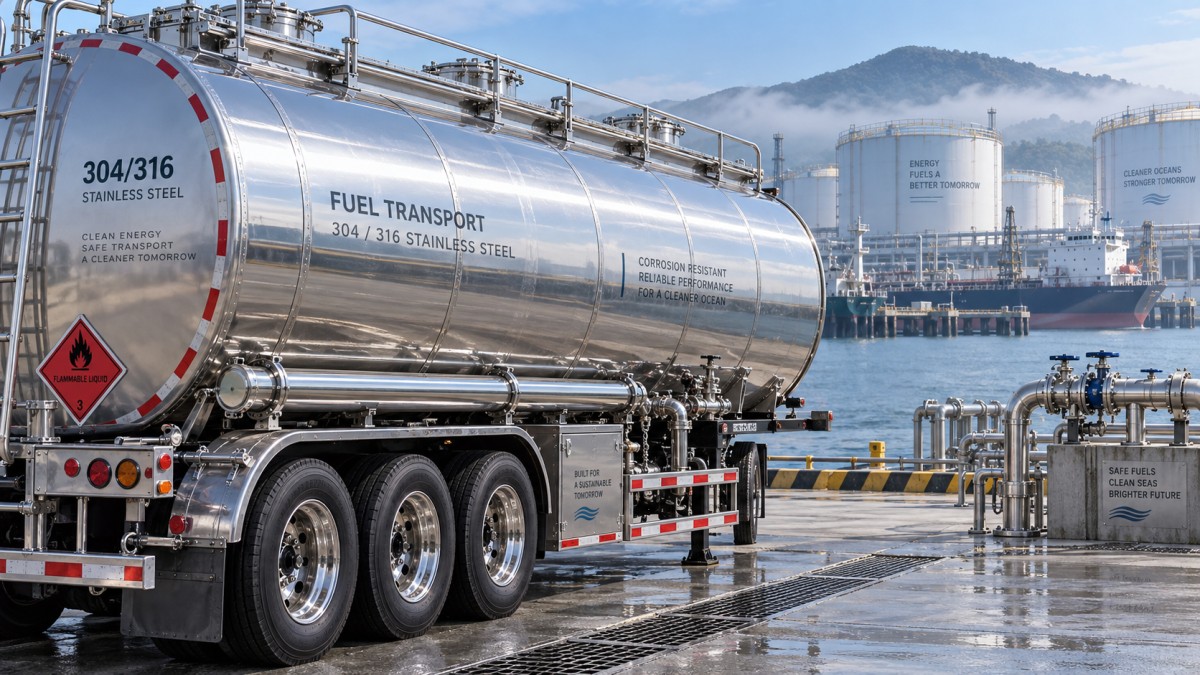
The comparison is not complete without fabrication details
Welding and post-weld treatment deserve particular attention. Heat tint, embedded iron contamination, rough weld surfaces, and inadequate cleaning after fabrication can create corrosion initiation points. Technical evaluators should clarify how welds are finished, whether internal surfaces are cleaned and passivated where appropriate, and how the manufacturer controls contamination between carbon-steel and stainless-steel work areas.
Tank geometry has similar importance. Compartments, baffles, manhole necks, outlet zones, and piping connections should allow effective draining and cleaning. If residues or wash water repeatedly remain in a crevice, choosing 316 may slow the problem but will not eliminate the underlying design or maintenance issue.
Do not overlook the weight and material-system question
Stainless steel is not the only material decision for fuel tanker fleets. Payload-sensitive distribution operations may also assess aluminum alloy tanks, particularly where corrosion conditions and cargo compatibility support that route. For example, a 45 m³ 6-Compartment Aluminum Alloy Oil Tanker Semi-Trailer uses a 5454 aluminum alloy tank body with six compartments, illustrating that compartment layout, tare weight, and delivery pattern can matter as much as choosing between two stainless grades.
That comparison should not be reduced to a simple hierarchy of materials. Aluminum alloy, 304 stainless, and 316 stainless each create different trade-offs in weight, fabrication, repair approach, corrosion exposure, and intended service. A technical evaluation should first establish why stainless steel is required for the assignment, then determine whether 304 or 316 provides the appropriate margin.
A practical specification review
Before issuing a purchase specification, ask a short set of operational questions. What products will each compartment carry over the trailer’s expected working life? Are routes inland, coastal, or port-connected? How is the tank cleaned, rinsed, and dried? Can the trailer be exposed to salt, brackish water, or chloride-bearing dust while parked? Are there locations where moisture can remain around fittings or under external attachments?
The answers should be tied to the proposed tank design, not left as general assumptions. Review the grade for the shell, ends, fittings, piping, and any wetted components separately where necessary. Confirm the plate thickness and structural design against the required volume, compartment arrangement, road conditions, and applicable local transport rules. Stainless grade alone says little about fatigue resistance, rollover performance, axle loading, or the quality of the running gear.
For a dedicated inland fuel operation with controlled cleaning, 304 is commonly the rational baseline. For coastal, chloride-exposed, or operationally variable service, 316 provides a stronger basis for managing localized corrosion risk. The final choice should follow the trailer’s real exposure profile, because the cost of the wrong grade is usually paid later through inspection findings, repairs, downtime, or restrictions on how the tanker can be used.
Get Quote Form
Please complete the form below, and our product experts will contact you within one business hour. All inquiry details are kept strictly confidential and used solely to provide you with a precise solution.
✅ 24/7 Engineer Online Support | Ready for any technical inquiries.
✅ Full Export Documentation Support | We provide full set of shipping documents to ensure smooth customs clearance.
LOGO
This stunning beach house property is a true oasis, nestled in a serene coastal community with direct access to the beach.
Opening Hours
Monday - Friday : 9AM to 5PM
Sunday: Closed
Closed during holidays
Contact
+18888888888
hezuo@eyingbao.com123 West Street, Melbourne Victoria 3000 Australia
Request a Free Quote Today
Need mainstream models or custom specs? Our engineers are ready.
Contact us today for a lasting partnership!