


Products
News
- ▶ Can Aluminum Oil Tanker Trailers Withstand Rough Roads and High-Cycle Use?
- ▶ Choosing Aluminum Alloy Grades for Oil Tanker Trailer Shell Construction
- ▶ Aluminum Tanker Trailer Maintenance: Preventing Galvanic Corrosion at Joints
- ▶ How an Aluminum Oil Tanker Trailer Can Increase Legal Payload Capacity
- ▶ Aluminum Oil Tanker Trailers: Evaluating Weight Savings Against Initial Cost
Can Aluminum Oil Tanker Trailers Withstand Rough Roads and High-Cycle Use?
Can Aluminum Oil Tanker Trailers Withstand Rough Roads and High-Cycle Use?
They can, but “aluminum” alone is not the answer. An aluminum oil tanker trailer operating on uneven highways, quarry access roads, patched urban routes, or long intercity corridors is exposed to repeated vibration, torsional movement, braking loads, and liquid surge. The real question for a technical evaluator is whether the tank, chassis interface, suspension, welds, and maintenance plan were designed as one fatigue-resistance system.
Aluminum has an obvious payload advantage over heavier tank construction, which can be valuable where legal gross vehicle weight limits are tight. Yet a lighter tank is not automatically a more durable tank. Rough-road service magnifies weak details: an abrupt change in plate thickness, an overstressed bracket, poor weld preparation, unsupported piping, or a suspension selected only for smooth-road operation. These are usually the areas that deserve closer inspection before purchase.
Fatigue performance starts with alloy choice and tank geometry
For fuel transport, alloy selection needs to be considered together with forming behavior, corrosion resistance, welding response, and the intended duty cycle. 5454 aluminum alloy is commonly specified for tanker bodies because it is suitable for fabricated tank applications, but the alloy label should never end the technical review. Evaluators should ask for the approved drawings, plate thicknesses, weld procedure information where available, internal support arrangement, and details of how the tank is connected to the trailer running gear.
Tank shape matters just as much. A large cylindrical or elliptical vessel constantly flexes in service, especially when it runs partially filled. Fuel does not remain still after acceleration, braking, or a wheel strike. Compartment bulkheads reduce longitudinal surge, but they also create local structural zones that must be properly designed and welded. The ends of the tank, the areas around manholes, outlet sumps, and the mounting points are typically where a careful inspection should focus.
Plate thickness should be evaluated in context, not as a single pass-or-fail number. Thicker material may add local robustness, but it also adds dead weight and does not compensate for poor load paths. In a 50,000 L tanker, the end plates and shell serve different structural functions; it is reasonable for them to have different thicknesses. The important point is whether the finished tank distributes dynamic load without concentrating stress at weld toes, brackets, or transitions.
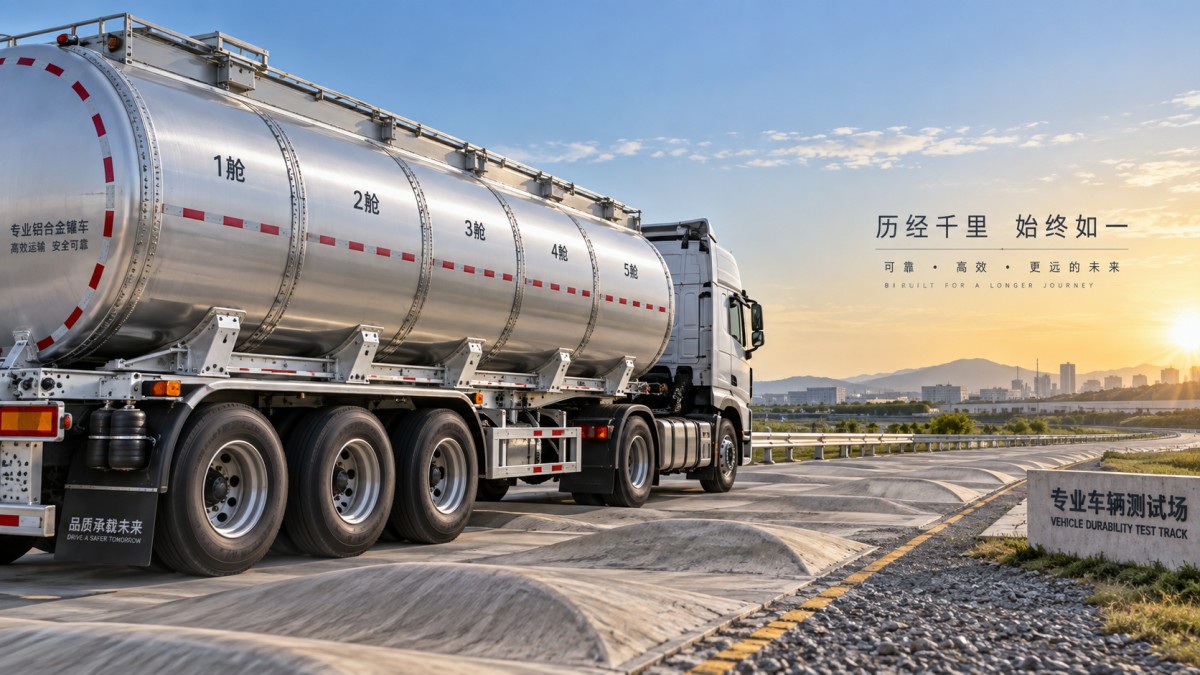
Rough roads test the suspension and tank mounting together
On rough routes, suspension choice can have more influence on service life than many buyers expect. A suspension does not merely carry axle load; it determines how much road shock reaches the tank shell, mounting saddles, valves, and pipework. Air suspension can help isolate vibration and maintain more consistent ride behavior than a basic mechanical arrangement, provided its air system, shock absorbers, height controls, and bushings are kept in working condition.
A tri-axle layout also requires attention to axle equalization and tire condition. If one axle carries disproportionately more load because of an incorrect ride height, worn components, or damaged tires, the resulting shock loads are not confined to that axle. They move through the chassis and into the tank supports. This is why a fatigue review should include the entire running gear assembly rather than treating the aluminum vessel as a separate component.
For example, the 50 m³ 5-Compartment Aluminum Alloy Oil Tanker Semi-Trailer uses a 5454 aluminum alloy tank body with a stated 5.7 mm shell thickness and 7 mm end plates. Its three 13-ton axles, air suspension, full-body lifting function, and front lift axle illustrate the kind of configuration that should be assessed as a complete operating package. Those specifications are meaningful only after confirming permitted axle loads, road conditions, tractor compatibility, and the operator’s maintenance capability.
Welding quality is a practical durability issue, not a paperwork exercise
Aluminum welding requires disciplined control. Heat input affects the properties of the material around the weld, and repeated road loading can reveal flaws that may not be obvious at delivery. Technical teams should look beyond a neat external bead. Consistency of fit-up, access to difficult joints, finish around attachments, and evidence of distortion control all matter. Where inspection records or non-destructive examination documentation are part of the project requirement, they should be reviewed against the agreed scope rather than assumed to cover every joint.
It is also worth checking non-tank welds. Ladder supports, guard rails, hose trays, landing gear brackets, and spare-wheel carriers can become nuisance failure points on heavily corrugated roads. A small cracked support may appear secondary, but loose equipment can transmit additional vibration into piping or damage adjacent tank surfaces.
High-cycle operation needs an inspection routine
An aluminum oil tanker trailer should not be judged solely by how it looks after commissioning. High-cycle use means examining it at intervals that reflect route severity, loading frequency, and service conditions. Operators with long distances between depots often benefit from a simple, repeatable check process rather than waiting for a major scheduled service.
- Inspect tank mounting areas, suspension brackets, and visible weld zones for cracking, rubbing, or fresh deformation.
- Check for loose fasteners at landing gear, kingpin mounting, axle assemblies, guards, and pipe supports.
- Monitor tire wear patterns; irregular wear can indicate ride-height, alignment, or suspension problems before structural damage becomes visible.
- Examine valves, outlet connections, and venting components for leakage, impact damage, and unsupported movement.
- Keep the tank exterior reasonably clean around critical joints, since dirt and fuel residue can hide early signs of cracking or abrasion.
Manual slack adjusters, where specified, also require disciplined attention. Their presence is not inherently a weakness, but they depend on correct inspection and adjustment practices. Brake performance, axle loading, and suspension condition are closely linked on descending or irregular roads, particularly when a tanker is carrying several partial compartment loads.
A useful acceptance test: examine the operating assumptions
Before approving a trailer, technical evaluators should challenge the original operating assumptions. Will the vehicle make frequent short hauls with constant braking? Will it cross unpaved terminal yards? Is the fleet likely to operate partly loaded, creating more surge events? Are service parts for the selected axle, brake, and air-suspension components available locally? The answers may change the preferred specification more than a headline capacity figure does.
Manufacturers serving East Africa, West Africa, and Saudi Arabia often encounter very different combinations of heat, road surface, axle-load practice, depot infrastructure, and maintenance access. Shandong ORNN Vehicle Co., Ltd., with 17 years in semi-trailer and transport equipment manufacturing, builds fuel, chemical liquid, dump, flatbed, and lowbed trailers for these varied operating environments. For a tanker project, the sensible approach is not to assume one configuration fits every market, but to match the tank design and running gear to the route reality.
So, can aluminum tankers withstand rough roads and high-cycle use? Yes—when the alloy, shell design, welded details, suspension, axle configuration, and inspection practice are aligned. If any one of those elements is treated as an afterthought, payload savings can quickly be outweighed by avoidable downtime.
Get Quote Form
Please complete the form below, and our product experts will contact you within one business hour. All inquiry details are kept strictly confidential and used solely to provide you with a precise solution.
✅ 24/7 Engineer Online Support | Ready for any technical inquiries.
✅ Full Export Documentation Support | We provide full set of shipping documents to ensure smooth customs clearance.
LOGO
This stunning beach house property is a true oasis, nestled in a serene coastal community with direct access to the beach.
Opening Hours
Monday - Friday : 9AM to 5PM
Sunday: Closed
Closed during holidays
Contact
+18888888888
hezuo@eyingbao.com123 West Street, Melbourne Victoria 3000 Australia
Request a Free Quote Today
Need mainstream models or custom specs? Our engineers are ready.
Contact us today for a lasting partnership!