


Products
News
- ▶ Aluminum Tanker Trailer Maintenance: Preventing Galvanic Corrosion at Joints
- ▶ How an Aluminum Oil Tanker Trailer Can Increase Legal Payload Capacity
- ▶ Aluminum Oil Tanker Trailers: Evaluating Weight Savings Against Initial Cost
- ▶ Why Baffle Design Matters in Carbon Steel Oil Tanker Trailer Stability
- ▶ What Tank Testing Should Be Required for a Carbon Steel Oil Tanker Trailer?
How an Aluminum Oil Tanker Trailer Can Increase Legal Payload Capacity
How an Aluminum Oil Tanker Trailer Can Increase Legal Payload Capacity
For fuel operators, the useful question is not whether an aluminum tanker is lighter in principle. It is whether the weight saved can be converted into saleable product without breaching gross combination weight, axle-load limits, bridge rules, or the operating limits of the tractor. In many fleets, that answer is yes—but only when the tank, running gear, compartment layout, and intended fuel density are evaluated as one system.
An aluminum oil tanker trailer can reduce tare weight relative to a comparable conventional steel tanker. That lower empty weight creates room within the legal gross vehicle weight allowance for additional fuel. The commercial appeal is straightforward: if the tractor-trailer combination is weight-limited rather than volume-limited, every kilogram removed from the trailer may become payload capacity. But “may” matters here. A larger nominal tank volume does not automatically mean more legal fuel on board.
The Payload Equation Starts With Tare Weight
The basic calculation is simple:
Legal payload = permitted gross combination weight − actual tractor weight − actual trailer tare weight.
The difficult part is obtaining the “actual” figures. Procurement teams sometimes compare brochure weights while overlooking installed options: pumping equipment, hose reels, spare-wheel carriers, fire equipment, discharge piping, walkways, manhole covers, suspension type, tire specification, and local-required accessories. These items can materially change the finished trailer weight. A serious comparison should use an agreed configuration and, ideally, a certified scale weight of the completed unit before deciding how much extra product can legally be loaded.
Aluminum does not remove the need for structural engineering. The tank still has to tolerate road vibration, liquid surge, repeated loading cycles, and stresses around supports, baffles, manholes, and discharge connections. The point of a well-designed aluminum tanker is not simply to use thinner material. It is to use an appropriate alloy, suitable plate thicknesses, sound welding practice, and a support arrangement that preserves durability while avoiding unnecessary dead mass.
For example, a tanker built in 5454 aluminum alloy may be assessed differently from a steel design because material behavior, fabrication process, and corrosion exposure are different. A specification showing 5.5 mm tank shell plate and 7 mm end plates says more than the word “aluminum” alone; it gives the evaluator a starting point for reviewing structural intent. It does not, however, replace a review of drawings, welding procedures, internal baffles, and the required local compliance documents.
Volume Capacity Is Not the Same as Legal Carrying Capacity
Fuel density determines whether a tanker becomes volume-limited or weight-limited. A tank may physically hold its full rated volume, yet a particular product may need to be loaded below that level to remain legal. This is especially relevant for operators carrying more than one petroleum product, or products whose density changes with temperature and batch characteristics.
That is why compartment planning deserves more attention than it often receives. Six compartments can support multi-drop distribution and product segregation, but their sizes and positions also influence axle loads. Filling the rear compartments first, for instance, can overload rear axle groups even if total gross weight remains below the nominal limit. In field operations, loading discipline matters as much as trailer capacity. The dispatch team needs a loading plan that accounts for delivery sequence, product density, and the permitted load on each axle group.
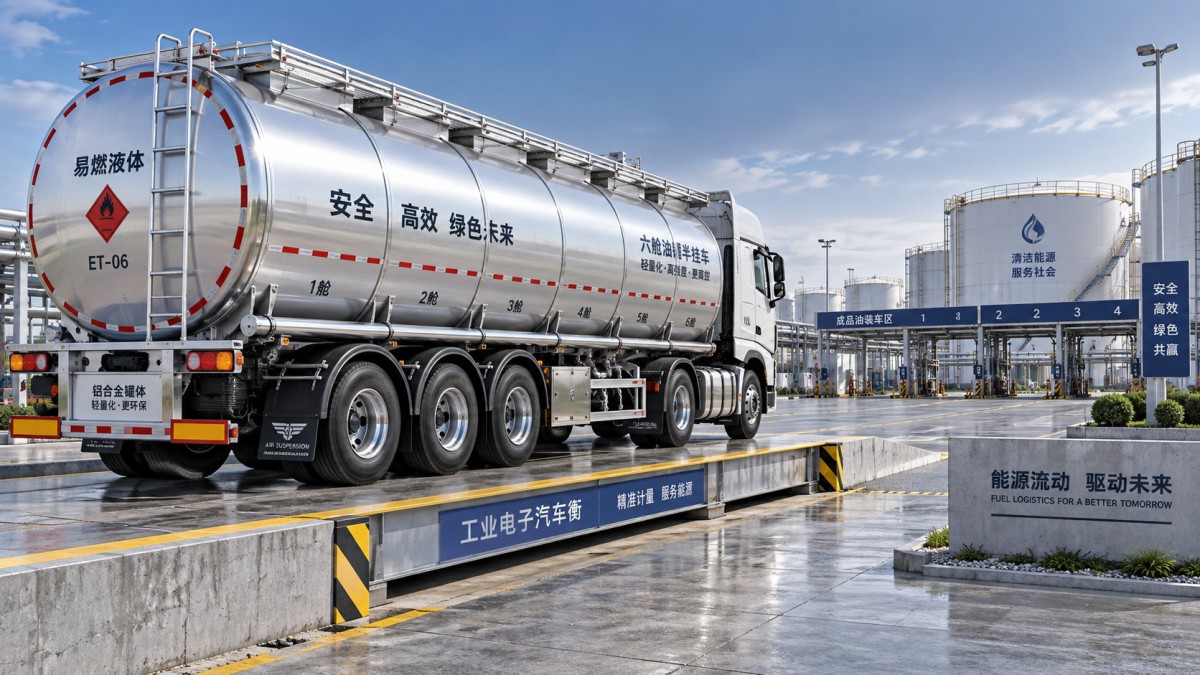
A 45,000 L tanker is therefore not automatically a “45,000 L legal payload” solution in every route or product mix. Technical evaluation should compare the expected loading mass at the fuel densities actually handled, then check the tractor and trailer axle loads in loaded and partially discharged conditions. The latter is easy to miss. A trailer can be compliant when full but poorly balanced midway through a multi-stop delivery run.
Axle Configuration Determines Whether Weight Savings Are Usable
A lighter tank shell creates potential payload, but axle configuration determines whether that potential can be used legally. Three axles rated at 13 tonnes each may provide substantial running-gear capacity, yet legal road limits are set by the jurisdiction, axle spacing, tire loading, suspension arrangement, tractor configuration, and sometimes the route itself. Component ratings should never be treated as legal operating permission.
Air suspension can be valuable because it supports more consistent ride behavior and helps protect the tank and its cargo on uneven roads. A front lift axle can also be useful when operating empty or lightly loaded, reducing tire scrub and unnecessary rolling resistance in appropriate conditions. It is not a substitute for a legal axle-load calculation. When the lift axle is raised, the remaining axles carry more load; that operating condition must be considered in the fleet’s procedures.
One configuration worth examining is the 45 m³ 6-Compartment Aluminum Alloy Oil Tanker Semi-Trailer. Its stated arrangement combines a 45,000 L six-compartment tank, 5454 aluminum alloy construction, three 13-tonne axles, tri-axle air suspension, and a front lift axle. With overall dimensions of 12,500 mm × 2,500 mm × 3,800 mm, it illustrates the kind of package that should be checked against the buyer’s tractor axle positions, coupling height, route restrictions, and loading method—not selected on volume alone.
Where Aluminum Usually Makes the Strongest Business Case
The strongest case tends to be recurring, weight-constrained fuel transport. If a fleet repeatedly reaches its allowable gross mass before it reaches the tank’s physical volume, reducing tare weight can allow more fuel to move on the same trip. Over a high-utilization operating cycle, that additional payload may matter more than a modest difference in initial trailer price.
The calculation is less compelling where routes are consistently volume-limited, annual mileage is low, or local load limits prevent the available weight saving from being used. It may also be less attractive where qualified aluminum repair capability is difficult to access. Aluminum tank repair is not interchangeable with ordinary steel fabrication. The workshop must understand the alloy, welding process, cleanliness requirements, and post-repair inspection expectations. A low tare weight advantage can be undermined if a fleet has no realistic plan for inspection and repair support.
Do Not Treat Material Choice as a Standalone Decision
Aluminum offers natural corrosion resistance in many transport environments, but the complete tanker still includes valves, piping, fasteners, landing gear, suspension components, and electrical connections. Mixed-material interfaces deserve attention, particularly where water, road salts, or aggressive cleaning practices are present. Buyers should ask how dissimilar-metal contact is managed and which components are exposed beneath the tank.
The same practical mindset applies to braking and serviceability. Drum brakes with ABS may suit a fleet’s maintenance capability and parts availability, while other operators may prioritize a different brake arrangement depending on local practice. Manual slack adjusters require disciplined inspection and adjustment. This is not necessarily a drawback, but it should align with the maintenance system actually in place rather than the system assumed during procurement.
Manufacturers serving fuel and liquid transport markets, including Shandong ORNN Vehicle Co., Ltd., often see specification priorities vary across East Africa, West Africa, and Saudi Arabia. Road conditions, workshop capability, product distribution patterns, tractor availability, and local approval processes all influence the final design. A tank that performs well on long highway runs may need different protection, suspension settings, or compartment logic for frequent depot deliveries on mixed road surfaces.
A Better Evaluation Method Before Purchase
Before approving an aluminum oil tanker trailer, build a route-specific payload sheet rather than relying on a general promise of “higher capacity.” Include the proposed trailer’s finished tare weight, tractor scale weight, expected fuel densities, gross and axle-load limits, axle spacing, fifth-wheel position, loading sequence, and likely partial-discharge condition. Then compare the outcome with a steel alternative configured with the same equipment.
Also ask for the tank material and plate thickness by area, compartment layout, axle and suspension details, brake specification, and the documentation required for the destination market. A lighter tanker is useful only if it remains legal, balanced, maintainable, and fit for the products carried. That is the real standard for judging whether aluminum converts into profitable payload rather than merely a lower number on the tare-weight sheet.
Get Quote Form
Please complete the form below, and our product experts will contact you within one business hour. All inquiry details are kept strictly confidential and used solely to provide you with a precise solution.
✅ 24/7 Engineer Online Support | Ready for any technical inquiries.
✅ Full Export Documentation Support | We provide full set of shipping documents to ensure smooth customs clearance.
LOGO
This stunning beach house property is a true oasis, nestled in a serene coastal community with direct access to the beach.
Opening Hours
Monday - Friday : 9AM to 5PM
Sunday: Closed
Closed during holidays
Contact
+18888888888
hezuo@eyingbao.com123 West Street, Melbourne Victoria 3000 Australia
Request a Free Quote Today
Need mainstream models or custom specs? Our engineers are ready.
Contact us today for a lasting partnership!