


Products
News
- ▶ Aluminum Oil Tanker Trailers: Evaluating Weight Savings Against Initial Cost
- ▶ Why Baffle Design Matters in Carbon Steel Oil Tanker Trailer Stability
- ▶ What Tank Testing Should Be Required for a Carbon Steel Oil Tanker Trailer?
- ▶ Corrosion Protection Options for Carbon Steel Oil Tanker Trailer Tanks
- ▶ Carbon Steel Oil Tanker Trailers: Selecting Plate Thickness for Payload and Durability
Why Baffle Design Matters in Carbon Steel Oil Tanker Trailer Stability
Liquid movement is one of the main stability loads in a carbon steel oil tanker trailer. When a partially filled tank brakes, turns, accelerates, or passes over an uneven surface, the fuel mass continues moving after the trailer changes direction. This creates surge forces that act against the tank shell, end plates, chassis connection points, suspension, and kingpin area. Baffles reduce the distance and speed of that internal movement, making the trailer response more predictable.
A tanker can have an adequate nominal capacity, axle arrangement, and shell thickness while still performing poorly at certain fill levels if its baffle layout is unsuitable. Stability assessment therefore requires more than confirming that internal plates are present. Their position, opening geometry, attachment quality, and relationship to compartment configuration determine whether they genuinely control surge or merely divide the tank volume.
Surge Changes the Effective Load Position
Fuel in a full tank has limited free surface movement. In a nearly empty tank, the liquid mass is smaller. The most demanding condition is often an intermediate fill level, where a substantial volume can travel across a broad free surface. Under braking, the liquid moves forward and raises longitudinal load on the front portion of the tank. During a turn, it shifts laterally and changes the effective center of gravity of the loaded trailer.
Without sufficient restraint, this shifting mass can produce a delayed vehicle response: the tractor and running gear begin the maneuver first, followed by a second force from the liquid. That delay is especially relevant in emergency braking, roundabout entry, lane changes, and downhill curves. It can also increase cyclic loading around baffle welds and tank-to-chassis supports.
Baffles interrupt the wave path. Rather than allowing fuel to travel through most of the tank length as one moving body, the plates divide the flow into shorter sections. The liquid still passes through designed openings, but its velocity and the amount of fuel moving at one time are reduced. Effective baffle design manages movement progressively instead of creating a solid barrier that causes a sharp pressure impact on one plate.
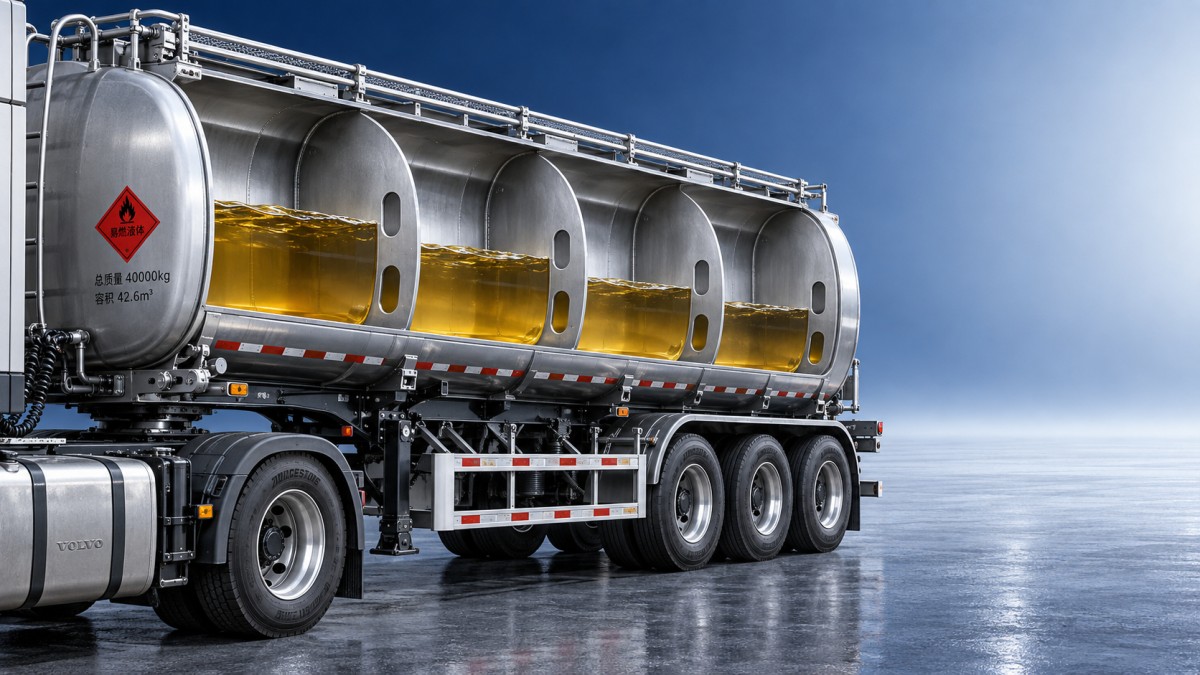
Plate Spacing Alone Does Not Define Performance
A common specification error is to judge baffle design only by the number of plates. More baffles do not automatically produce better stability. Closely spaced plates can reduce surge distance, yet they also complicate cleaning, inspection, drainage, and internal coating work. Wide spacing can simplify fabrication but permits larger liquid momentum between plates. The appropriate interval must be considered with tank length, tank cross-section, intended fill pattern, fuel density, and expected route conditions.
The shape of the tank matters because it changes how liquid climbs and returns during a maneuver. A circular or elliptical shell has different free-surface behavior from a wider, lower-profile tank. A tank mounted higher above the road also amplifies the effect of lateral liquid transfer. Baffle spacing that is reasonable for one shell geometry should not be transferred unchanged to another design.
Openings Must Control Flow Without Blocking Service Access
Baffle openings allow liquid transfer between sections during loading and unloading. Their size, location, edge finish, and total open area affect both hydraulic behavior and maintainability. Large central openings can permit rapid surge through the tank even when several baffles are installed. Very restrictive openings slow transfer, but may leave retained product, extend discharge time, or make tank flushing difficult.
Opening placement also affects drainage. A low opening supports more complete emptying, while upper openings allow air and vapor movement during filling. A practical design accounts for both functions without creating narrow areas where sediment, residue, or water can remain. For petroleum service, inspection access must be considered from the start; an internal arrangement that cannot be adequately examined after fabrication leaves weld condition and coating integrity difficult to verify.
Rounded opening corners and properly finished edges matter. Sharp internal corners concentrate stress as the plate flexes under repeated liquid impact. Poorly dressed cutouts can also damage cleaning equipment or become early corrosion points where protective coating coverage is weak.
Attachment Detail Is Part of the Stability Design
A baffle functions as a structural member as well as a flow-control element. It transfers liquid load into the tank shell, so the weld layout, plate thickness, reinforcement approach, and fit-up quality need review together. A plate that appears substantial can still create a problem if its connection concentrates force into a small shell area or if welding distortion affects shell roundness.
Carbon steel tanks require particular attention to corrosion protection around internal weld seams, cut edges, and areas exposed to water contamination in the fuel. Surface preparation before internal coating has a direct effect on service life. Local coating failure near a baffle foot may allow corrosion to progress beneath the coating, reducing shell thickness where repeated pressure and surge loads are already present.
Inspection should distinguish between a cosmetic weld concern and a load-path concern. Undercut, incomplete fusion, abrupt weld termination, excessive overlap, or visible distortion around the baffle perimeter deserve closer evaluation because these conditions can affect fatigue resistance. Internal attachments should also be checked for alignment. A baffle installed out of plane can alter opening position, reduce clearance for cleaning tools, and impose uneven force on the shell.
Compartments and Baffles Solve Different Problems
Compartments separate products or delivery quantities. Baffles primarily control liquid motion within a volume. A multi-compartment fuel tanker may need surge-control plates inside individual compartments, particularly where a compartment is long relative to its liquid depth. Conversely, a single-compartment tank can use several baffles without becoming a multi-product tanker.
This distinction matters when comparing specification sheets. A stated compartment count gives little information about the free movement distance inside each section. Review the longitudinal arrangement drawing, the internal baffle locations, the opening details, and the design fill condition rather than relying on a compartment number alone.
The same principle applies when assessing tanks for other liquids. For example, a 38 m³ Stainless Steel Insulated Palm Oil Tanker is specified as a single-compartment design with a 304 stainless steel tank body, whereas a carbon steel oil tanker trailer serves a different product and material duty. The comparison is useful because compartment count, insulation, shell material, and axle configuration do not reveal the internal surge-control strategy. Baffle drawings remain necessary for either tank type.
Conditions That Change the Assessment
- Partial-load operation: Repeated travel at varying delivery volumes places greater emphasis on baffle performance than a route that routinely carries a nearly full load from terminal to depot.
- Road profile: Frequent gradients, tight curves, rough pavement, and stop-start urban delivery increase longitudinal and lateral liquid excitation.
- Tank dimensions: A longer tank creates more distance for a liquid wave to build momentum. Diameter, shell profile, and mounting height influence the resulting load transfer.
- Product characteristics: Fuel viscosity, density, temperature, and contamination level affect flow through baffle openings and the force imposed during surge.
- Loading sequence: Unevenly filled compartments or an unintended fill distribution can create handling behavior that differs from the intended design condition.
These factors should be reviewed alongside suspension characteristics and axle loading, but they should not be used to excuse an unclear internal design. Air suspension can influence ride response; it does not replace liquid surge control. Likewise, a stable chassis cannot fully compensate for a large unrestrained liquid mass moving high within the tank.
Drawing Review Before Fabrication
The most useful technical document is a sectioned internal layout drawing, not an exterior rendering. It should identify each baffle location, plate profile, opening dimensions, weld connection, manhole relationship, drain path, and compartment boundary. Where the drawing shows only a generic note such as “internal baffles installed,” the surge-control arrangement cannot be properly assessed.
Tank drawings should also be read with fabrication sequence in mind. Internal baffles are installed before the shell is fully closed, so late changes can require substantial rework. A revised opening size, added reinforcement, or moved plate may affect cutting templates, welding access, coating preparation, hydrostatic testing arrangements, and inspection points. Resolving those details before production protects both the structural intent and the practical ability to inspect the finished tank.
After fabrication, internal visual inspection should confirm that the installed configuration matches the approved drawing. This includes plate count, orientation, openings, weld continuity, and freedom from loose material. Where internal coating is specified, the inspection record should show that baffle edges, weld toes, and hidden transition areas received the same preparation attention as open shell surfaces.
A sound baffle design gives the trailer a more controlled response because it limits the size and travel distance of each moving liquid mass. The evaluation should remain focused on the whole internal system: tank geometry, free-surface behavior, baffle spacing, opening design, structural attachment, drainage, and fabrication quality. That combination determines whether the carbon steel tank can manage surge loads throughout real fuel transport conditions.
Get Quote Form
Please complete the form below, and our product experts will contact you within one business hour. All inquiry details are kept strictly confidential and used solely to provide you with a precise solution.
✅ 24/7 Engineer Online Support | Ready for any technical inquiries.
✅ Full Export Documentation Support | We provide full set of shipping documents to ensure smooth customs clearance.
LOGO
This stunning beach house property is a true oasis, nestled in a serene coastal community with direct access to the beach.
Opening Hours
Monday - Friday : 9AM to 5PM
Sunday: Closed
Closed during holidays
Contact
+18888888888
hezuo@eyingbao.com123 West Street, Melbourne Victoria 3000 Australia
Request a Free Quote Today
Need mainstream models or custom specs? Our engineers are ready.
Contact us today for a lasting partnership!