


Products
News
- ▶ What Tank Testing Should Be Required for a Carbon Steel Oil Tanker Trailer?
- ▶ Corrosion Protection Options for Carbon Steel Oil Tanker Trailer Tanks
- ▶ Carbon Steel Oil Tanker Trailers: Selecting Plate Thickness for Payload and Durability
- ▶ Oil Tanker Trailer Price Trends: How Steel, Aluminum, and Component Costs Move
- ▶ When Does a Higher-Priced Oil Tanker Trailer Reduce Downtime and Repair Risk?
Corrosion Protection Options for Carbon Steel Oil Tanker Trailer Tanks
A carbon steel oil tanker trailer can look sound from the outside while corrosion is already developing in places that are hard to inspect: beneath external paint damage, around weld seams, under clamps, at manhole surrounds, or inside compartments where water and sediment collect. For safety and quality-control teams, the main decision is not simply whether to “paint the tank.” The protection system must match the cargo, water exposure, operating climate, cleaning method, and the fleet’s ability to inspect and repair damage before it becomes a leak or contamination issue.
The practical starting point is this: use an internal lining only when the carried fuel, expected water contamination, cleaning practice, or cargo specification requires a compatible barrier; use a robust exterior coating system on every carbon steel tank; and treat drainage, inspection access, and repair control as part of corrosion protection rather than separate maintenance tasks. A carbon steel oil tanker trailer is not protected by coating alone if water is repeatedly left in low points or if damaged areas are not repaired promptly.
First separate internal corrosion risk from external corrosion risk
Internal and external surfaces fail for different reasons, so they should not automatically receive the same treatment. Internally, petroleum products may be relatively non-corrosive when clean and dry, but corrosion risk rises when free water, condensation, salts, microbial activity, acidic contaminants, or incompatible fuel components are present. Water is often the decisive factor because it settles below fuel in compartments and collects near sumps, drain points, outlet areas, and poorly drained sections.
Externally, the tank is exposed to rain, road spray, dust, ultraviolet light, stone impact, salt-laden air, and chemical splash from roads or loading areas. A trailer working in a dry inland environment may mainly suffer mechanical paint damage and localized corrosion. A unit exposed to coastal air, wet-season roads, or frequent washdown needs greater attention to edge retention, seam sealing, underbody coverage, and rapid touch-up procedures.
When bare internal carbon steel may be acceptable—and when it is not
A properly fabricated and maintained bare carbon steel interior can be used for certain fuel transport duties where the fuel specification permits contact with steel and the operator can control water and contamination. This is not a reason to ignore internal condition. Bare steel requires disciplined compartment draining, tank cleaning practices that do not leave residual water, and inspection of lower surfaces where corrosion commonly begins.
An internal lining becomes more important when cargoes have greater sensitivity to metal contamination, when water ingress cannot be reliably prevented, or when the trailer may handle fuel blends and additives that have different compatibility requirements. Ethanol-containing fuels, biodiesel blends, additive packages, and certain chemical-related products can introduce compatibility concerns that should be reviewed before selecting a lining. A coating that performs well with conventional diesel is not automatically suitable for every blend, cleaning chemical, or temperature range.
Before approving an internal coating, confirm the exact cargo list, anticipated concentration ranges, cleaning agents, maximum service temperature, and required cure conditions. Request the coating supplier’s documented compatibility information for those actual conditions. Do not rely on a generic statement that a product is “fuel resistant,” because resistance may vary by fuel type, immersion duration, and additive content.
The internal lining decision depends on surface preparation as much as coating chemistry
Most lining failures are not caused by choosing the wrong product alone. Poor removal of mill scale, rust, oil, welding residue, and soluble salts can leave a coating with weak adhesion even when it initially appears uniform. Weld spatter, sharp edges, rough repairs, and incomplete cleaning around fittings are frequent starting points for under-film corrosion.
A controlled lining process should include:
- Inspection of the steel shell, welds, nozzles, internal ladders, baffles, and compartment partitions before blasting or coating.
- Removal of oil, grease, salts, and contaminants before abrasive preparation.
- Surface preparation to the coating manufacturer’s specified cleanliness and anchor profile.
- Rounding or conditioning sharp edges where the coating may pull away or become too thin.
- Extra “stripe coats” on welds, edges, joints, and complex geometry before full coats are applied.
- Measurement of dry film thickness in accessible areas and verification that coating has cured under the required conditions.
- Holiday detection where the lining system and tank design require it, so pinholes and discontinuities are identified before service.
A lining should also be evaluated for repairability. In fleet operation, small damage near outlet areas, access covers, or cleaning points is likely at some stage. The maintenance team should know the approved repair preparation, overlap requirement, cure time, and inspection method. A lining that cannot be repaired correctly during normal downtime may create a larger operational problem than a simpler, well-managed system.
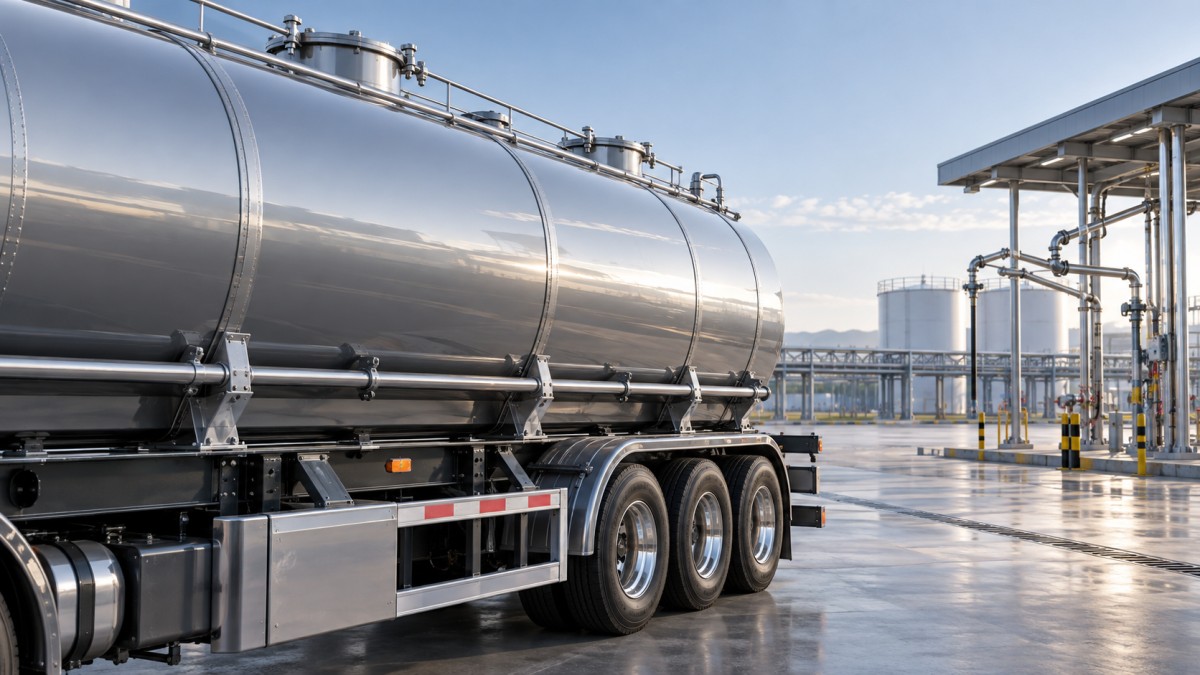
Exterior protection should be treated as a layered system
For the outside of a carbon steel oil tanker trailer, the usual objective is to combine adhesion, barrier protection, weather resistance, and damage tolerance. This is generally achieved through a prepared steel surface, a corrosion-inhibiting primer or primer system, intermediate protection where specified, and a durable topcoat. The exact chemistry should be selected for the climate and exposure, but the system must also suit field repair conditions.
Exterior paint often fails first at details rather than broad shell surfaces. Quality checks should focus on weld toes, brackets, handrail supports, manhole collars, discharge piping supports, ladder attachments, mudguard interfaces, and areas behind clamps. These features can retain water or receive repeated abrasion. Applying additional coating to edges and welds before the main coats helps maintain adequate film build where a spray pass alone may leave a thin area.
Underside protection deserves separate attention. Road debris can cut coatings, while trapped mud holds moisture against steel. Thick underbody products can help in abrasion-prone locations, but they should not be used to cover active rust, wet contamination, or poorly prepared steel. A heavy coating applied over a compromised surface may hide corrosion until the damage is extensive.
Use operating symptoms to direct inspections
Not every trailer needs the same inspection interval. Inspection frequency should increase after exposure to flooding, marine air, long periods of parking, repeated product changes, tank washing, or visible paint damage. The following findings should trigger closer examination rather than a simple cosmetic touch-up:
- Blistering, lifting paint, rust staining, or cracking around seams and fittings.
- Persistent water found during compartment draining or evidence of sediment at low points.
- Coating softening, discoloration, peeling, or loss of adhesion after a cargo or cleaning-process change.
- Repeated corrosion at the same external location, suggesting trapped moisture, poor drainage, or mechanical rubbing.
- Damage near valves, outlet piping, manholes, and access points where fuel leakage would have higher safety consequences.
When a defect is found, identify the cause before selecting the repair. A small stone chip can be cleaned, feathered, primed, and recoated. Recurrent blistering beneath a bracket may require removal of the bracket or sealant, correction of the water trap, surface preparation, and restoration of the complete coating system. Internal corrosion at a compartment bottom should prompt review of draining practice, water-control procedures, and the suitability of any existing lining—not just local rust removal.
Tank design details can reduce corrosion workload
Material thickness does not eliminate the need for corrosion control, but it affects inspection planning and repair decisions. For example, the 54 m³ 6-Compartment Carbon Steel Fuel Tanker uses a 5 mm carbon steel tank body and 6 mm carbon steel end plates, with six separate compartments for fuel transport. In a multi-compartment design, corrosion checks should be compartment-specific because water retention, cleaning quality, and product exposure may not be identical across all sections.
Access arrangements also matter. A tank that can be safely inspected around manholes, outlets, and external attachments is easier to maintain before damage progresses. During acceptance inspection or major repainting, record coating condition at defined locations, especially compartment bottoms, end plates, weld zones, landing gear interfaces, suspension-adjacent areas, and discharge assemblies. Comparable records make it easier to distinguish isolated impact damage from a repeated corrosion pattern.
Set practical acceptance criteria before the tanker enters service
Quality control is stronger when the owner, fabricator, coating contractor, and maintenance team agree on what will be checked and documented. The record should identify the cargo exposure assumptions, approved coating or lining system, surface preparation requirements, film-thickness target, cure requirements, repair procedure, and inspection points. For internal linings, include the test method used to locate discontinuities if that method is applicable to the selected system.
Safety managers should also ensure that tank-entry controls are separate from coating inspection decisions. Internal examination may involve confined-space hazards, residual flammable vapor, oxygen deficiency, and cleaning chemical exposure. Inspection planning should therefore account for isolation, gas testing, ventilation, permit controls, and safe access arrangements required by the operator’s applicable procedures.
The strongest corrosion protection program is usually a combination of compatible materials, well-prepared surfaces, controlled application, prompt damage repair, and operational discipline around water removal. Where the cargo mix or cleaning regime changes, recheck the compatibility basis before assuming the existing internal protection remains suitable.
Get Quote Form
Please complete the form below, and our product experts will contact you within one business hour. All inquiry details are kept strictly confidential and used solely to provide you with a precise solution.
✅ 24/7 Engineer Online Support | Ready for any technical inquiries.
✅ Full Export Documentation Support | We provide full set of shipping documents to ensure smooth customs clearance.
LOGO
This stunning beach house property is a true oasis, nestled in a serene coastal community with direct access to the beach.
Opening Hours
Monday - Friday : 9AM to 5PM
Sunday: Closed
Closed during holidays
Contact
+18888888888
hezuo@eyingbao.com123 West Street, Melbourne Victoria 3000 Australia
Request a Free Quote Today
Need mainstream models or custom specs? Our engineers are ready.
Contact us today for a lasting partnership!