


Products
News
- ▶ What Tank Testing Should Be Required for a Carbon Steel Oil Tanker Trailer?
- ▶ Corrosion Protection Options for Carbon Steel Oil Tanker Trailer Tanks
- ▶ Carbon Steel Oil Tanker Trailers: Selecting Plate Thickness for Payload and Durability
- ▶ Oil Tanker Trailer Price Trends: How Steel, Aluminum, and Component Costs Move
- ▶ When Does a Higher-Priced Oil Tanker Trailer Reduce Downtime and Repair Risk?
What Tank Testing Should Be Required for a Carbon Steel Oil Tanker Trailer?
What Tank Testing Should Be Required for a Carbon Steel Oil Tanker Trailer?
For a quality-control or safety manager, accepting a carbon steel oil tanker trailer should never be based on appearance alone. A clean paint finish, straight chassis rails, and neatly fitted valves do not prove that the tank is safe to fill, transport, or discharge. The important questions are less visible: Are the welds sound? Will the shell remain leak-tight under service pressure? Is the internal surface suitable for the intended fuel? Have repairs, fittings, and manholes been tested as part of the complete system?
The required test package depends on the cargo, tank design, transport route, customer specification, and the regulations governing the operating country. East African, West African, and Saudi Arabian projects can also differ in inspection practice and documentation expectations. Still, a disciplined acceptance process for a carbon steel oil tanker trailer normally combines fabrication inspection, non-destructive examination where required, pressure or leak testing, coating checks, and functional verification of safety-related equipment.
Start With the Approved Design and Material Records
Testing begins before the tank is closed. The buyer or appointed inspector should confirm that the delivered trailer matches approved drawings: tank volume, shell and end-plate arrangement, compartment layout, baffle arrangement where applicable, manhole positions, discharge piping, vapor connections, ladder, walkways, chassis interfaces, and axle configuration. A pressure test cannot correct a tank built to the wrong design.
For carbon steel construction, material identification matters. Review available mill certificates or traceability records for the shell plate, heads, reinforcement pads, and major pressure-retaining fittings. The practical objective is to confirm that the materials and plate thicknesses used in fabrication correspond with the approved bill of materials. If a project requires a particular steel grade, impact property, lining system, or welding procedure, that requirement should be written into the inspection and test plan rather than assumed at final inspection.
It is also worth checking the intended product. Carbon steel is widely used for many petroleum products, but suitability is not universal. Water contamination, sulfur-bearing cargoes, aggressive additives, cleaning chemicals, and long idle periods can alter corrosion risk. The tank material and lining decision should be made against the actual cargo specification, not simply the word “oil.”
Weld Inspection: Visual Checks Are Necessary, but Not Enough
Every pressure-retaining weld should receive a documented visual inspection. Inspectors should look for undercut, overlap, visible porosity, cracks, arc strikes, incomplete tie-in, excessive reinforcement, sharp transitions, and poor weld starts or stops. Particular attention is needed at shell-to-head joints, longitudinal seams, nozzle necks, manhole rings, drain sumps, mounting brackets near the tank shell, and repaired areas.
Visual inspection is a first filter, not a substitute for deeper examination. Depending on the design code, customer requirement, and risk category, the inspection plan may call for liquid penetrant, magnetic particle, ultrasonic, or radiographic examination of selected welds. The appropriate method depends on what must be found and where. Surface-breaking defects around a nozzle weld are not evaluated in exactly the same way as potential internal discontinuities in a long seam.
A common acceptance mistake is treating the tank shell as the only critical area. In service, leaks often develop around attachments: outlet connections, emergency valve interfaces, vapor-return nozzles, manhole covers, calibration ports, and flange joints. These areas deserve the same inspection discipline as the main shell.
Pressure and Leak Testing Must Test the Complete Tank System
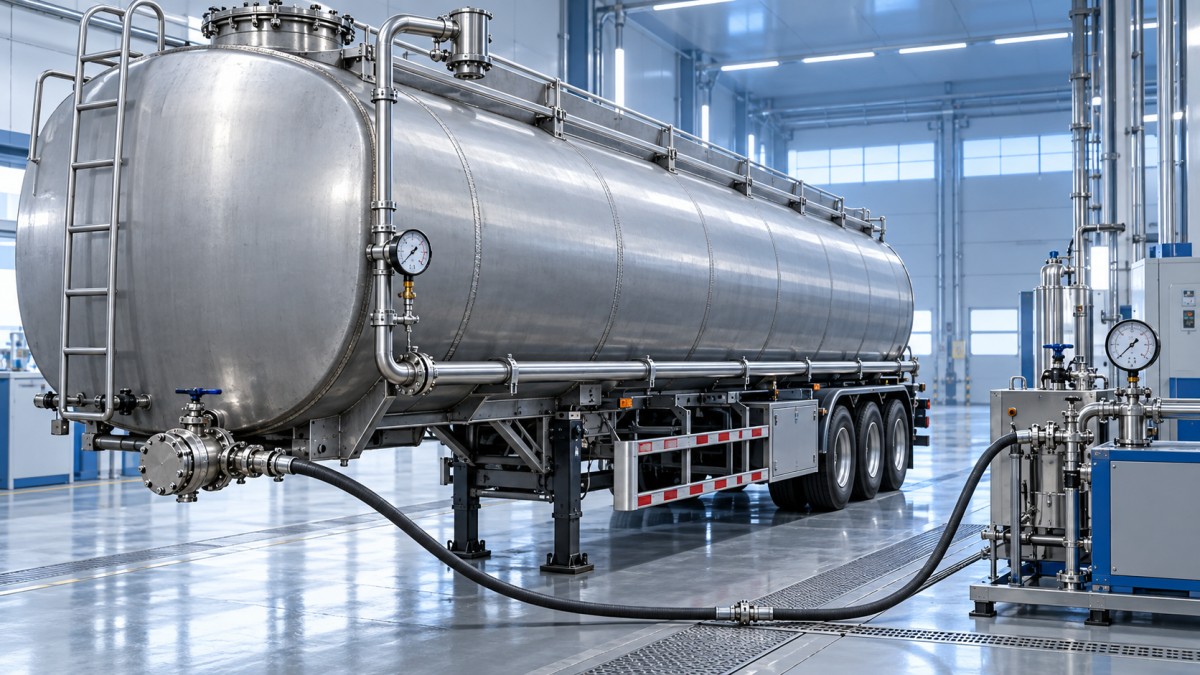
A pressure test verifies more than whether a weld is visibly leaking. It checks the tank’s ability to hold the specified test condition without unacceptable loss of pressure, deformation, sweating at seams, or leakage at closures and connections. The exact test medium, pressure, hold time, and acceptance criteria should come from the applicable standard and approved manufacturer procedure. They should not be selected casually on the workshop floor.
Hydrostatic testing is often preferred where the applicable procedure permits it because water stores far less hazardous energy than compressed gas. However, the tank must be properly supported during filling, and the post-test drying process must be controlled. Residual water inside a fuel tank can cause contamination, corrosion, or commissioning problems. If pneumatic testing is specified, it requires a more stringent safety exclusion zone, calibrated gauges, controlled pressurization, and a clear emergency procedure. Compressed-air testing carries stored-energy risk and should be handled accordingly.
The test should include the operational boundaries of the tank, not just a bare shell. Manhole lids, gaskets, outlet valves, pipework, venting devices, vapor-recovery connections, inspection covers, and blanked ports all need verification. After pressure testing, check that valves still operate correctly and that seals have not been damaged by assembly or test pressure.
Do Not Overlook Coating, Cleanliness, and Internal Condition
For a carbon steel oil tanker trailer, the internal coating or lining system can be as important as the steel itself. If an internal coating is specified, inspectors should verify surface preparation records, coating product compatibility, curing conditions, dry-film thickness where relevant, and holiday testing when the coating system and project specification call for it. A coating may look intact at the manhole opening while containing pinholes around welds, edges, or reinforcement pads.
The final internal cleanliness inspection is simple in principle but often rushed before dispatch. The tank should be free of weld spatter, grinding debris, loose scale, water, rags, blasting residue, and other foreign material. For fuel service, even a small amount of debris can block strainers, damage pumps, or trigger a costly contamination investigation. Close the tank only after the internal inspection is recorded and all temporary test materials have been removed.
Functional Tests Belong in the Tank Acceptance Package
Tank integrity testing should be followed by a practical functional check. Open and close each bottom outlet, emergency shut-off device, vent, manhole cover, and vapor-related connection through its normal range. Confirm that valve handles, linkages, and remote controls are accessible and do not interfere with chassis components. Where a vapor recovery system is fitted, its connections should be checked for correct routing, secure installation, and leak-tight assembly under the applicable test procedure.
This is especially relevant when comparing material options. For example, a 41 m³ Single-Compartment Stainless Steel Tanker Truck with Vapor Recovery System uses a 304 stainless steel tank with a stated 41,000 L capacity, 4 mm tank material thickness, and 5 mm end plates. It is not a direct substitute for every carbon steel tanker specification, but it illustrates why the test plan must follow the actual tank material, cargo duty, compartment configuration, and vapor-handling arrangement rather than a generic trailer checklist.
The chassis-to-tank relationship also needs scrutiny. Inspect tank saddles, mounting straps, supports, braces, and fasteners for proper fit and protection against metal-to-metal wear. A tank that passes a workshop leak test can still develop fatigue issues if support loads are poorly distributed or if movement is possible between the tank and trailer frame.
What Should Be Included in the Final Test Dossier?
A useful dossier lets an operator understand what was tested, by whom, under which procedure, and with what result. At minimum, it should identify the trailer and tank serial numbers, approved drawings, material records available for review, weld inspection results, non-destructive test reports where performed, pressure or leak-test records, gauge calibration status, coating inspection records where applicable, and a final punch-list closure record.
Photographs can be helpful, particularly for internal condition before closure, marked repair locations, nozzle arrangements, and completed safety equipment. They are not a replacement for test records, but they make later maintenance discussions much easier. Any deviations accepted during fabrication should be documented clearly instead of being buried in informal workshop communication.
Manufacturers with broad tanker experience usually build these checks into their production flow. Shandong ORNN Vehicle Co., Ltd., which has worked in semi-trailer and transport equipment manufacturing for 17 years, supplies fuel and chemical liquid tanker trailers alongside general cargo and heavy-transport equipment for markets including East Africa, West Africa, and Saudi Arabia. For buyers, the key point is to agree on the inspection hold points before fabrication starts—especially if an independent inspector, destination-country requirement, or customer-specific test witness is involved.
The best acceptance decision is not “the tank passed a test.” It is “the specified tank, fittings, coating condition, and supporting records were all verified against the service duty.” That distinction is what protects operators when the trailer is full, moving, and far from the workshop that built it.
Get Quote Form
Please complete the form below, and our product experts will contact you within one business hour. All inquiry details are kept strictly confidential and used solely to provide you with a precise solution.
✅ 24/7 Engineer Online Support | Ready for any technical inquiries.
✅ Full Export Documentation Support | We provide full set of shipping documents to ensure smooth customs clearance.
LOGO
This stunning beach house property is a true oasis, nestled in a serene coastal community with direct access to the beach.
Opening Hours
Monday - Friday : 9AM to 5PM
Sunday: Closed
Closed during holidays
Contact
+18888888888
hezuo@eyingbao.com123 West Street, Melbourne Victoria 3000 Australia
Request a Free Quote Today
Need mainstream models or custom specs? Our engineers are ready.
Contact us today for a lasting partnership!