


Products
News
- ▶ When Does a Higher-Priced Oil Tanker Trailer Reduce Downtime and Repair Risk?
- ▶ Comparing Oil Tanker Trailer Quotes: A Checklist for Like-for-Like Pricing
- ▶ How Tank Material, Axles, and Safety Systems Affect Oil Tanker Trailer Prices
- ▶ How to Prevent Overloading and Stability Issues with a 45 m3 Fuel Semi Trailer
- ▶ Building High-Volume Fuel Distribution Plans Around a 45 m3 Semi Trailer
When Does a Higher-Priced Oil Tanker Trailer Reduce Downtime and Repair Risk?
A higher oil tanker trailer price reduces downtime and repair exposure only when the added cost addresses a failure mechanism present in the intended operation. Paying more for capacity alone does not achieve that result. Paying more for appropriate shell construction, compartment layout, running gear, welding quality, and serviceable components often does, especially where the trailer works at high payload, travels rough routes, or completes frequent loading and discharge cycles.
The useful comparison is not a low quotation against a high quotation. It is the likely cost of taking a loaded or scheduled tanker out of service: missed deliveries, emergency recovery, product transfer, workshop labor, replacement parts, inspection after a leak, and disruption to planned vehicle rotation. A premium is justified when it removes a recurring weak point rather than merely adding an optional feature.
Tank construction is where repair risk often begins
A tanker shell experiences more than static liquid weight. Fuel moves during braking, acceleration, cornering, and travel over uneven surfaces. That movement creates repeated stress at shell seams, baffle connections, end plates, mounting areas, and outlet connections. If the tank is built close to its practical structural limit, fatigue-related cracking or distortion can emerge long before the trailer appears worn externally.
Material thickness should therefore be read together with tank geometry and fabrication details. A thicker plate can add resistance to denting and fatigue, but it also changes tare weight and allowable payload. The relevant question is whether thickness is placed where the operating stresses are highest. End plates, for example, carry pressure and surge loads differently from the cylindrical shell. Reinforcement around supports, manholes, discharge outlets, and pipe brackets matters because these local areas concentrate vibration and load transfer.
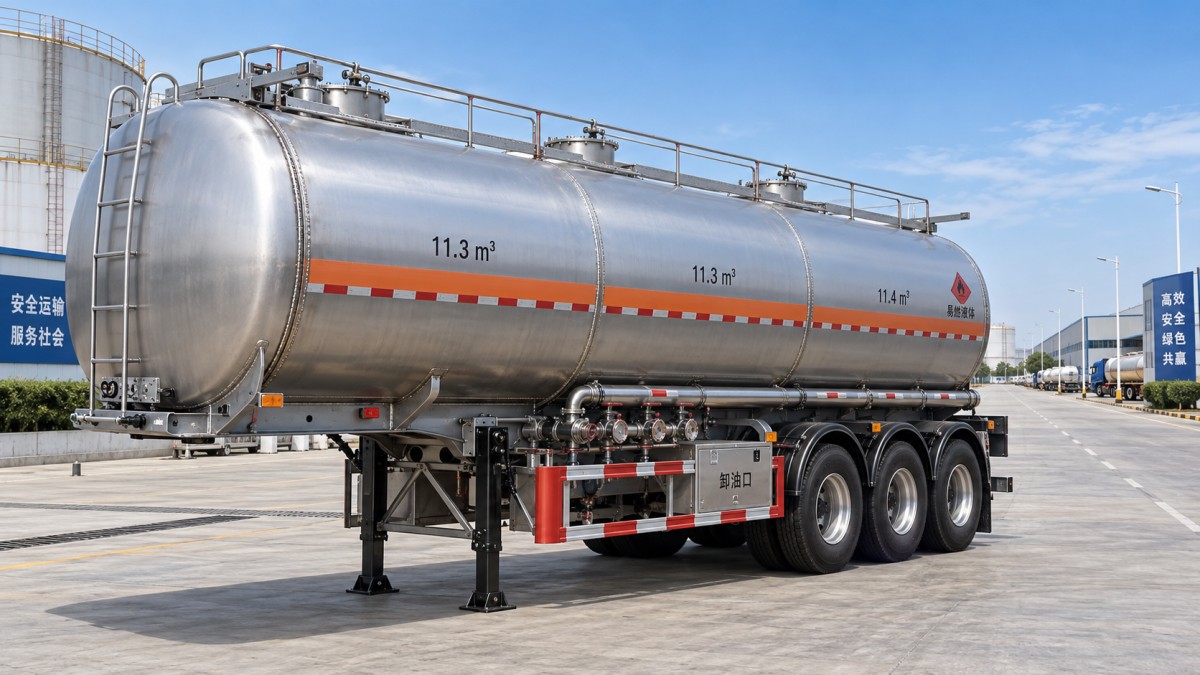
For a 34,000 L three-compartment tanker, a configuration with a 4 mm carbon-steel tank shell and 5 mm end plates illustrates why a quotation should not be reduced to a single thickness figure. The number of compartments, their volume distribution, internal partitions, and the alignment of tank supports all influence how liquid surge reaches the frame. A lower-priced unit with a similar stated capacity may have different reinforcement, weld access, or support spacing. Those differences are not always obvious in a general specification sheet, yet they influence repair frequency.
Surge control affects both safety and component life
Multi-compartment transport can improve load planning, but partially filled compartments create changing surge patterns. Internal baffles and partitions must restrain movement without becoming difficult-to-repair stress points. Poorly positioned or insufficient internal stiffening can increase the cyclic load transmitted to the tank body and chassis. This may first appear as loose brackets, damaged pipe supports, leaking fittings, or cracks near welded attachments rather than an immediate shell failure.
A higher-priced tanker is more likely to be economically sound where routes include repeated stop-start driving, abrupt grades, unpaved sections, or loading conditions that regularly leave one compartment partly filled. Under these conditions, mechanical stress accumulates faster than it does on consistent paved highway runs with stable fill levels. The purchase comparison should include the expected duty cycle, not simply the maximum liquid volume.
Running gear upgrades matter when the route is the problem
Suspension, axle capacity, wheel-end components, and mounting hardware determine whether road shock remains manageable or becomes a continuing source of repairs. A tanker body may be well built, yet frequent failures can still arise from loose U-bolts, worn suspension bushes, cracked hangers, broken spring leaves, uneven tire wear, or damage to pipework caused by excessive vibration.
Specifications need to be evaluated as a system. Three 13-ton axles, for example, should be considered alongside the permitted laden mass, axle spacing, suspension design, tire load rating, expected road surface, and local axle-load restrictions. Selecting high-capacity axles without confirming the complete mass distribution does not prevent overload-related failures. Conversely, a robust suspension can be worth a higher initial cost where depot access roads, fuel-station yards, and delivery routes impose repeated shock loading.
Details that appear minor in a quotation can have disproportionate maintenance consequences. Heavy-duty mechanical suspension with 70 mm pins may be relevant on demanding routes because pin wear and hanger movement affect wheel alignment and stress the frame. The value lies in the complete assembly: pin diameter, bushing arrangement, bracket welding, equalization, access for lubrication or replacement, and availability of compatible wear parts. A stronger-looking suspension is not automatically better if routine service requires difficult disassembly or uncommon components.
Leakage prevention should be assessed at interfaces, not only at the tank shell
Many unplanned tanker repairs involve interfaces: manhole covers, gaskets, valves, outlet flanges, hose connections, vents, discharge piping, and their brackets. Leakage can result from poor sealing, incorrect component compatibility, vibration, distorted flanges, or a valve that is difficult to operate and therefore forced during service. The tank may be structurally intact while the trailer remains unavailable because a small but critical sealing point requires attention.
A higher price earns its place when the specification identifies the valve arrangement, sealing approach, piping supports, and accessibility for inspection. It is reasonable to request confirmation of where discharge lines are supported, how exposed valves are protected from road impact, and whether valves can be removed without cutting or disturbing adjacent pipework. A component that costs little less at purchase may be expensive when it creates repeated product-handling delays.
Material suitability also deserves a precise discussion. Carbon steel can be suitable for oil transportation where the intended product and operating arrangement are compatible with it. The assessment changes for corrosive liquids, contaminated water accumulation, external salt exposure, or prolonged idle storage. Painting quality and surface preparation affect external corrosion resistance, while drainage and internal cleanliness influence hidden deterioration. A price comparison that treats all “carbon steel tankers” as equivalent overlooks these service conditions.
Where a higher specification has limited payback
There are operating profiles where the lowest reasonable specification may be adequate. A trailer carrying compatible fuel on maintained roads, with controlled loading, predictable loads, regular inspection, and nearby repair capability faces a different risk profile from one making long-distance deliveries over harsh surfaces. In the first case, added structural mass or specialized hardware may not return its cost through fewer stoppages.
The same caution applies to features that do not match the operating method. Extra compartments are valuable when multiple products or delivery drops require segregation; otherwise, they add internal complexity and cleaning considerations. Larger tires may improve suitability for certain road conditions, but tire choice must remain aligned with rim availability, replacement stock, and load requirements. A premium feature without local service support can create a different kind of downtime.
Turn quotations into a comparable operating assumption
Before comparing oil tanker trailer price, place each offer against the same written operating basis: product type, annual distance, typical fill level, route condition, loading frequency, expected parked environment, and repair access. Then compare the actual structural and service details rather than broad labels such as “heavy duty.”
- Ask for shell and end-plate thickness separately, plus the reinforcement method around supports, outlets, and manholes.
- Review compartment volumes and baffle arrangement against the expected mix of full and partial loads.
- Match axle, suspension, and tire specifications to the real laden weight and road impact, rather than judging any one capacity figure in isolation.
- Identify components likely to need routine replacement, including valve seals, bushes, brake parts, and suspension wear items, then confirm practical access and part compatibility.
- Clarify whether dimensions and tank mounting follow approved design drawings, because a late mismatch with the intended tractor, depot, or loading arrangement can create costly rework before service begins.
A concrete reference point is the 34 m³ 3-Compartment Carbon Steel Oil Tanker, specified with three 13-ton axles, 385/65R22.5 tires, a 4 mm shell, 5 mm end plates, and reinforced mechanical suspension. These figures are useful only after being tested against the route, product handling pattern, axle-load requirements, and maintenance environment. Their value is in showing the level of detail needed for a meaningful comparison.
The higher-priced trailer reduces repair risk when its construction and components are selected for the loads that will actually occur, and when those components remain inspectable and repairable after years of service. Where the premium only changes appearance, adds unused capacity, or duplicates capability already sufficient for the route, the lower-priced option may carry the better lifecycle outcome.
Get Quote Form
Please complete the form below, and our product experts will contact you within one business hour. All inquiry details are kept strictly confidential and used solely to provide you with a precise solution.
✅ 24/7 Engineer Online Support | Ready for any technical inquiries.
✅ Full Export Documentation Support | We provide full set of shipping documents to ensure smooth customs clearance.
LOGO
This stunning beach house property is a true oasis, nestled in a serene coastal community with direct access to the beach.
Opening Hours
Monday - Friday : 9AM to 5PM
Sunday: Closed
Closed during holidays
Contact
+18888888888
hezuo@eyingbao.com123 West Street, Melbourne Victoria 3000 Australia
Request a Free Quote Today
Need mainstream models or custom specs? Our engineers are ready.
Contact us today for a lasting partnership!