


Products
News
- ▶ Building High-Volume Fuel Distribution Plans Around a 45 m3 Semi Trailer
- ▶ Pre-Delivery Inspection Points for a 45 m3 Fuel Semi Trailer
- ▶ Calculating Total Ownership Cost for a 45 m3 Fuel Semi Trailer Fleet
- ▶ 45 m3 Fuel Semi Trailer Selection: Payload Limits, Axles, and Road Rules
- ▶ How a 42 m2 Carbon Steel Fuel Tanker Supports Depot-to-Station Deliveries
Building High-Volume Fuel Distribution Plans Around a 45 m3 Semi Trailer
Building High-Volume Fuel Distribution Plans Around a 45 m3 Semi Trailer
For project managers, a 45 m3 fuel semi trailer is valuable only when its capacity matches delivery demand, route conditions, storage limits, and operational safety controls.
The central planning question is not simply whether a larger tanker carries more fuel. It is whether each loaded trip reduces supply risk without creating idle inventory.
For construction, mining, logistics, and industrial projects, fuel availability directly affects equipment utilization, production schedules, labor efficiency, and contractual delivery commitments.
A well-designed distribution plan uses tanker capacity as one component of a controlled system that includes depot loading, delivery windows, receiving facilities, dispatch visibility, and contingency capacity.
Start With Daily Consumption and Required Supply Resilience
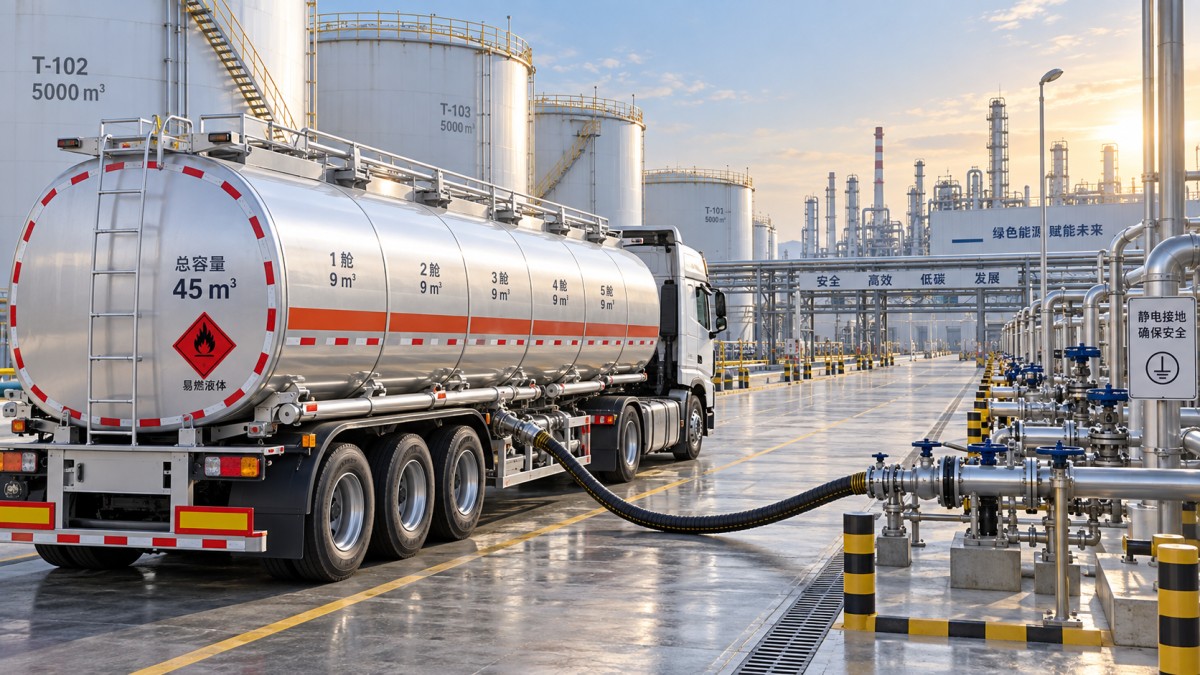
Before selecting routes or fleet quantities, calculate actual fuel consumption by site, equipment class, operating hours, seasonal conditions, and expected production changes.
Project managers should separate baseline consumption from peak consumption. Normal daily demand may look manageable, while major earthmoving, night shifts, or generator use create sharp spikes.
For example, a site consuming 18,000 liters daily may technically receive a 45,000-liter load every two days. That schedule may still be inadequate during peak operations.
Use a supply-resilience target rather than relying on average demand alone. Many projects need enough onsite fuel for at least one delayed delivery cycle.
The appropriate buffer depends on road reliability, loading terminal access, weather exposure, security conditions, and the consequences of equipment shutdown at the project site.
A 45 m3 fuel semi trailer can support high-volume replenishment efficiently when site storage can safely receive most or all of the delivered load.
If receiving tanks are too small, the trailer may wait for tank space, discharge partially, or require more frequent deliveries. Each outcome reduces transport efficiency.
Translate 45 m3 Capacity Into a Delivery Frequency Model
A nominal 45 m3 fuel semi trailer provides approximately 45,000 liters of gross carrying volume, subject to product density, legal weight restrictions, and local regulations.
For planning purposes, calculate usable delivered volume conservatively. Avoid building a project supply model around a theoretical maximum that cannot be loaded legally.
Divide site fuel demand by realistic payload, then add a service allowance for delivery delays, unloading time, traffic, terminal queues, and required driver rest periods.
A project using 90,000 liters weekly may require two full tanker deliveries under ideal conditions. In practice, managers should plan additional capacity for disruption.
Delivery frequency also affects working capital. Larger drops reduce transport cost per liter, but excessive onsite stock increases inventory exposure and potential fuel losses.
The best operating point balances vehicle utilization against stockout risk. It rarely comes from selecting the largest load without reviewing each delivery location.
Build a weekly movement schedule that shows planned loads, route duration, unloading windows, reserve inventory, and an alternative delivery day for critical sites.
Assess Routes Before Committing to a High-Capacity Tanker Strategy
High-volume distribution depends on route practicality. A tanker may be commercially efficient on highways but unsuitable for narrow access roads, weak bridges, steep grades, or congested yards.
Route assessment should include total distance, road surface quality, fuel consumption, tolls, security checkpoints, traffic restrictions, turning space, and emergency stopping locations.
Managers should measure cycle time from loading terminal entry to the trailer's return. Driving time alone is not a reliable basis for fleet planning.
Waiting at the depot, documentation, security inspections, loading procedures, discharge operations, and washout requirements can materially change the number of achievable trips.
Where projects operate across East Africa, West Africa, or Saudi Arabia, road conditions and compliance requirements can vary significantly between operating regions.
Use route categories to assign equipment appropriately. Major corridors may support full-capacity movements, while remote sites may need smaller deliveries, transloading, or staged storage.
Do not assume one tanker configuration solves every distribution requirement. A mixed fleet strategy can protect service levels while retaining economies of scale on core routes.
Match Site Storage Capacity to Trailer Discharge Capacity
Receiving infrastructure determines whether a 45 m3 fuel semi trailer improves operations or introduces delivery bottlenecks. Storage capacity must be reviewed alongside actual consumption patterns.
As a practical principle, the receiving tank should accommodate the planned drop while retaining sufficient ullage for volume measurement, temperature variation, and safe unloading procedures.
Projects should also confirm that transfer pumps, hoses, couplings, grounding points, vents, and spill-control systems can support the intended discharge rate safely.
A quick unloading operation is not automatically a better operation. Rapid transfer without proper pressure, bonding, tank-level monitoring, and supervision creates unacceptable operational risk.
For remote sites, consider whether fixed storage tanks, mobile bowsers, or smaller internal distribution vehicles are required after the main tanker unloads.
This hub-and-spoke model is useful when a central project depot receives bulk fuel, then supplies generators, equipment zones, and temporary work fronts throughout the day.
Storage planning should include reconciliation procedures. Metered receipts, dip checks, delivery documentation, and daily issue reports help identify losses before they become material.
Design Compartments Around Product Mix and Delivery Flexibility
Not every project needs a single-product tanker. Mixed fuel requirements can make compartment design important, especially when diesel, gasoline, or other approved petroleum products are distributed together.
Separate compartments allow a tanker to serve multiple receiving tanks during one route. This can reduce empty running and simplify delivery to smaller satellite sites.
However, additional compartments also require more disciplined loading plans, product identification, valve control, documentation, and contamination prevention procedures.
Where lower-volume, multi-stop deliveries are required, a 34 m³ 3-Compartment Carbon Steel Oil Tanker may complement a larger 45 m3 tanker fleet.
Its 34,000-liter capacity and three-compartment layout can support product segregation or varied delivery quantities for routes that do not justify a full 45,000-liter drop.
When comparing equipment, assess tank material, shell thickness, suspension strength, axle ratings, tire specification, manhole arrangement, discharge valves, and local certification requirements.
Equipment selection should follow the operating model. A tanker with more compartments is not inherently better unless the distribution plan genuinely benefits from that flexibility.
Calculate Cost Per Delivered Liter, Not Just Cost Per Trip
Project managers should evaluate tanker economics through cost per delivered liter. Trip cost alone can hide expensive underutilization, detention, excess idling, and unnecessary return journeys.
Include fuel consumption, driver cost, maintenance, tires, insurance, terminal charges, permits, depreciation, financing, dispatch administration, and expected downtime in the calculation.
Then compare the result across different payload assumptions. A trailer that completes fewer trips but consistently carries near-optimal legal payload may offer a lower delivered-liter cost.
Also measure the financial impact of fuel shortages. A delayed delivery can stop excavators, trucks, generators, batching plants, and support vehicles, causing losses beyond transport cost.
For critical projects, a slightly higher logistics cost may be justified when it significantly improves supply reliability and reduces the probability of production interruptions.
Use scenario planning for normal operations, peak demand, delayed loading, road closure, vehicle maintenance, and unexpected site consumption. This produces a more defensible investment decision.
Build Safety and Compliance Into the Distribution Plan
Fuel distribution planning must treat safety as an operating requirement, not a final checklist. The tanker, terminal, route, driver, and receiving site all affect risk.
Confirm applicable rules for tank construction, emergency equipment, reflective markings, fire extinguishers, grounding, driver training, dangerous-goods documentation, and inspection intervals before deployment.
Driver procedures should cover pre-trip inspection, compartment verification, loading supervision, route reporting, secure parking, emergency communication, controlled unloading, and post-delivery documentation.
Site personnel also need clear responsibilities. They should verify product identity, confirm available tank capacity, supervise transfer, record volume received, and report discrepancies immediately.
Emergency planning must be practical. Identify spill-response resources, local emergency contacts, isolation procedures, communication escalation, and alternative fuel supply arrangements for high-priority sites.
A capable tanker manufacturer can support the equipment side of this process, but the project operator remains responsible for integrating vehicles into site-specific safety systems.
Create a Practical Fleet and Contingency Structure
One 45 m3 fuel semi trailer may be enough for a stable, nearby project. It is rarely sufficient as the sole supply solution for a remote or continuously operating operation.
Fleet sizing should account for planned utilization, maintenance reserve, driver availability, terminal capacity, and the risk that a single route disruption affects project continuity.
Consider maintaining reserve capacity through an additional trailer, contracted carrier, backup loading terminal, or strategically positioned storage stock, depending on project scale.
Dispatch teams should receive daily information on tanker location, current inventory, consumption trends, confirmed loading slots, delivery status, and expected stockout timing.
This visibility enables proactive intervention. Managers can advance a delivery, redirect a loaded vehicle, adjust equipment use, or mobilize reserve supply before operations are affected.
Performance reviews should track on-time deliveries, liters delivered per trip, trailer utilization, turnaround time, unloading delays, safety events, inventory variance, and unplanned fuel outages.
Conclusion: Use Capacity as a Planning Lever
A 45 m3 fuel semi trailer can reduce delivery frequency and improve transport economics, but only when route capability, storage capacity, demand patterns, and safety controls are aligned.
For project managers, the strongest distribution plan begins with consumption data and ends with measurable service performance, rather than relying on tanker volume as the primary decision.
Evaluate payload, cycle time, onsite storage, product mix, legal requirements, and contingency coverage together. This approach creates a fuel supply system that is efficient, resilient, and operationally credible.
Get Quote Form
Please complete the form below, and our product experts will contact you within one business hour. All inquiry details are kept strictly confidential and used solely to provide you with a precise solution.
✅ 24/7 Engineer Online Support | Ready for any technical inquiries.
✅ Full Export Documentation Support | We provide full set of shipping documents to ensure smooth customs clearance.
LOGO
This stunning beach house property is a true oasis, nestled in a serene coastal community with direct access to the beach.
Opening Hours
Monday - Friday : 9AM to 5PM
Sunday: Closed
Closed during holidays
Contact
+18888888888
hezuo@eyingbao.com123 West Street, Melbourne Victoria 3000 Australia
Request a Free Quote Today
Need mainstream models or custom specs? Our engineers are ready.
Contact us today for a lasting partnership!