


Products
News
- ▶ Calculating Total Ownership Cost for a 45 m3 Fuel Semi Trailer Fleet
- ▶ 45 m3 Fuel Semi Trailer Selection: Payload Limits, Axles, and Road Rules
- ▶ How a 42 m2 Carbon Steel Fuel Tanker Supports Depot-to-Station Deliveries
- ▶ Managing Sloshing Risk in 42 m2 Single-Compartment Fuel Tanker Operations
- ▶ Carbon Steel Tank Protection Requirements for 42 m2 Fuel Tanker Trailers
45 m3 Fuel Semi Trailer Selection: Payload Limits, Axles, and Road Rules
A 45 m3 fuel semi trailer can be an efficient fleet asset, but its usable payload is determined by legal gross combination weight and axle-load limits long before the tank reaches its nominal volume. For procurement teams, the central question is not whether 45,000 litres can fit in the shell. It is whether that volume can be carried legally, safely, and repeatedly on the intended routes with the chosen tractor, axle group, and fuel mix.
In many operations, a 45 m3 tank is appropriate for long-haul fuel distribution where road access is good and payload regulations permit a high-capacity combination. It becomes a poor fit when routes include restrictive bridges, weak local roads, low axle-load limits, short depot turnarounds, or delivery points with limited manoeuvring space. Selecting the tank volume first and checking the legal mass later is one of the most expensive mistakes in tanker procurement.
Start with mass, not tank volume
Tank capacity is measured in cubic metres or litres; road authorities regulate mass. A 45 m3 fuel semi trailer holds up to 45,000 litres at nominal capacity, but the cargo weight changes with the product being loaded. Diesel, petrol, kerosene, aviation fuel, and blended products do not have identical densities, and density also changes with temperature.
The practical calculation begins with the heaviest product the trailer will be authorized to carry:
- Product mass = loaded volume × fuel density
- Gross combination mass = product mass + trailer tare weight + tractor tare weight + operating equipment
- Axle-group loading = the distribution of that total mass across steer, drive, and trailer axles
A procurement specification should require the supplier to state the empty weight in delivered operating condition, rather than quoting an optimistic bare-shell weight. Manholes, piping, pump systems, meters, hose reels, fire equipment, spare wheels, toolboxes, insulation, vapour-control equipment, and suspension choice all add mass. A trailer that looks competitive on capacity can lose its advantage if its tare weight leaves too little legal payload margin.
It is also unsafe to assume that a full tank is always the target operating condition. If the legal payload supports less than the maximum cargo weight, the fleet may need to apply a fill limit for denser fuels. That restriction should be documented in loading procedures and reflected in compartment markings or dispatch controls. Otherwise, drivers and loading-terminal staff may interpret “45 m3” as permission to load 45,000 litres of every approved product.
Axle count only helps when the layout works with the road rules
More axles can spread vehicle mass over more tyre contact points, but axle count alone does not guarantee legal compliance. Authorities may apply limits to individual axles, tandem or tridem groups, overall combination mass, bridge formulas, axle spacing, and tyre load ratings. A configuration accepted in one operating country or corridor may be restricted on another.
For a 45 m3 tanker, the procurement review should examine the complete vehicle combination rather than the trailer in isolation. The tractor’s drive-axle arrangement, fifth-wheel location, kingpin load, trailer axle spacing, suspension type, and loaded centre of gravity all affect measured axle loads. Moving the kingpin or changing the tractor specification can shift several hundred kilograms or more between axle groups without changing the cargo quantity.
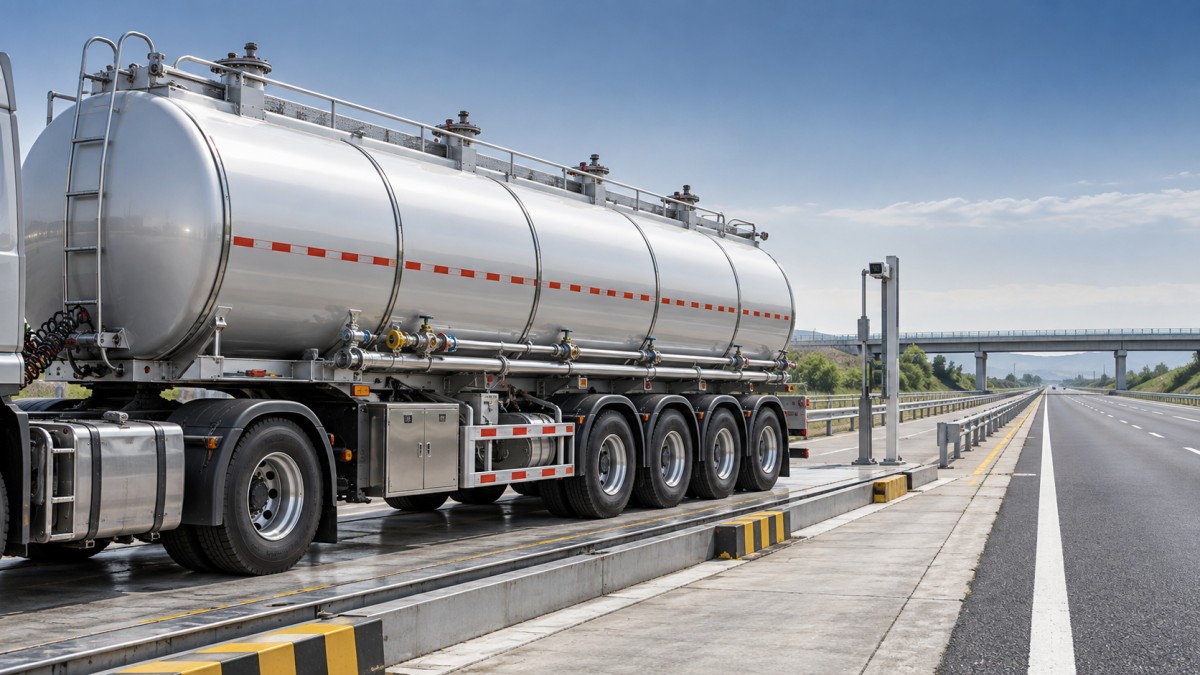
Three-axle trailers are common where road rules and payload targets allow them. Four-axle arrangements may create a better compliance margin on routes with tighter axle-load restrictions, especially where the tanker’s own tare weight is substantial. They also introduce operational trade-offs: more tyres, brakes, hubs, suspension components, and potential tyre scrub in tight turns. The correct comparison is therefore payload delivered per trip under legal conditions, not simply the number of axles on the quotation.
Suspension needs the same route-specific assessment. Air suspension can support load sharing, ride quality, and chassis protection, but it must be correctly specified, maintained, and accepted under the relevant regulations. Mechanical suspension may be suitable for certain duty cycles, but a procurement decision should consider axle-load equalization on uneven roads, maintenance capability, and expected pavement conditions rather than treating either option as universally preferable.
Road access can reduce the value of a large tanker
Legal highway limits are only one part of the road-rule question. A fuel distributor may have an approved route from terminal to regional depot, yet the final delivery segment can involve sharp entrances, narrow service roads, unpaved forecourts, height restrictions, or bridges with lower posted limits. A 45 m3 unit may maximize trunk-route efficiency while being unsuitable for last-mile delivery.
Before ordering, map the typical operating cycle: loading terminal, highway sections, weighbridges, regional depots, customer sites, and return route. The route review should establish whether the trailer can legally travel at its intended load, turn into the site without excessive tyre scrub, and park or discharge on stable ground. A tanker that must routinely transfer part of its load to smaller units can still have a role in a hub-and-spoke network, but its economics should be evaluated as part of that system rather than as a standalone vehicle.
Road geometry also affects tank design. Long wheelbases and extended axle groups can improve mass distribution but reduce manoeuvrability. Higher tank placement can increase ground clearance, while also raising the centre of gravity. These are not abstract design choices for a liquid tanker: emergency handling, roundabout stability, uneven depot surfaces, and braking behaviour all depend on them.
Compartments matter as much as the total capacity
A 45 m3 tanker with one large compartment behaves differently from a tanker divided into several compartments. A single-compartment design is simpler and may offer a slightly better usable volume, but it limits product segregation and makes partial-load operations more difficult. Multiple compartments allow different grades or customers to be served on one route, yet each bulkhead, valve set, and pipe run adds weight, complexity, and cleaning responsibility.
For fuel distribution, the compartment plan should follow the loading and delivery pattern. Procurement teams should ask whether the fleet mainly moves one product in full loads to depots, or whether it makes multi-drop deliveries of several fuel grades. The wrong compartment arrangement can force uneconomic partial deliveries or frequent returns to the terminal.
Surge control is another reason to avoid treating volume as the only specification. Partially filled compartments can generate liquid movement during acceleration, braking, and cornering. Properly designed baffles or compartment bulkheads help manage that movement, but dispatch policy remains important. Filling levels should be compatible with the tanker’s approved design, stability requirements, and local dangerous-goods operating rules.
Specify the compliance package, not just the tank shell
Fuel transport involves flammable liquid, so the tanker must be assessed as a complete safety system. The exact approval requirements depend on the country and the transport route, but the purchasing specification should identify the applicable dangerous-goods rules before fabrication begins. Leaving compliance details until inspection risks expensive rework to pipework, electrical equipment, grounding points, emergency equipment, signage, or discharge controls.
A clear technical specification normally addresses the following areas:
- Tank material, wall thickness, welding requirements, pressure or leak testing, and compatibility with the approved fuels.
- Compartment count, baffle arrangement, manholes, breathers, bottom valves, emergency shut-off functions, and valve accessibility.
- Overfill-prevention and vapour-control requirements where the terminal or local rules require them.
- Electrical grounding, lighting, wiring protection, fire extinguishers, static-control provisions, and emergency markings.
- Axle, suspension, brake, tyre, rim, and landing-gear ratings matched to the intended legal axle loads.
- Calibration, metering, pumping, hose-reel, and discharge arrangements when the trailer will supply customers directly.
Do not accept broad wording such as “road legal” or “export standard” as a substitute for an agreed compliance matrix. The purchase order should identify the operating country, permitted products, expected gross weight, required documentation, and the authority or terminal requirements that apply. This gives the manufacturer a defined design basis and gives the buyer a practical acceptance checklist.
Build a payload margin into the purchase decision
Operating at the theoretical maximum leaves little room for variation in fuel density, optional equipment, debris accumulation, tyre replacement choices, or differences between tractors. A tanker configuration that is only compliant under ideal tare-weight assumptions can become a recurring overload risk in service.
Ask for a loaded axle-weight calculation using the proposed tractor and the heaviest intended fuel, with the tanker in its actual ordered configuration. Review at least full-load and representative partial-load conditions. The calculation should show individual axle and axle-group loads, not only total gross mass. It should also identify the permitted fill volume for each product if the nominal 45 m3 capacity exceeds the legal cargo mass on a particular route.
A useful cross-check comes from liquid-tanker designs outside fuel transport. For example, a 38 m³ Stainless Steel Insulated Palm Oil Tanker uses four 13-ton-capacity axles and 295/80R22.5 tyres. That configuration does not establish what a fuel tanker should use, because cargo properties, tank construction, road rules, and dangerous-goods requirements differ. It does illustrate why a capacity figure must always be read alongside axle ratings, tyre specification, suspension, and tare weight.
Questions to settle before placing the order
The final selection should be based on a defined operating envelope. Procurement teams should be able to answer these questions in writing:
- Which fuel has the highest density among the products to be carried?
- What gross combination mass and axle limits apply on every planned route?
- Which tractor configuration will pull the trailer in normal service?
- Will the trailer make full-load depot runs, multi-drop deliveries, or both?
- What compartment sizes match actual order quantities and fuel-grade mix?
- Which dangerous-goods, terminal-entry, metering, and discharge requirements must be met at delivery?
- Can workshops support the chosen suspension, braking, tyre, and valve systems?
A 45 m3 fuel semi trailer is a strong option when its payload potential aligns with permitted mass, route access, and distribution pattern. When those conditions do not align, a smaller tank, a different axle layout, or a two-stage distribution model can deliver more usable fuel per operating day than a nominally larger trailer that must run underfilled or avoid part of its network.
Get Quote Form
Please complete the form below, and our product experts will contact you within one business hour. All inquiry details are kept strictly confidential and used solely to provide you with a precise solution.
✅ 24/7 Engineer Online Support | Ready for any technical inquiries.
✅ Full Export Documentation Support | We provide full set of shipping documents to ensure smooth customs clearance.
LOGO
This stunning beach house property is a true oasis, nestled in a serene coastal community with direct access to the beach.
Opening Hours
Monday - Friday : 9AM to 5PM
Sunday: Closed
Closed during holidays
Contact
+18888888888
hezuo@eyingbao.com123 West Street, Melbourne Victoria 3000 Australia
Request a Free Quote Today
Need mainstream models or custom specs? Our engineers are ready.
Contact us today for a lasting partnership!