


Products
News
- ▶ Calculating Total Ownership Cost for a 45 m3 Fuel Semi Trailer Fleet
- ▶ 45 m3 Fuel Semi Trailer Selection: Payload Limits, Axles, and Road Rules
- ▶ How a 42 m2 Carbon Steel Fuel Tanker Supports Depot-to-Station Deliveries
- ▶ Managing Sloshing Risk in 42 m2 Single-Compartment Fuel Tanker Operations
- ▶ Carbon Steel Tank Protection Requirements for 42 m2 Fuel Tanker Trailers
Calculating Total Ownership Cost for a 45 m3 Fuel Semi Trailer Fleet
Calculating Total Ownership Cost for a 45 m3 Fuel Semi Trailer Fleet
For fleet decision-makers, the purchase price is only one part of the investment. Calculating the total ownership cost of a 45 m3 fuel semi trailer fleet requires evaluating fuel efficiency, maintenance intervals, tanker material, payload capacity, compliance, spare-parts availability and long-term resale value. A trailer that appears less expensive at the quotation stage can become the higher-cost option if it causes more tractor fuel consumption, lost delivery time, loading restrictions, or difficult repairs.
The right comparison is not “which trailer costs less today?” It is “which fleet configuration delivers saleable fuel safely, consistently, and at the lowest controllable cost over its operating life?” That distinction matters particularly for fuel distributors and transport companies running frequent delivery routes, serving several stations on one trip, or operating in remote areas where workshop access and parts supply are uneven.
Start With a Fleet-Level Cost Model
Total cost of ownership (TCO) should be calculated over a defined ownership period, commonly the intended operational life or the planned replacement cycle. The model should compare equivalent operating assumptions: route distance, annual trips, tractor type, loading rules, product mix, driver practice, and expected residual value. Comparing only trailer prices from different suppliers rarely produces a useful procurement decision.
A practical calculation can be expressed as:
TCO = acquisition cost + financing and delivery costs + operating costs + maintenance and repair costs + compliance costs + downtime costs − residual value.
For a fleet, calculate both the total amount and the cost per delivered litre or per completed trip. The latter often exposes the real commercial impact of trailer mass, usable capacity, compartment layout, and serviceability. A trailer may complete the same route as another unit but generate less revenue per trip if its tare weight reduces legal payload or if its compartment arrangement does not match the distributor’s usual delivery pattern.
Payload Is a Revenue Variable, Not Just a Capacity Figure
A nominal 45,000-litre tanker does not automatically carry 45,000 litres on every route. Actual loaded volume depends on product density, permitted gross combination weight, tractor weight, trailer tare weight, axle distribution, and local operating rules. Procurement teams should therefore request a weight calculation based on the intended tractor and the fuel products being transported, rather than relying on tank volume alone.
Tanker material has a direct role in this calculation. Aluminum alloy tanks are often considered when reducing tare weight is commercially valuable, but the material choice should be assessed against route conditions, repair resources, customer specifications, and the operating environment. The decision is not simply aluminum versus steel; it is whether the whole trailer design supports the payload and maintenance strategy of the fleet.
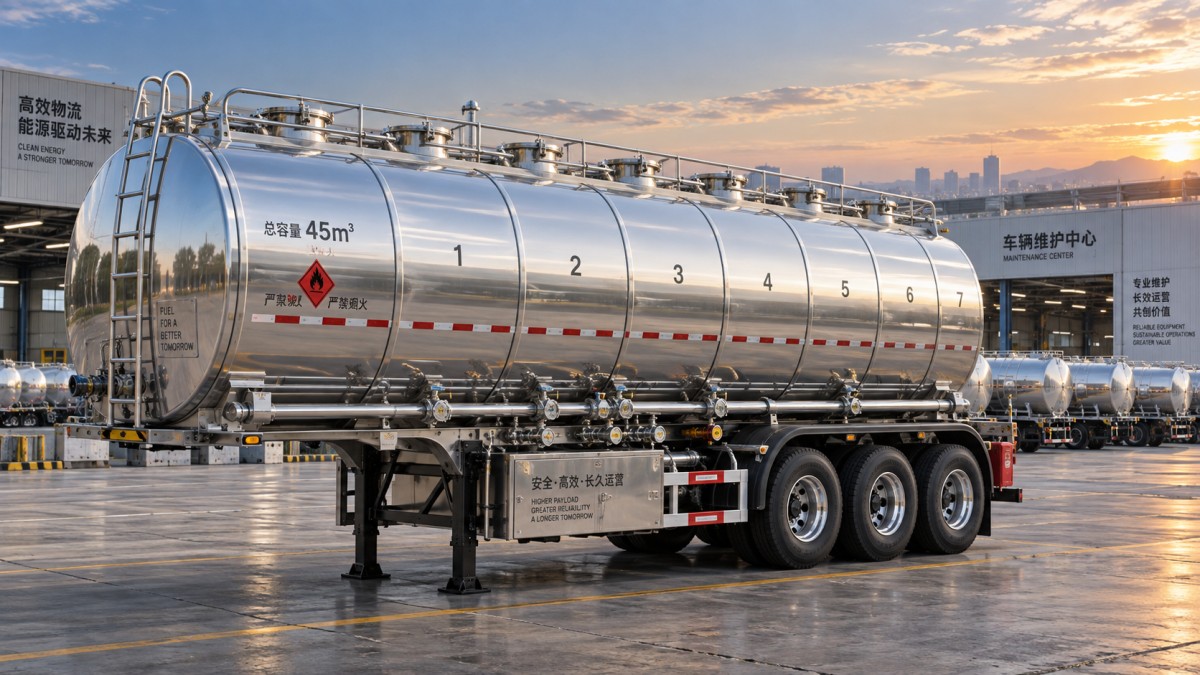
Compartment configuration is equally important. Seven compartments can give a distributor the flexibility to carry separate fuel grades or allocate volume across multiple delivery points. Yet more compartments also mean more internal divisions, outlets, valves, and operating checks. The best layout is the one that matches typical order sizes and minimizes partial loads, product handling complexity, and unnecessary return volume.
Maintenance Cost Is Usually Decided Before Delivery
Fuel tanker maintenance is not limited to routine chassis work. A fleet must inspect and maintain the tank shell, compartment seals, manhole covers, discharge equipment, emergency controls, electrical connections, braking system, suspension, landing gear, and axle assemblies. The cost is shaped by component selection, workmanship, access for inspection, and the availability of replacement parts in the operating region.
During technical evaluation, buyers should look beyond brand names on major components. Ask for the exact axle rating, landing-gear rating, tyre and rim specification, valve arrangement, tank thickness, and drawings or approved design details relevant to the project. Confirm which spare parts are included at delivery and which consumables should be stocked locally. A low-cost tanker with a long lead time for a small but essential valve or seal can create a disproportionate downtime cost.
For example, the 45 m³ 7-Compartment Polished Aluminum Alloy Fuel Tanker uses 5454 aluminum alloy and has a stated 45,000 L total capacity. Its tank body is specified at 5.7 + 5.2 mm, with 6 mm end plates, 13-ton axle capacity, 28-ton landing gear capacity, and a 90# (3.5-inch) kingpin. These figures are useful starting points for a TCO review, but they should still be checked against the purchaser’s tractor configuration, loading practice, road conditions, and applicable local requirements.
Do Not Underestimate Downtime and Compliance Exposure
Downtime is often omitted because it is harder to place on a quotation sheet. In reality, it can be one of the most expensive elements of ownership. A tanker out of service may require a replacement unit, delay a station delivery, interrupt route planning, or force the fleet to carry lower utilization across the remaining trailers. Procurement should estimate likely downtime by considering inspection intervals, expected wear parts, workshop capacity, supplier response, and the practical time needed to source parts.
Compliance should be treated in the same way: as a budgeted operating requirement, not an afterthought. Tanker specifications may need to align with road transport rules, petroleum-company requirements, terminal procedures, and destination-country approvals. Requirements differ by market and project. Before placing an order, establish which documents, markings, safety equipment, test procedures, and inspection arrangements are required, and identify whether they must be completed before shipment, after arrival, or both.
This is particularly relevant for fleets working across East Africa, West Africa, or Saudi Arabia, where route conditions, import processes, terminal expectations, and local service networks can vary significantly. A technically sound trailer can still be a poor fleet asset if its configuration does not suit the operating environment or if essential parts are not accessible when needed.
Compare Quotes on a Like-for-Like Basis
A disciplined tender comparison should normalize every quote. Create one specification sheet and ask suppliers to state compliance point by point, including deviations. Separate included items from optional items. Clarify delivery terms, documentation, inspection scope, warranty boundaries, recommended spare-parts packages, and technical support after arrival. If a supplier provides a lower price, identify precisely what is different before treating it as a saving.
It is also sensible to model at least three scenarios: normal route operation, severe-road operation, and a downtime event involving a key component. This does not require invented precision. Even a qualitative risk score, supported by parts availability and maintenance planning, can prevent a fleet from selecting a specification that looks economical only under ideal conditions.
Shandong ORNN Vehicle Co., Ltd. brings 17 years of semi-trailer and transport-equipment manufacturing experience to discussions involving fuel tankers, chemical liquid tankers, dump trailers, flatbeds, and lowbeds. For transport companies, oil companies, fuel distributors, logistics fleets, liquid operators, and dealers, the useful starting point is a specification review tied to real duty cycles—not a generic tanker comparison. Capacity, compartment layout, material, axle loading, and service planning should all be evaluated as one operating system.
A Better Purchase Decision Starts With the Route
Before approving a 45 m3 fuel semi trailer fleet, procurement teams should gather route mileage, typical load composition, delivery-stop patterns, tractor weights, road quality, workshop capability, and the customer or regulator requirements that apply to the operation. Those inputs make it possible to test whether the proposed tanker will produce acceptable cost per trip and cost per delivered litre over time.
The purchase price still matters, but it should be the result of a technical and commercial comparison—not the only number in it. The fleet with the lower lifetime cost is usually the one that carries the right payload legally, stays available for scheduled deliveries, can be repaired without delay, and retains value when the replacement cycle arrives.
Get Quote Form
Please complete the form below, and our product experts will contact you within one business hour. All inquiry details are kept strictly confidential and used solely to provide you with a precise solution.
✅ 24/7 Engineer Online Support | Ready for any technical inquiries.
✅ Full Export Documentation Support | We provide full set of shipping documents to ensure smooth customs clearance.
LOGO
This stunning beach house property is a true oasis, nestled in a serene coastal community with direct access to the beach.
Opening Hours
Monday - Friday : 9AM to 5PM
Sunday: Closed
Closed during holidays
Contact
+18888888888
hezuo@eyingbao.com123 West Street, Melbourne Victoria 3000 Australia
Request a Free Quote Today
Need mainstream models or custom specs? Our engineers are ready.
Contact us today for a lasting partnership!