


Products
News
- ▶ How a 42 m2 Carbon Steel Fuel Tanker Supports Depot-to-Station Deliveries
- ▶ Managing Sloshing Risk in 42 m2 Single-Compartment Fuel Tanker Operations
- ▶ Carbon Steel Tank Protection Requirements for 42 m2 Fuel Tanker Trailers
- ▶ Single-Compartment Fuel Tankers: When Higher Payload Improves Fleet Economics
- ▶ Is a 42 m2 Single-Compartment Carbon Steel Fuel Tanker Right for Bulk Hauls?
Managing Sloshing Risk in 42 m2 Single-Compartment Fuel Tanker Operations
Managing fuel transport risk starts with controlling liquid movement, load stability, and operational reliability during every stage of delivery.
A 42 m2 Single-CompartmentCarbon Steel Fuel Tanker can simplify high-volume fuel delivery, but its single-compartment design requires careful planning around dynamic loads.
For project managers, the central question is not simply tanker capacity. It is whether the equipment, route, operating procedures, and supplier controls work together reliably.
Sloshing can affect braking distance, directional stability, rollover exposure, driver workload, fuel quality, and the predictability of delivery schedules.
Projects serving fuel stations, depots, construction sites, mining operations, or remote industrial facilities need tanker decisions that protect both throughput and operating margins.
The most effective approach combines correct tanker specification, disciplined loading practices, route assessment, driver training, preventive maintenance, and measurable safety controls.
Why Sloshing Becomes a Project-Level Risk
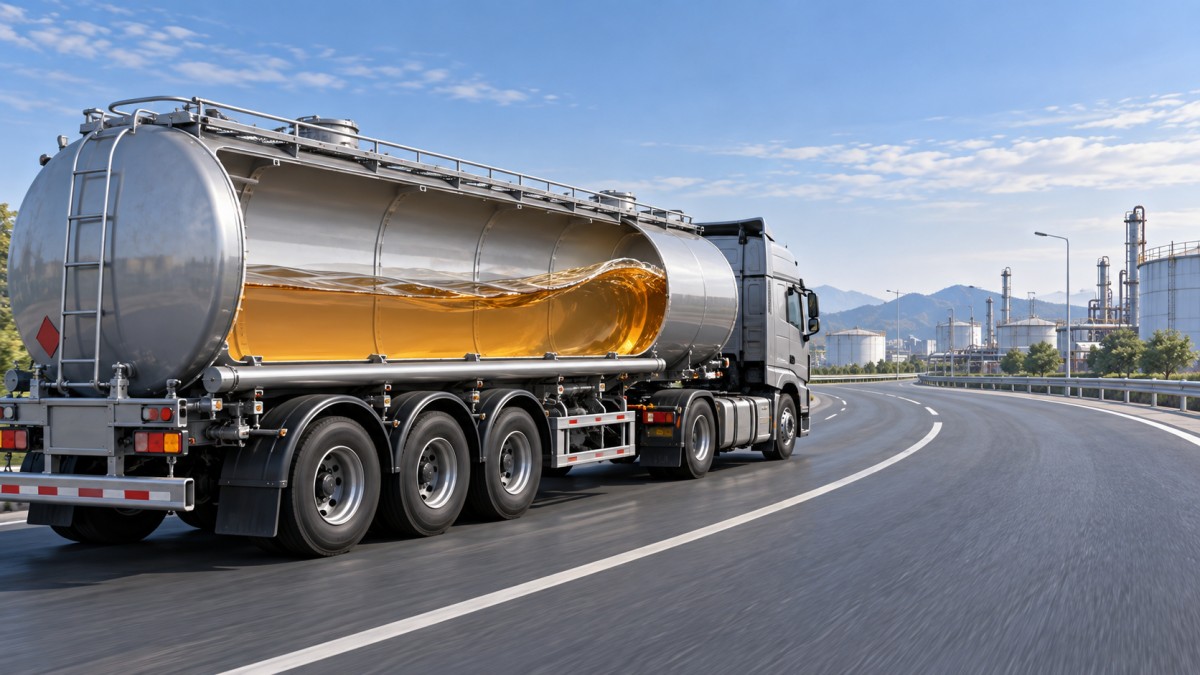
Fuel movement inside a partially filled single-compartment tanker creates shifting forces that can continue after the vehicle begins braking, turning, or accelerating.
Unlike solid cargo, liquid cargo does not remain fixed. Its momentum transfers through the tank shell, chassis, suspension, tires, kingpin, and tractor.
During emergency braking, fuel can surge toward the front of the tank, increasing transient load on the fifth wheel and front trailer structure.
During acceleration, fuel shifts rearward and may alter traction balance. On gradients, the effect becomes stronger and can reduce operational consistency.
Cornering creates lateral force, which is usually the most serious concern. A high center of gravity combined with rapid liquid transfer raises rollover risk.
Project managers should treat sloshing as an operating-system issue, not merely a driver behavior problem or a tank manufacturing detail.
The risk is highest when loads are partial, roads are uneven, delivery windows are tight, drivers face repeated stop-start cycles, or sites have constrained access.
Urban fuel distribution, unpaved access roads, mountainous routes, terminal queues, and busy depot loading areas each require different control measures.
A tanker that performs acceptably on highways may require stricter operating limits when serving construction projects or remote fuel distribution points.
Specify the Tanker Around Actual Operating Conditions
Capacity should be selected from annual volume requirements, trip frequency, legal axle limits, route quality, loading infrastructure, and acceptable delivery risk.
Project teams should confirm whether “42 m2” is an internal designation, a drawing reference, or an intended 42 cubic meter capacity.
Fuel tanker capacity should normally be expressed in cubic meters or liters. Clarifying this before procurement avoids design assumptions and contract disputes.
For a single-compartment configuration, the tank geometry matters as much as nominal volume. Length, diameter, shell thickness, and centerline height influence stability.
A lower tank centerline generally improves rollover resistance, but it must be balanced against ground clearance, axle distribution, discharge layout, and site conditions.
Managers should request approved design drawings showing tank dimensions, compartment arrangement, axle spacing, suspension type, landing gear, piping, and manhole locations.
Load calculations should include the fuel density expected in service. Diesel, gasoline, aviation fuel, and blended products may create different operational conditions.
Specification reviews must also consider local road regulations, vehicle registration requirements, hazardous-goods rules, and insurance conditions in the destination market.
For East Africa, West Africa, and Saudi Arabia, route heat, road surface variation, spare-parts access, and service capability should influence the final specification.
Control Partial Loads Before They Become a Stability Problem
A single-compartment tanker is operationally efficient when transporting one product, but it does not isolate liquid movement across multiple smaller chambers.
The greatest sloshing exposure often occurs at intermediate fill levels, where the fuel has sufficient empty space to build momentum.
Project managers should define permitted loading bands for each route type, rather than leaving partial-load decisions entirely to dispatchers or loading operators.
For example, a fleet may set different rules for highway delivery, urban delivery, rough-road delivery, and steep-gradient routes based on risk assessments.
Loading procedures should confirm product type, target volume, density, free space, seal condition, vapor controls, grounding sequence, and document accuracy.
Dispatch planning can reduce unnecessary partial loads by consolidating orders, scheduling compatible delivery volumes, and assigning the appropriate tanker capacity to each route.
When partial loads are unavoidable, the driver should receive route-specific limits for speed, cornering, braking, following distance, and emergency maneuver expectations.
These operating limits should be practical and enforceable. A policy that ignores delivery deadlines, road conditions, and customer unloading constraints will fail in daily operation.
Telematics data can help supervisors identify harsh braking, high-speed turns, repeated route deviations, and excessive idle time that indicate elevated operational risk.
Evaluate Safety Features as a Working System
Safety equipment should be assessed according to how it supports real fuel transport work, not simply whether each item appears on a specification sheet.
Anti-lock braking systems help maintain wheel control during braking, particularly when changing liquid loads affect tire contact forces and trailer response.
Brake configuration, air-line protection, brake adjustment practices, and inspection intervals remain important because ABS cannot compensate for neglected mechanical condition.
Mechanical suspension can provide robust serviceability, especially where repair infrastructure is limited, but its condition must be monitored against harsh road impacts.
Correct axle ratings and tire selection are essential. Overloading, uneven tire pressure, damaged wheel components, and poor alignment can magnify sloshing-related instability.
Vapor recovery systems improve environmental and operational control by managing fuel vapors during loading and unloading, reducing losses and site exposure.
Grounding, emergency shutoff capability, protected valves, anti-spill arrangements, secure manholes, reflective markings, and fire equipment should be reviewed together.
Consider the 41 m³ Single-Compartment Stainless Steel Tanker Truck with Vapor Recovery System as a reference configuration when evaluating how tank material, vapor controls, ABS, axles, and braking systems support fleet risk management.
Its 41,000-liter capacity, 304 stainless steel tank, three 13-ton axles, drum brakes, and vapor recovery system illustrate the level of detail required during technical comparison.
Build Route and Driver Controls Into the Project Plan
Even a well-specified tanker cannot offset poor route planning. Delivery routes should be assessed before fleet deployment, especially for new project locations.
Assess sharp bends, roundabouts, road shoulders, potholes, steep descents, bridge restrictions, terminal congestion, weather patterns, and safe emergency stopping locations.
Route maps should identify locations where lower speeds are mandatory, including fuel station entrances, industrial gates, uneven loading yards, and densely populated areas.
Driver training should explain liquid dynamics in practical terms. Drivers need to understand why a partially loaded tanker responds differently from a full vehicle.
Training should include controlled braking, safe corner entry, downhill management, following distances, avoidance of sudden steering inputs, and fatigue awareness.
Managers should avoid measuring driver performance only through trip completion time. Such metrics can unintentionally reward unsafe speed and aggressive scheduling decisions.
Better performance indicators include incident-free deliveries, harsh-event frequency, fuel losses, maintenance findings, on-time delivery reliability, and customer-site compliance.
A pre-trip inspection should verify brakes, tires, suspension, couplings, hoses, valve security, electrical connections, tank seals, fire equipment, and emergency documentation.
At unloading sites, drivers need controlled access, correct grounding, clear exclusion zones, reliable communication, and authority to stop work when conditions are unsafe.
Choose a Manufacturing Partner for Lifecycle Reliability
Fuel tanker procurement should not end with a price comparison. The lowest acquisition cost can become expensive when downtime, repair delays, and compliance failures occur.
Project managers should evaluate whether the manufacturer can provide design support, material traceability, quality inspections, test records, drawings, and responsive spare-parts assistance.
Tank material selection should match the transported product, customer requirements, operating environment, corrosion exposure, cleaning methods, and expected service life.
Carbon steel may suit many fuel applications when correctly specified and protected, while stainless steel can offer advantages for particular fuel grades and corrosion conditions.
Weld quality, shell thickness, end-plate construction, internal cleanliness, pressure testing, valve quality, and chassis integration deserve direct technical review before acceptance.
Ask manufacturers how they validate axle loading, tank support structure, suspension mounting, braking performance, piping integrity, and compatibility with local tractors.
For distributed operations, confirm lead times for consumable parts, brake components, suspension parts, seals, valves, and vapor recovery equipment before placing an order.
Shandong ORNN Vehicle Co., Ltd. manufactures fuel tanker trailers and other transport equipment for customers operating across African and Saudi Arabian logistics markets.
That regional operating experience can be relevant when project teams need equipment adapted to fleet workflows, commercial fuel distribution, road conditions, and support expectations.
Make the Investment Decision Using Measurable Risk Criteria
A sound tanker decision connects engineering controls to business outcomes. Reduced sloshing risk supports safer operations, lower incident exposure, and more reliable delivery schedules.
Project managers should calculate the cost of delayed deliveries, fuel loss, vehicle downtime, driver turnover, insurance claims, customer penalties, and reputation damage.
These costs should be compared against the incremental investment in suitable specifications, safety systems, training, route planning, and preventive maintenance.
Procurement evaluation should include total cost of ownership over the expected operating period, rather than focusing only on the tanker purchase price.
Before commissioning, establish acceptance criteria covering tank capacity, axle loading, brake tests, leak tests, vapor control performance, documentation, and driver familiarization.
After deployment, review incident reports, telematics events, inspection findings, delivery delays, and maintenance patterns regularly to identify emerging risks early.
Managing sloshing in a single-compartment fuel tanker requires disciplined decisions before, during, and after procurement. Capacity alone is never an adequate selection criterion.
When tank design, operating limits, driver competence, route controls, and manufacturer support align, project teams can move fuel efficiently without accepting avoidable stability risk.
Get Quote Form
Please complete the form below, and our product experts will contact you within one business hour. All inquiry details are kept strictly confidential and used solely to provide you with a precise solution.
✅ 24/7 Engineer Online Support | Ready for any technical inquiries.
✅ Full Export Documentation Support | We provide full set of shipping documents to ensure smooth customs clearance.
LOGO
This stunning beach house property is a true oasis, nestled in a serene coastal community with direct access to the beach.
Opening Hours
Monday - Friday : 9AM to 5PM
Sunday: Closed
Closed during holidays
Contact
+18888888888
hezuo@eyingbao.com123 West Street, Melbourne Victoria 3000 Australia
Request a Free Quote Today
Need mainstream models or custom specs? Our engineers are ready.
Contact us today for a lasting partnership!