


Products
News
- ▶ Is a 42 m2 Single-Compartment Carbon Steel Fuel Tanker Right for Bulk Hauls?
- ▶ Demand Drivers for Insulated Palm Oil Tankers in Food Logistics Markets
- ▶ Avoiding Palm Oil Solidification During Long-Haul Tanker Transportation
- ▶ Cleaning Standards for Food-Grade Stainless Steel Palm Oil Tanker Trailers
- ▶ Estimating Heat Loss and Delivery Costs for 38 m3 Palm Oil Tanker Routes
Is a 42 m2 Single-Compartment Carbon Steel Fuel Tanker Right for Bulk Hauls?
A 42 m³ single-compartment carbon steel fuel tanker is a sound choice when a route repeatedly carries one compatible fuel grade in full or near-full loads, the loading terminal can fill it efficiently, and the receiving point can accept a large discharge volume without creating long waiting time. Its commercial value comes from concentrating volume in one tank: fewer internal partitions, simpler product segregation, and a straightforward loading and unloading routine.
The decision becomes weaker when one trip must supply several fuel grades, when delivery drops are small and scattered, or when local gross-weight and axle-load limits prevent the tank from being used near its intended volume. Tank capacity alone does not determine usable payload. Fuel density, tare weight, tractor configuration, permitted road weight, and residual product all affect whether 42 m³ is a productive working size or an expensive volume that cannot legally be filled.
Start with the route, not the nominal capacity
A single-compartment tanker is designed around load consolidation. It suits a depot-to-depot movement, a terminal-to-large-station delivery, or a dedicated contract route where the same product is carried repeatedly. A full tank of one fuel grade avoids the scheduling friction of matching each compartment to a separate order. Loading is quicker to plan, product accounting is simpler, and there is less risk of allocating the wrong grade to the wrong outlet.
That simplicity has a trade-off. Once the tanker has been loaded with one product, it cannot serve a second fuel grade without emptying, draining, and following the required cleaning or compatibility process. A route carrying petrol and diesel to several smaller sites will often lose flexibility with a single large compartment. The apparent saving from a simpler tank can be overtaken by extra trips, partial deliveries, or stock imbalance at receiving locations.
The term “42 m2” should also be clarified before any specification is issued. Tanker capacity is normally expressed in cubic metres or litres, while square metres describes an area. The technical request should state whether the intended volume is 42 m³, identify the fuel grade, and define the permitted filling volume. Leaving this unresolved can produce a tank body with the wrong geometry, manhole arrangement, or payload expectation.
Why one large compartment behaves differently on the road
Internal baffles are particularly important in a single-compartment fuel tanker. During braking, acceleration, and cornering, liquid moves across a much longer uninterrupted space than it does in a multi-compartment body. Baffles reduce surge, but they do not remove it. A partly filled tank is normally the most demanding condition because the liquid has room to build momentum before contacting the internal structure.
For that reason, the operating pattern matters as much as tank construction. A vehicle carrying consistent full loads on intercity roads behaves differently from one making irregular partial deliveries over uneven access roads. The latter duty cycle places more emphasis on surge control, suspension condition, brake balance, tyre condition, and driver familiarity with liquid load behaviour. A large single compartment should not be assessed only at full capacity.
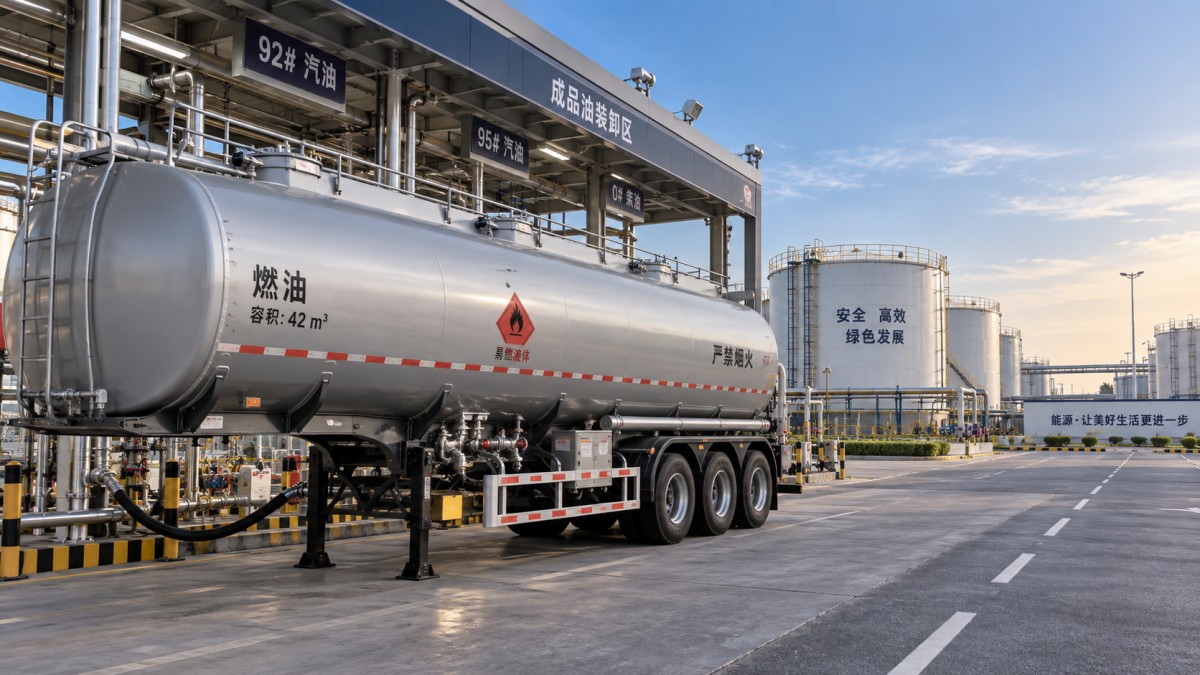
Tank geometry also affects stability. Diameter, shell length, mounting height, chassis layout, and axle spacing influence the loaded centre of gravity. A low mounting position is generally preferable, but clearance beneath the tank, drainage arrangement, suspension travel, and local road conditions must be considered at the same time. A low tank that repeatedly strikes rough yard entrances creates a different maintenance problem from a higher tank with less favourable roll behaviour.
Carbon steel: suitable only when the product and protection system align
Carbon steel is widely used for petroleum fuel tank bodies because it is robust, repairable, and practical for demanding transport service. The selection still requires confirmation of product compatibility, internal cleanliness requirements, coating strategy where applicable, and the expected exposure to water contamination. The material choice is not a substitute for fabrication quality. Weld quality, shell forming, end-plate design, baffle attachment, leak testing, and protection of external weld areas determine how well the tank endures vibration and repeated loading cycles.
Thickness figures should not be compared in isolation. A thicker shell adds durability margin but also raises tare weight, which can reduce legal payload. End plates, high-stress supports, manhole reinforcement, and mounting zones may require different treatment from the main shell. The design should show the shell thickness, end-plate thickness, baffle arrangement, saddle structure, and chassis connection rather than listing only a single steel thickness.
Corrosion risk often develops at places that receive less attention during ordering: under saddles, around brackets, at drain points, behind pipe supports, and where paint damage remains unrepaired after road debris impacts. External preparation and coating quality therefore affect lifecycle cost, especially on routes with wet conditions, coastal exposure, or frequent washing. Inside the tank, water entry and neglected drainage can create contamination concerns even when the steel itself remains structurally sound.
The payload calculation that changes the answer
A stated 42 m³ volume does not mean 42 tonnes of payload. Fuel mass changes with product density and temperature, while the vehicle’s legal gross combination weight sets an upper limit regardless of tank volume. The calculation should begin with the applicable density range, then add the tanker tare weight, tractor weight, equipment weight, and a realistic allowance for retained product. The resulting loaded axle distribution must remain within the limits used on the actual route, not only at the loading terminal.
A common error is to compare a large tanker with a smaller unit only by litres per trip. The larger unit may reduce trip frequency, yet that gain disappears where fill volume is limited by mass, roads require frequent detours, or customers cannot receive a full load. Conversely, a stable high-volume route can justify the larger body even when the tank is not filled to its geometric maximum every time, provided the remaining volume supports practical scheduling.
Loading and discharge details that deserve specification
Single-compartment operation is simpler only when the product path is clearly defined. Specify the loading arrangement, manhole access, vapour handling requirements where applicable, bottom or top discharge preference, valve configuration, outlet size, hose stowage, emergency shut-off arrangement, and grounding provisions according to the operating environment. These details should match the terminal and receiving connections already in use. An outlet that is technically adequate but mismatched to the installed unloading setup causes avoidable adapter use and longer discharge time.
Drainage needs similar attention. Low points, discharge pipes, and valve locations should allow controlled removal of retained product and water without creating trapped pockets. Poor drainage is particularly troublesome when changing fuel grade, carrying out inspection, or returning a vehicle after maintenance. It also complicates reconciliation because a residual volume in a large compartment can be material even when it appears small relative to total capacity.
The chassis specification should be evaluated as part of the tank, not as a separate purchase item. A tri-axle configuration, for example, needs axle rating, brake arrangement, suspension type, tyre size, and lift-axle use to be assessed against route weight rules and turning conditions. A front lift axle can be useful in selected operating states, but it changes axle loading and must be used within the approved load plan. Manual brake adjustment requires a disciplined inspection routine; it should not be treated as equivalent to an automatically adjusted system without accounting for the maintenance practice available.
Where multi-product distribution is a regular requirement, a 40 m³ 6-Compartment Carbon Steel Tanker Semi-Trailer illustrates the alternative configuration: separate compartments support grade segregation and multiple drops, although they add valves, internal divisions, cleaning considerations, and a more complex loading plan. The comparison is therefore operational rather than purely volumetric.
When the 42 m³ single-compartment option is the stronger fit
The configuration is well aligned with dedicated bulk movements of one compatible product, predictable return routes, high-throughput loading points, and receivers able to take substantial deliveries. It also suits operations where simple tank management is valued over product-mix flexibility. Robust carbon steel construction can be appropriate for hard service, provided the design weight remains workable and corrosion protection is maintained.
It is less suitable where orders are fragmented, product grades change frequently, road access is restrictive, or the tanker is expected to operate for long periods at partial fill. In those conditions, compartment count, tank geometry, axle layout, and delivery sequence deserve greater weight than the headline capacity. A usable specification should finish with approved design drawings showing dimensions, centre of gravity, compartment arrangement or baffle layout, piping, axle positions, and estimated tare weight. That review exposes conflicts before fabrication, when changes are still far less disruptive.
Get Quote Form
Please complete the form below, and our product experts will contact you within one business hour. All inquiry details are kept strictly confidential and used solely to provide you with a precise solution.
✅ 24/7 Engineer Online Support | Ready for any technical inquiries.
✅ Full Export Documentation Support | We provide full set of shipping documents to ensure smooth customs clearance.
LOGO
This stunning beach house property is a true oasis, nestled in a serene coastal community with direct access to the beach.
Opening Hours
Monday - Friday : 9AM to 5PM
Sunday: Closed
Closed during holidays
Contact
+18888888888
hezuo@eyingbao.com123 West Street, Melbourne Victoria 3000 Australia
Request a Free Quote Today
Need mainstream models or custom specs? Our engineers are ready.
Contact us today for a lasting partnership!