


Products
News
- ▶ Avoiding Palm Oil Solidification During Long-Haul Tanker Transportation
- ▶ Cleaning Standards for Food-Grade Stainless Steel Palm Oil Tanker Trailers
- ▶ Estimating Heat Loss and Delivery Costs for 38 m3 Palm Oil Tanker Routes
- ▶ Stainless Steel Grades to Compare for a 38 m3 Insulated Palm Oil Tanker
- ▶ Why Insulation Matters When Transporting Palm Oil in a 38 m3 Tanker
Cleaning Standards for Food-Grade Stainless Steel Palm Oil Tanker Trailers
A food-grade stainless steel palm oil tanker is clean only when it is demonstrably free of the previous cargo, cleaning chemicals, excess water, foreign matter, and conditions that can alter the next load. A visually bright tank is not enough. For palm oil transport, the critical controls are residue removal from hard-to-drain areas, complete rinsing, drying before loading, and records that prove the cleaning release decision was justified.
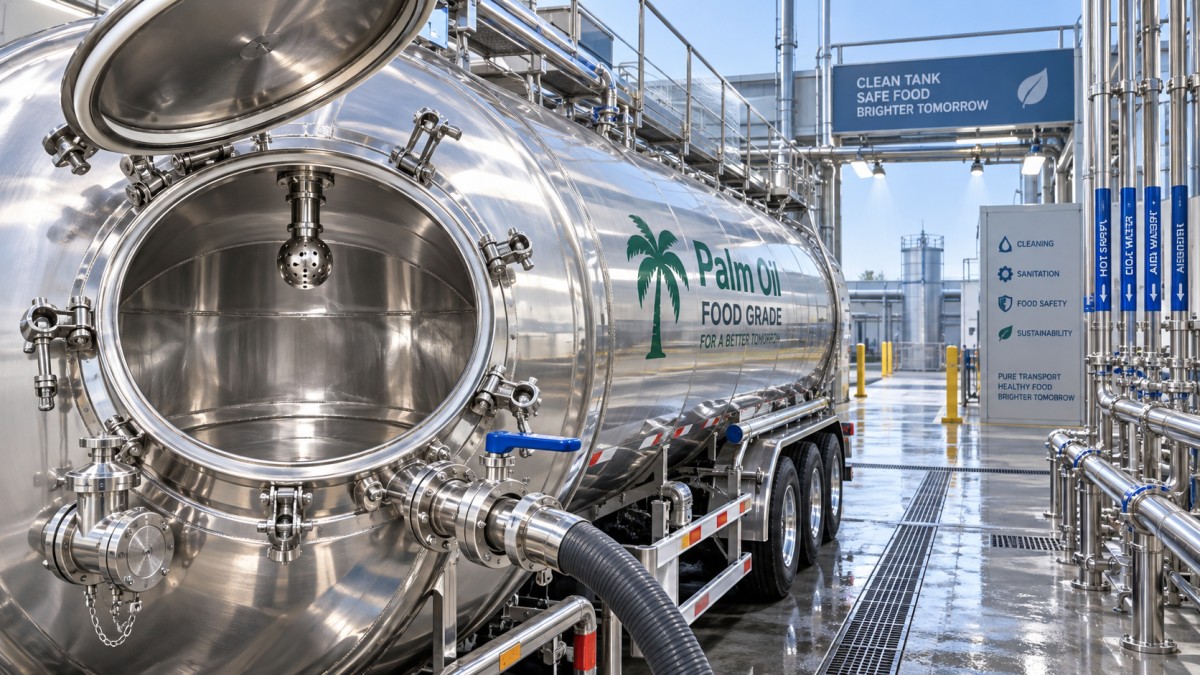
This is especially important for a 38 m3 Stainless Steel Insulated Palm Oil Tanker. Its larger internal surface, pipework, manlids, valves, heating-related fittings, and insulated configuration create more locations where residual oil, wash water, or cleaning solution can remain. The cleaning standard must therefore address the whole wetted system, not only the visible tank shell.
Cleaning must start with cargo compatibility, not with the wash cycle
The required cleaning level depends on what the tanker carried immediately before palm oil. A tank returning from food-grade edible oil service presents a different risk profile from one that carried non-food material, strongly odorous cargo, chemicals, fuels, lubricants, or products containing allergens.
For food-grade palm oil movements, the operator should maintain a cargo history for each compartment and associated hose set. The release decision should be based on the last cargo, earlier cargoes where applicable, the customer’s approved cargo list, and the cleaning method used. If the prior cargo is outside the accepted compatibility list, ordinary washing may not be an adequate control. The tank may require a validated intensive cleaning process, third-party inspection, or exclusion from food service according to the shipper’s requirements and applicable local rules.
A common operational mistake is treating stainless steel as inherently self-protecting. Stainless steel resists corrosion under suitable conditions, but it does not prevent product taint, residue carryover, microbial growth in retained moisture, or contamination from damaged seals and poorly maintained valves. Food-grade status is a controlled condition of the complete tank system, not simply a material description.
Remove bulk palm oil before applying water
Palm oil can become viscous or semi-solid as its temperature falls. Attempting to wash a tank while significant product remains on the shell or in the outlet system often leads to ineffective cleaning, excessive water consumption, and deposits that are difficult to remove from valve cavities and low points.
Before the wash begins, the tank should be fully discharged through the normal outlet route. Where the transport specification permits controlled warming, residual oil should be softened sufficiently to drain without overheating the product-contact surface or damaging gaskets. Heating should not become a substitute for drainage discipline: the outlet valve, bottom discharge assembly, hoses, bends, pump connections, and any sampling points must be emptied separately.
Operators should inspect for residual pools at:
- the lowest point of the tank shell and outlet sump;
- butterfly valves, ball valves, and valve seat areas;
- manlid recesses and gasket contact surfaces;
- loading pipes, discharge lines, elbows, flexible hoses, and hose couplings;
- heating-coil interfaces or other internal fittings, where fitted.
Residual palm oil left behind is not merely a yield-loss issue. Aged oil can oxidize, develop off-odours, retain wash chemicals, and make it harder to determine whether the next cleaning cycle has been effective.
Use a wash sequence that matches palm oil residue and food-contact risk
There is no single wash temperature, detergent concentration, or cycle duration suitable for every tanker and every previous cargo. Those parameters should be established in the operator’s sanitation procedure, with reference to the detergent supplier’s instructions, tank design, water quality, local discharge requirements, and customer specifications. What matters is that the process is repeatable and can be verified.
A practical cleaning sequence generally includes the following controls:
Pre-rinse and gross residue removal. A warm-water pre-rinse can loosen residual palm oil and prepare the surface for detergent action. Water temperature must be controlled. Water that is too cool may leave fat deposits; excessively high temperatures may accelerate wear on seals or create unnecessary safety risks.
Detergent circulation or spray cleaning. An alkaline detergent is commonly used where the objective is to remove fats and oils, but its suitability must be confirmed for the tank material, seals, and cleaning system. The wash must reach all internal areas through correctly operating spray balls, rotary cleaning heads, or other approved devices. Poor spray coverage creates a false pass condition: the accessible shell may look clean while upper surfaces, fittings, and pipework remain contaminated.
Targeted attention to valves and removable components. External rinsing of a closed valve does not clean the product-contact cavity. Valve bodies, outlet assemblies, caps, screens, and detachable hose fittings require disassembly or an established cleaning method that reaches their internal surfaces. Gaskets should be checked for swelling, cracking, embedded debris, and retained odour.
Final potable-water rinse. The final rinse should remove detergent and loosened residue. Water used on product-contact surfaces should meet the applicable potable-water requirement for the operation. Where rinse-water checks are part of the site procedure, they should be interpreted against defined acceptance criteria rather than judged informally by appearance alone.
Drainage and drying. After rinsing, all low points must be opened and drained. Water retention is one of the most underestimated risks in edible-oil transport. Free water can affect cargo quality, encourage microbial concerns in contaminated niches, and introduce uncertainty into loading acceptance. A tank should not be closed immediately after washing if moisture remains inside. Ventilation, air drying, or another approved drying method should continue until the internal surfaces and fittings meet the operator’s dry-condition requirement.
Inspection is a release control, not a quick visual check
Cleaning verification should take place before the tanker is released for loading, not after it reaches the loading terminal. Inspection requires safe access procedures, adequate lighting, and controls for confined-space hazards. Entry into a tanker should never be treated as a routine cleaning shortcut; where internal entry is necessary, it must follow the applicable confined-space permit, atmospheric testing, isolation, rescue, and supervision requirements.
External inspection tools can reduce the need for entry. Inspection lamps, mirrors, cameras, and borescopes may help examine upper shell areas, manlid necks, and difficult pipe sections. However, these tools do not eliminate the need to inspect the outlet system, seals, hose connections, and other points known to retain product.
The release inspection should confirm at minimum that:
- no visible palm oil residue, sediment, foreign particles, or staining remains;
- there is no unusual or carryover odour;
- no free water is present in the tank, lines, valves, or hose assemblies;
- manlid gaskets, valve seals, caps, and couplings are clean and intact;
- all product-contact closures are protected from dust, insects, rainwater, and road contamination after cleaning;
- the tank identification, compartment status, and cleaning record correspond to the vehicle presented for loading.
Visual and odour checks are useful but limited. They can identify obvious failures, not prove that a cleaning process has removed all residues. Where cargo specifications, prior-cargo risk, or internal quality systems require stronger evidence, the operation may use defined verification methods such as rinse-water monitoring, swab testing, conductivity checks for chemical removal, or other validated controls. The method should be selected for the risk being controlled. A test that indicates detergent removal does not automatically demonstrate the absence of odour or incompatible product residue.
Insulated equipment adds controls around temperature and moisture
Insulation improves temperature stability but can conceal maintenance problems. External cladding damage, compromised insulation, leaking fittings, or poorly sealed manlids may allow water ingress or make it difficult to maintain the intended thermal condition. These issues should be included in periodic hygiene inspections because moisture entering from outside can compromise a tank that was correctly washed.
If the tanker uses heating equipment, it is important to distinguish the heating medium circuit from the cargo space. The cargo-contact tank surface and all loading/discharge components remain the sanitation priority. Any sign of leakage, abnormal moisture, pressure irregularity, or contamination around heating-related equipment should trigger maintenance review before the unit returns to food service.
Single-compartment stainless tankers can simplify cargo segregation, but design features do not replace sanitation controls. For example, a 41 m³ Single-Compartment Stainless Steel Tanker Truck with Vapor Recovery System is configured for fuel transport rather than edible-oil service. The comparison matters because a stainless steel tank’s intended cargo system, fittings, seals, vapour handling arrangement, and operating history must all be evaluated before any food-grade assignment. Material similarity alone is not a food-grade qualification.
Documentation closes the control loop
A cleaning record should enable a reviewer to reconstruct what happened without relying on memory. At a minimum, it should identify the vehicle and compartment, previous cargo, date and time of cleaning, cleaning location, wash method, detergent or chemical used, rinse and drying status, inspection result, corrective actions, and the person authorizing release.
Where hoses are interchangeable, hose identification should be included. A properly cleaned tank can still be contaminated by a hose, adapter, pump connection, or loading cap that was stored uncovered or used on an incompatible product. The same applies to sampling equipment and seals.
Records are most valuable when they support exception management. If a wash temperature was outside the approved range, a spray device malfunctioned, final drainage was incomplete, or the previous cargo was not accepted for direct changeover, the record should show how the deviation was assessed and resolved. Simply signing a cleaning certificate after an irregular wash cycle removes the evidence needed for later quality investigation.
Conditions that should stop loading
Loading should be held when there is unresolved uncertainty about the previous cargo, a persistent odour, visible residue, pooled water, damaged product-contact seals, missing cleaning records, or an unverified cleaning deviation. These are not administrative defects. Each condition can undermine the ability to demonstrate that the tanker is suitable for edible palm oil.
The practical standard is therefore straightforward: clean the entire wetted system, verify rather than assume cleanliness, protect the tank after release, and retain a traceable record. For food-grade palm oil, the reliability of the cleaning decision matters as much as the wash itself.
Get Quote Form
Please complete the form below, and our product experts will contact you within one business hour. All inquiry details are kept strictly confidential and used solely to provide you with a precise solution.
✅ 24/7 Engineer Online Support | Ready for any technical inquiries.
✅ Full Export Documentation Support | We provide full set of shipping documents to ensure smooth customs clearance.
LOGO
This stunning beach house property is a true oasis, nestled in a serene coastal community with direct access to the beach.
Opening Hours
Monday - Friday : 9AM to 5PM
Sunday: Closed
Closed during holidays
Contact
+18888888888
hezuo@eyingbao.com123 West Street, Melbourne Victoria 3000 Australia
Request a Free Quote Today
Need mainstream models or custom specs? Our engineers are ready.
Contact us today for a lasting partnership!