


Products
News
- ▶ Estimating Heat Loss and Delivery Costs for 38 m3 Palm Oil Tanker Routes
- ▶ Stainless Steel Grades to Compare for a 38 m3 Insulated Palm Oil Tanker
- ▶ Why Insulation Matters When Transporting Palm Oil in a 38 m3 Tanker
- ▶ 20 m2 Two-Compartment Fuel Tankers: Features That Matter to Resellers
- ▶ Planning Fleet Routes with a 20 m2 2-Compartment Fuel Tanker Truck
Estimating Heat Loss and Delivery Costs for 38 m3 Palm Oil Tanker Routes
A palm oil delivery can appear profitable when quoted by distance and payload alone, yet the margin often changes after the tanker reaches the receiving point. Long waiting times, night cooling, mountain sections, repeated stops, and a poorly matched insulation package can increase fuel use or leave the consignee with oil that needs additional handling before discharge. For a 38 m³ route, the practical answer is to estimate thermal risk and transport cost together, using the actual loading temperature, route duration, ambient conditions, discharge requirement, and tanker configuration.
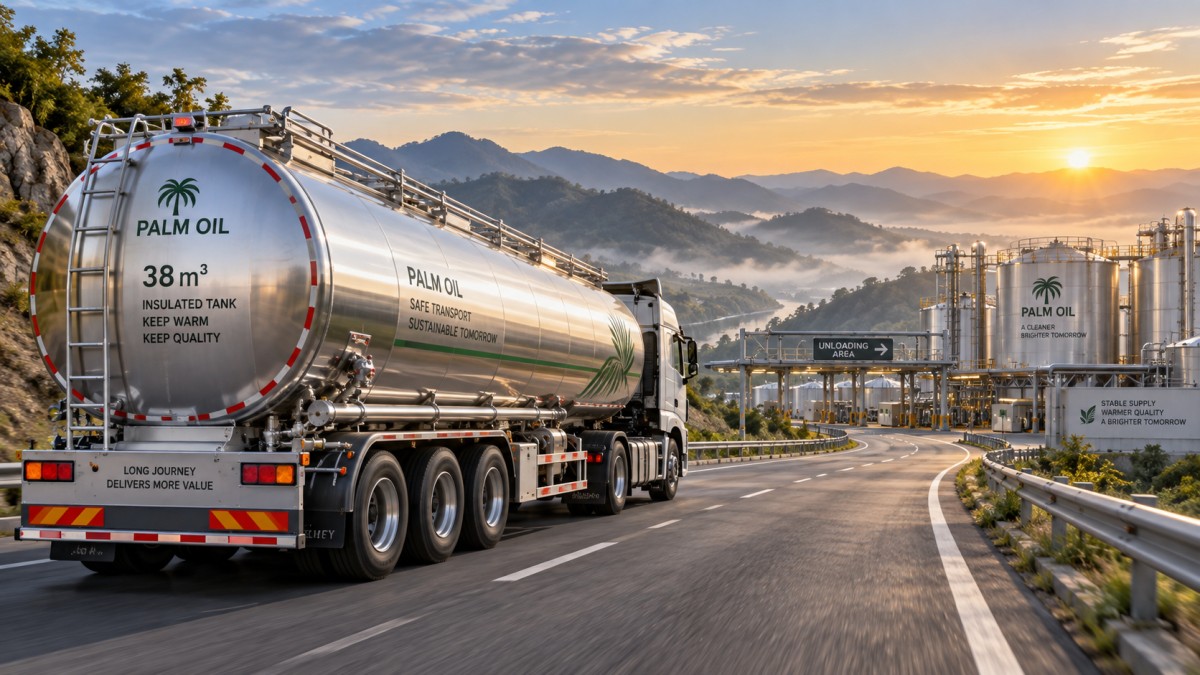
A 38 m3 Stainless Steel InsulatedPalm Oil Tanker should not be selected only by nominal capacity. The useful procurement question is whether its insulation and operating arrangement can keep the product within the receiver’s acceptable handling range for the longest realistic trip, including loading delays and queue time. Once that is clear, delivery cost can be calculated with fewer assumptions and fewer surprises at unloading.
Start with the route window, not the highway distance
Distance is necessary, but it is not the main predictor of heat loss. Palm oil loses heat over time, so a route with moderate mileage and long terminal waiting periods may create more temperature risk than a longer trip completed without interruption.
For each lane, record the full period from the end of loading to the start of discharge:
- Loading and documentation time after the cargo reaches its dispatch temperature.
- Expected driving hours, including border checks, checkpoints, fuel stops, and traffic restrictions.
- Likely parking or overnight time.
- Queue time at the receiving terminal.
- Ambient temperature range during the actual travel period, not only the daytime average.
- Road surface, gradient, and congestion conditions that affect fuel consumption and transit time.
Use a normal operating estimate and a delayed-delivery estimate. The delayed case is particularly important where vehicle access to depots is scheduled, roads are slow after rainfall, or border formalities can extend the trip. A procurement decision based only on the best-case transit time can understate both heat retention requirements and working-capital exposure.
A practical way to estimate heat loss
Heat loss from a tanker is driven by the temperature difference between the oil and the surrounding air, the effective thermal performance of the tank body, exposed surface area, wind, and elapsed time. It is not necessary to claim one universal cooling rate, because that rate changes substantially by route and equipment condition. Instead, build a route-specific estimate and verify it through controlled operating records.
Begin with four values:
The working thermal margin is the difference between loading temperature and the minimum acceptable discharge temperature. Divide that margin by the expected total elapsed time to obtain the maximum average temperature drop the trip can tolerate. This is not a guaranteed cooling rate; it is a decision limit. If historical records from comparable loads show a faster decline than the route can tolerate, the operator needs a stronger insulation specification, a higher approved loading temperature, a shorter route window, or an agreed heating and discharge procedure.
Do not use external shell temperature as proof that the cargo is protected. Shell temperature can react quickly to sunlight or nighttime cooling while the bulk product responds more slowly. The relevant record is the internal cargo temperature measured consistently at loading and before discharge.
Where thermal performance is commonly lost
Procurement specifications sometimes focus on the main tank shell while overlooking the areas that make a noticeable difference during extended transport. Heat can escape through end sections, manholes, pipework, outlet assemblies, access covers, and locations where insulation has been compressed, damaged, or exposed to moisture. Insulation also performs differently when a tanker is repeatedly washed, parked outdoors, or operated over rough roads that loosen outer cladding and fasteners.
Ask the supplier to define the insulation construction, protective outer finish, coverage around fittings, inspection access, and repair method. For an existing tanker fleet, inspect insulation condition before assuming that the original specification still represents field performance.
Translate the route into delivery cost
The delivered cost per litre or per tonne should be calculated from a round-trip operating model, then adjusted for the usable payload of the specific product lane. A simple structure is:
Total delivery cost = fuel + driver and trip allowance + tolls or route charges + loading and unloading time cost + maintenance allowance + financing/depreciation allocation + temperature-control or recovery cost + expected delay cost.
The thermal element enters the model in more than one place. Better insulation may add acquisition cost and some tare weight, but it can reduce the need for remedial heating, extended unloading, cargo handling disruption, and rejected delivery risk. Conversely, selecting the lightest or lowest-cost tank arrangement without considering the route may produce a lower purchase price but a higher cost per successful delivery.
Fuel cost needs route-specific assumptions
Do not use one fleet-wide fuel-consumption figure for every palm oil lane. Loaded consumption is affected by gross combination weight, tyre condition, rolling terrain, traffic, idling, auxiliary equipment use, and driving pattern. A route that has long low-speed sections may consume more fuel per kilometre than a longer, steady-speed lane.
Calculate fuel using separate assumptions for loaded travel, empty return travel, and stationary engine hours where applicable. Then test the result against a higher-consumption case. This is useful when evaluating a new route or when fuel price exposure makes a narrow delivery margin unreliable.
Payload is not simply tank volume
A nominal 38 m³ tank does not automatically mean 38 m³ of saleable cargo on every run. Usable payload depends on product density at loading temperature, legal axle limits, tractor and trailer tare weight, residual product, and any compartment or operating restrictions. Overlooking axle distribution can lead to an apparent payload calculation that cannot be used legally or safely.
Before finalizing a purchase order, request a weight distribution calculation for the intended tractor configuration and product density range. The procurement team should compare maximum permissible gross combination weight with the expected loaded weight, rather than using tank capacity as the only measure of earning potential.
Separate edible-oil requirements from fuel-tanker features
Some fleets transport several liquid categories and may review a broader range of tanker equipment during procurement. That comparison is useful only when the service requirements remain clear. An edible-oil tanker typically requires careful attention to cargo-contact material, cleanliness, drainage, temperature retention, and the product handling process at both ends of the journey.
A fuel-oriented configuration may solve different operating problems. For example, the 45 m³ 6-Compartment Painted Aluminum Alloy Tanker with Vapor Recovery System is specified with a 5454 aluminum alloy tank body, six compartments, vapor recovery, ABS, drum brakes, and tri-axle air suspension with a front lift axle. Those features can be relevant when assessing compartmentalized petroleum distribution and vapor handling, but they should not be treated as evidence that the configuration is suitable for insulated edible-oil service. Product compatibility, thermal design, cleaning process, and loading/discharge arrangement must be assessed separately.
Questions to settle before approving the tanker specification
Decision-makers can avoid expensive late changes by obtaining clear answers before production begins:
- What loading and minimum discharge temperatures apply on each priority route?
- How many hours must the tanker protect the cargo under a realistic delay scenario?
- What cargo-contact material and internal finish are required by the buyer’s handling process?
- Are heating coils, external heating provisions, or dedicated discharge arrangements required, and who controls their use?
- What is the calculated axle load with the intended tractor, full load, and expected product density?
- Can insulation, cladding, valves, and outlet areas be inspected and repaired without major dismantling?
- Which costs arise when the truck waits at loading or discharge, and who bears them contractually?
The last question is often underestimated. A tanker can retain heat adequately yet still lose money through detention, missed delivery windows, and unproductive return time. Route pricing should distinguish between a transport cost that is controllable by the carrier and a delay cost caused by terminal scheduling or access restrictions.
Use operating records to refine the estimate
After the first comparable trips, record loading temperature, departure time, arrival time, discharge temperature, ambient conditions, fuel issued, distance, idle hours, payload, and any unloading difficulty. A small set of consistent records is more useful than a theoretical thermal claim that does not reflect actual road conditions.
Review results by route rather than averaging all deliveries together. If temperature decline is concentrated on overnight stops, focus on parking duration and insulation integrity. If fuel cost rises on one lane, separate grade, congestion, and waiting time before attributing the increase to vehicle performance. When the actual route record repeatedly approaches the allowable thermal margin, the decision should be made before cargo quality or discharge flow becomes a recurring operational problem.
Get Quote Form
Please complete the form below, and our product experts will contact you within one business hour. All inquiry details are kept strictly confidential and used solely to provide you with a precise solution.
✅ 24/7 Engineer Online Support | Ready for any technical inquiries.
✅ Full Export Documentation Support | We provide full set of shipping documents to ensure smooth customs clearance.
LOGO
This stunning beach house property is a true oasis, nestled in a serene coastal community with direct access to the beach.
Opening Hours
Monday - Friday : 9AM to 5PM
Sunday: Closed
Closed during holidays
Contact
+18888888888
hezuo@eyingbao.com123 West Street, Melbourne Victoria 3000 Australia
Request a Free Quote Today
Need mainstream models or custom specs? Our engineers are ready.
Contact us today for a lasting partnership!