


Products
News
- ▶ Planning Fleet Routes with a 20 m2 2-Compartment Fuel Tanker Truck
- ▶ Fuel Segregation and Discharge Controls for 20 m2 Two-Compartment Tankers
- ▶ Evaluating Compartment Split Ratios in a 20 m2 Fuel Tanker Truck
- ▶ What Can a 20 m2 2-Compartment Fuel Tanker Truck Carry on One Delivery Run?
- ▶ Which Custom Tanker Trailer Options Help Distributors Serve More End Users?
Planning Fleet Routes with a 20 m2 2-Compartment Fuel Tanker Truck
A 20 m2 2-Compartment Fuel Tanker Truck is most useful when the route has two distinct delivery demands: two fuel grades, two groups of customers, or a main site plus a smaller secondary location. The routing benefit does not come from having two compartments alone. It comes from assigning each compartment to a planned delivery stream before the truck leaves the depot.
For a project with generators, construction equipment, support vehicles, or regional distribution points, that arrangement can reduce return trips and prevent a common operational problem: arriving at a site with enough total fuel on the vehicle but not enough of the required product in the accessible compartment.
The first planning decision is therefore not “Which route is shortest?” It is “Which deliveries can safely and reliably travel together?” A route that looks efficient on a map may become inefficient if it creates frequent partial unloading, long waiting periods, or a return journey with unusable residual fuel.
Build the Route Around Delivery Compatibility
Two compartments give a fleet planner flexibility, but they also create a fixed boundary between loads. Each compartment should have a clear role on every trip. In practical terms, that role may be:
- one compartment for diesel and one for petrol, where the operating procedure and equipment support separate handling;
- one compartment for a high-consumption project site and the other for a smaller nearby site;
- one compartment reserved for scheduled deliveries and the other for an expected top-up request;
- one compartment for an outward route and the other for a return-leg delivery in the same service area.
The best paired stops usually share the same road corridor, loading window, and product-handling requirements. Pairing a remote, time-sensitive delivery with a stop that is prone to delays can hold the entire vehicle and disrupt the next loading cycle. A two-compartment tanker helps only when the stops have compatible operating conditions.
Before dispatch, list each stop by product requirement, requested volume, delivery time, road access, unloading equipment, and expected waiting time. This simple dispatch sheet often reveals that the shortest route is not the most productive route.
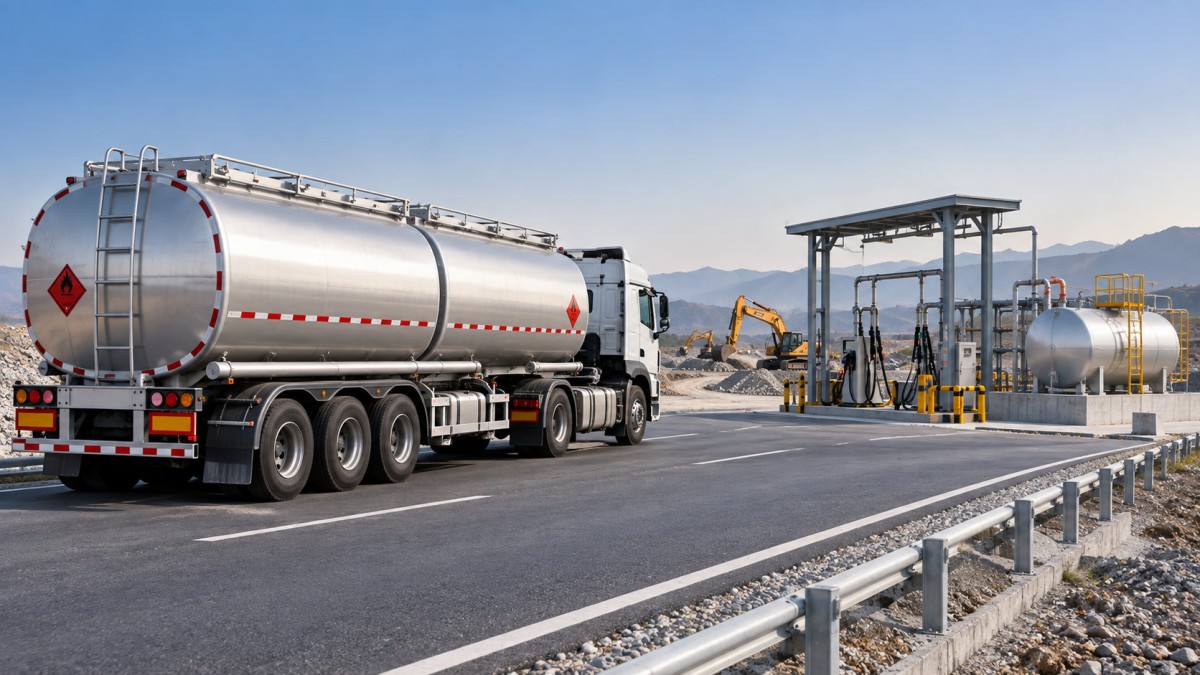
Do Not Treat Total Tank Capacity as Available Capacity
A frequent routing error is to plan from the tanker’s combined nominal capacity. For a two-compartment fuel tanker, the usable load for each delivery chain is limited by the compartment assigned to it. If one customer’s demand exceeds that compartment’s planned allocation, surplus space in the other compartment does not solve the problem unless the product and operating plan permit it.
Start with expected consumption between deliveries, then allocate a practical quantity to each compartment. Leave room for variation where site consumption is unpredictable. Construction projects are a typical example: equipment hours, generator use, weather disruptions, and shift changes can alter fuel draw without much notice.
A disciplined plan distinguishes between:
This is why route planning and loading planning should be done together. A dispatcher who sees only destinations may optimize kilometres while creating a poor fuel allocation. A loading team that sees only ordered volumes may fill the compartments efficiently but create a sequence that wastes driver hours.
Choose the Stop Sequence Carefully
There is no universal rule that the largest delivery must be first. The correct sequence depends on access, time commitments, unloading constraints, and the effect of each stop on the remaining load.
Delivering the more restrictive site first is often sensible. A mine entrance, active construction zone, or site with narrow delivery access may have limited entry windows. Missing that window can turn a short delivery into a long delay. By contrast, a depot or distribution point with more flexible receiving arrangements may be better placed later in the route.
However, the first stop should not leave the vehicle poorly balanced for a difficult road section or force the driver to carry an unsuitable residual quantity across a long distance. Route sequencing needs input from both the project schedule and the transport team. Map distance alone cannot account for road condition, vehicle access, queueing, site safety controls, or turnaround time.
Use Compartment Separation for Control, Not Just Convenience
For project managers, separate compartments can improve accountability. Each compartment can be tied to a delivery order, a site budget, or a fuel grade. That makes it easier to compare planned volume, delivered volume, and remaining stock at each location.
The control value is especially strong when a project has scattered fuel users. One compartment can support core operations, while the other serves smaller assets such as backup generators, remote pumps, temporary lighting, or support vehicles. The route is then planned around operational priority rather than around whichever request arrived first.
This arrangement is less suitable when most deliveries are consistently large, identical-product drops to a single destination. In that case, compartment division may limit load flexibility rather than improve it. A larger single-compartment road tanker can be the more practical choice for stable, high-volume point-to-point distribution.
For example, a fleet serving one major terminal or a single high-demand project may evaluate a 42 m³ Single-Compartment Carbon Steel Fuel Tanker instead of dividing the load. Its 42,000 L single-compartment configuration is aimed at a different routing pattern: moving one product in a larger consolidated load. The decision should follow the delivery profile, not an assumption that more compartments are always better.
Plan for the Site, Not Only the Road
Fuel delivery routes frequently fail at the final few hundred metres. A tanker may reach the project area on schedule but face soft ground, restricted turning space, overhead obstructions, poor vehicle separation, or an unavailable receiving tank. These conditions affect whether a stop belongs on a combined route.
Before placing a location on a regular tanker route, confirm the approach road, turning area, unloading position, communication method, and responsible receiver. For temporary projects, these details should be reviewed whenever site layout changes. A route plan that was workable during early construction can become unsuitable once materials, machinery, excavations, or new traffic controls occupy the access area.
Waiting time deserves the same attention. A small stop with uncertain receiving arrangements can consume more fleet capacity than a larger stop with a prepared unloading point. When one compartment is committed to that stop, the delay also holds the delivery planned for the other compartment.
Create Dispatch Rules for Mid-Route Changes
Fuel projects rarely operate with perfectly fixed demand. A site supervisor may request an urgent top-up after the tanker has departed, or an original delivery may be reduced because the receiving tank has less available space than reported. Without clear dispatch rules, drivers are pressured to make improvised allocation decisions.
Set the rules before the route begins:
- Identify which compartment, if any, may be used for approved unscheduled delivery.
- Define who can authorize a change in destination or delivered volume.
- Record the compartment balance after every discharge.
- Do not redirect product intended for another site without confirming that the remaining delivery can still be completed.
- Require the receiving location to confirm available tank capacity before a major route change.
These controls are not administrative extras. They protect the planned supply chain. A diverted load can leave a high-priority project without fuel, even when the fleet has moved the expected total volume that day.
What to Confirm Before Selecting the Tanker Layout
Start with several weeks of delivery records or a realistic forecast. Group orders by product, volume range, geography, access conditions, and delivery urgency. Then look for patterns. If routes repeatedly combine two compatible demand streams, a 20 m2 2-Compartment Fuel Tanker Truck can support a more controlled dispatch model. If most orders are one large delivery of one product, the route may favor a single-compartment tanker instead.
Shandong ORNN Vehicle Co., Ltd. manufactures tanker trailers and other semi-trailer equipment for fuel, chemical liquid, general cargo, and heavy-equipment transport. When configuring a tanker for operations in East Africa, West Africa, or Saudi Arabia, the route study should include local road conditions, tractor compatibility, site access, and the operating pattern of the fleet. Tank capacity matters, but the compartment layout, axle arrangement, and daily delivery sequence determine whether the vehicle improves the project’s fuel supply or simply adds another constraint.
A route plan is ready when each compartment has a defined load purpose, every scheduled stop has a workable unloading arrangement, and the dispatch team knows how to handle deviations without putting the remaining deliveries at risk.
Get Quote Form
Please complete the form below, and our product experts will contact you within one business hour. All inquiry details are kept strictly confidential and used solely to provide you with a precise solution.
✅ 24/7 Engineer Online Support | Ready for any technical inquiries.
✅ Full Export Documentation Support | We provide full set of shipping documents to ensure smooth customs clearance.
LOGO
This stunning beach house property is a true oasis, nestled in a serene coastal community with direct access to the beach.
Opening Hours
Monday - Friday : 9AM to 5PM
Sunday: Closed
Closed during holidays
Contact
+18888888888
hezuo@eyingbao.com123 West Street, Melbourne Victoria 3000 Australia
Request a Free Quote Today
Need mainstream models or custom specs? Our engineers are ready.
Contact us today for a lasting partnership!