


Products
News
- ▶ Which Custom Tanker Trailer Options Help Distributors Serve More End Users?
- ▶ Designing Custom Tanker Trailers for Remote Sites and Uneven Road Conditions
- ▶ Key Safety Specifications to Review Before Ordering a Custom Tanker Trailer
- ▶ Custom Tanker Trailer Buying Checklist: Tank Material, Capacity, and Axles
- ▶ What Buyers Should Know About 45m³ Single-Compartment Stainless Steel Oil Tanker Truck Configuration
Which Custom Tanker Trailer Options Help Distributors Serve More End Users?
A distributor can lose an otherwise qualified sale when the trailer on offer suits only one delivery pattern. A fuel retailer may need frequent drops to several stations, while an industrial buyer may want a large single-product load with fast unloading. A chemical operator may prioritize material compatibility and closed handling over maximum volume. These needs often appear in the same sales territory, yet they cannot be served well with one generic specification.
The Custom Tanker Trailer options that most effectively expand a distributor’s end-user coverage are usually not cosmetic additions. The strongest choices are those that change payload usability, product segregation, unloading method, safety control, axle suitability, and maintenance practicality. Before comparing purchase prices, distributors should identify which options let one platform serve a repeatable group of local transport jobs without creating unnecessary complexity.
Start with the delivery pattern, not the tank size
Capacity is often the first figure requested, but it is not the first decision to make. A larger tank can reduce trips on long-haul routes, yet it may be inefficient when the end user delivers small quantities across multiple locations. Tank volume should follow the likely route pattern, the available tractor capability, road conditions, legal operating limits, and the customer’s preferred delivery cycle.
For distributors, the useful question is: what load profile occurs most often among the buyers you want to serve? The answer usually falls into one of several practical categories:
- Single-product, high-volume transport: suited to a single-compartment tank where full capacity can be dedicated to one fuel or liquid.
- Multi-stop fuel distribution: better supported by several independently managed compartments, allowing separate product grades or controlled drop quantities.
- Industrial or remote-site supply: may require a balance between volume, pumping capability, hose arrangement, and access to uneven loading or unloading areas.
- Chemical liquid transport: requires the tank material, seals, valves, and cleaning approach to be assessed against the actual liquid, rather than selected from a fuel-trailer specification.
A distributor that stocks only the highest-capacity configuration may miss smaller operators that need flexibility more than total liters. Conversely, offering only compartmentalized units can add cost and operating complexity for buyers whose business is built around full loads of one product. The specification should match the route economics of the end user, not simply the largest available tank shell.
Compartment design creates different sales opportunities
Compartment count is one of the clearest ways to position tanker inventory for different buyer groups. More compartments can help an end user carry different products or allocate separate volumes for scheduled drops. This is valuable for fuel distributors supplying multiple stations or customers who cannot receive a full trailer load at one time.
However, extra compartments are not automatically better. Each partition affects usable volume, pipework layout, valve arrangements, inspection needs, and the operator’s loading discipline. A poorly matched multi-compartment design can leave capacity underused when a customer mainly carries one product. It can also increase the number of points that need careful operation during loading and discharge.
When discussing compartments with a buyer, ask what happens to the remaining volume after the first few delivery stops. This reveals whether the customer needs product separation, measured allocation, or simply a larger single load. It also prevents a distributor from recommending a layout that looks versatile on paper but does not fit the customer’s dispatch routine.
Unloading equipment can matter more than a larger tank
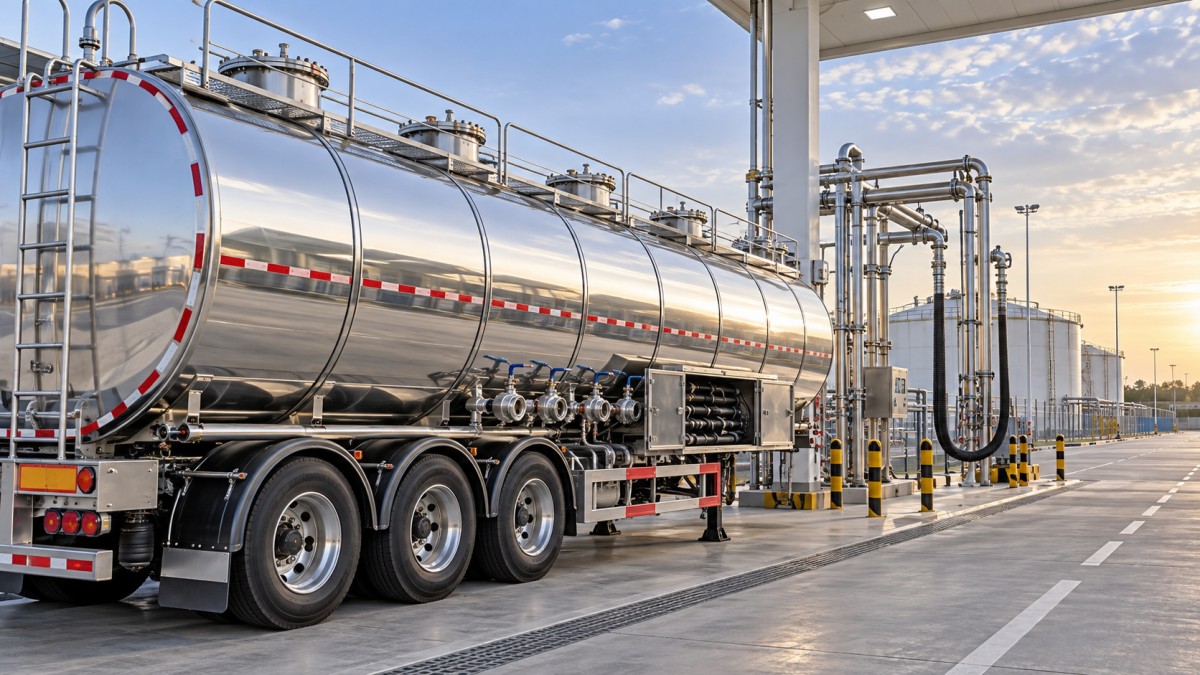
Two trailers with similar capacity may deliver very different value at the end-user level because their discharge systems are not the same. Some operators unload at terminals or sites with their own infrastructure. Others need the trailer to handle much of the transfer process. The second group may place more value on pump selection, power source, hose storage, discharge outlets, and valve accessibility than on a modest increase in capacity.
A distributor should clarify whether the end user will rely on gravity discharge, a pumping system, or both. Gravity discharge can be appropriate where site layouts and receiving equipment support it. Pump-assisted unloading may be needed where the receiving tank position, flow requirement, or site arrangement makes gravity transfer impractical. The pump must be suitable for the liquid being carried and aligned with the buyer’s operating process; adding a pump without confirming that process can produce avoidable cost and little practical benefit.
Look beyond the pump itself. Ask where hoses will be stored, how operators reach valves, whether connections are protected from road debris, and whether the customer needs separate discharge points for separate compartments. These details influence daily usability. They also affect how easily the dealer can explain the trailer’s value during a purchase discussion.
Material selection should follow the cargo, not a general preference
Material is sometimes treated as a simple choice between a lower initial purchase cost and a higher-grade tank body. In reality, the liquid type, contamination sensitivity, cleaning method, climate, and expected service pattern should guide the decision. A material that works well for one fuel application may not be appropriate for another liquid transport task.
For example, a stainless-steel tank configuration may be relevant where the intended cargo and operating requirements support that material choice. The tank thickness, end-plate construction, weld quality, fittings, and internal arrangement should be reviewed together rather than discussed as isolated specifications. The same principle applies to gaskets, manhole components, piping, valves, and pump-contact parts: the whole liquid-contact system matters.
Distributors should avoid promising that one material is universally superior. The better sales approach is to identify the cargo first, then confirm the material compatibility and cleaning requirements. This protects both the buyer and the distributor from a specification mismatch that may only become visible after the trailer enters service.
Chassis and suspension options determine where the trailer can work
End users operating on consistently paved highways may assess a tanker differently from operators serving depots, construction-linked sites, rural fuel stations, or roads with variable surfaces. Axle count, axle load rating, suspension type, tire specification, frame construction, and lift-axle availability all influence how a trailer fits its working environment.
A lift axle can be useful where operating conditions, maneuverability needs, or axle-load management make it relevant. Suspension selection also deserves a practical conversation. Air suspension can support ride behavior and load protection in some applications, while mechanical suspension may be preferred by operators who prioritize a familiar and straightforward maintenance approach. Neither should be presented as an automatic upgrade; road quality, workshop capability, operating loads, and fleet practice should shape the choice.
One configuration that illustrates a single-product transport direction is the 45 m³ Single-Compartment Stainless Steel Oil Tanker Truck. Its stated 45,000 L capacity, 4 mm stainless-steel tank and end plates, four 13-ton axles, lift axle, front-axle air suspension, rear mechanical suspension, and 13R22.5 tires may be relevant to buyers moving one fuel product in substantial volume. It is not a substitute for a multi-compartment retail-delivery layout, but it gives distributors a clear option for customers whose routes favor full-load, single-cargo transport.
Safety options should solve specific operating exposures
Safety equipment should be specified according to the loading, transport, parking, and unloading conditions the end user faces. Buyers may ask broadly for “more safety features,” but distributors can make the discussion more useful by connecting each option to a real exposure: spill control during discharge, access at the tank top, protection of valves and piping, visibility in traffic, emergency isolation, or stable parking during transfer.
Rather than building a long option list, confirm the working routine. Does the operator regularly unload at night? Are delivery sites congested? Is the trailer parked between runs in unsecured areas? Must personnel access top fittings frequently? The answers help determine the value of access arrangements, lighting, protective guards, emergency controls, hose management, and other application-specific provisions.
Local transport and hazardous-liquid requirements must also be confirmed before finalizing the order. Requirements can differ by cargo category and operating jurisdiction, and a trailer intended for cross-border movement may need additional review. A distributor should treat compliance confirmation as part of specification control, not as a document check after production choices have already been made.
Control the cost of options by separating “needed” from “nice to have”
Purchase cost becomes difficult to manage when every buyer request is accepted as an add-on without examining its operating purpose. A better approach is to group options into three decisions: features required for the cargo and route, features that reduce recurring operating friction, and features that are unlikely to be used often enough to justify their cost.
For instance, a multi-compartment arrangement may justify its added cost for a buyer delivering multiple fuel grades each day. It is less compelling for an operator who loads and discharges one product at a single depot. Similarly, upgraded suspension or a lift axle may be appropriate when the operating environment makes those features useful, but they should not be treated as universal specifications.
Distributors can reduce quotation revisions by collecting a short set of information before proposing a Custom Tanker Trailer:
- What liquid or liquids will be transported?
- Will each trip carry one product or several products?
- How many delivery points are typical on one route?
- Is unloading performed by gravity, by pump, or through site equipment?
- What road conditions, tractor configuration, and local axle limits apply?
- What maintenance support and replacement-part access does the buyer have?
These questions turn a broad request for a tanker into a specification that can be costed realistically. More importantly, they help distributors present a trailer as an operational fit rather than a collection of expensive options. The configurations most likely to reach more end users are the ones built around repeatable delivery needs: the right compartment layout, the correct liquid-contact materials, workable discharge equipment, and a chassis arrangement that suits the roads where the trailer will actually run.
Get Quote Form
Please complete the form below, and our product experts will contact you within one business hour. All inquiry details are kept strictly confidential and used solely to provide you with a precise solution.
✅ 24/7 Engineer Online Support | Ready for any technical inquiries.
✅ Full Export Documentation Support | We provide full set of shipping documents to ensure smooth customs clearance.
LOGO
This stunning beach house property is a true oasis, nestled in a serene coastal community with direct access to the beach.
Opening Hours
Monday - Friday : 9AM to 5PM
Sunday: Closed
Closed during holidays
Contact
+18888888888
hezuo@eyingbao.com123 West Street, Melbourne Victoria 3000 Australia
Request a Free Quote Today
Need mainstream models or custom specs? Our engineers are ready.
Contact us today for a lasting partnership!