


Products
News
- ▶ Which Custom Tanker Trailer Options Help Distributors Serve More End Users?
- ▶ Designing Custom Tanker Trailers for Remote Sites and Uneven Road Conditions
- ▶ Key Safety Specifications to Review Before Ordering a Custom Tanker Trailer
- ▶ Custom Tanker Trailer Buying Checklist: Tank Material, Capacity, and Axles
- ▶ What Buyers Should Know About 45m³ Single-Compartment Stainless Steel Oil Tanker Truck Configuration
Key Safety Specifications to Review Before Ordering a Custom Tanker Trailer
Key Safety Specifications to Review Before Ordering a Custom Tanker Trailer
Introduction: Before ordering a Custom Tanker Trailer, quality-control and safety managers should verify the specifications that directly affect containment, stability, compliance, maintenance, and emergency response.
The correct specification is not simply the highest capacity or lowest purchase price. It is a documented safety package matched to cargo properties, road conditions, loading practices, and operating regulations.
Fuel and chemical transport failures often begin with overlooked details: unsuitable tank material, weak weld inspection, poorly selected valves, inadequate braking performance, or unclear compartment isolation requirements.
A structured technical review before procurement helps protect drivers, cargo, surrounding communities, fleet assets, and the operator's compliance record throughout the tanker trailer's service life.
Start With Cargo Compatibility and Tank Construction
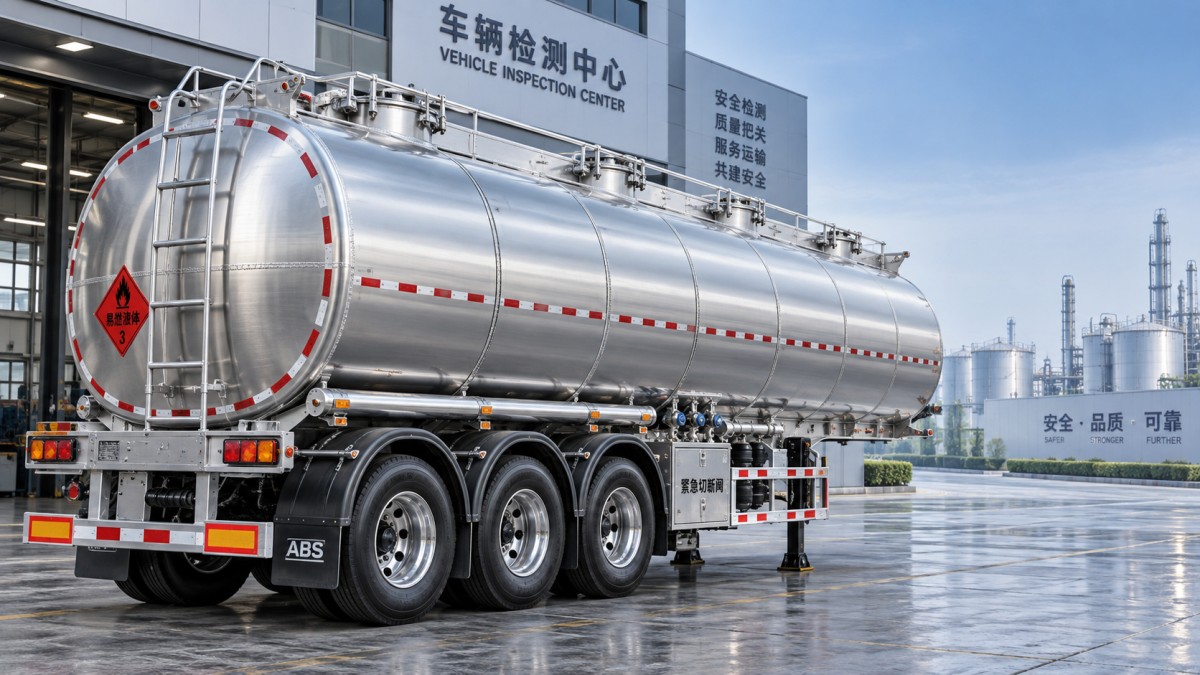
The first review question is simple: what liquid will the tanker carry, and how can its chemical, physical, and temperature characteristics affect the tank structure?
Fuel products, edible oils, corrosive chemicals, and volatile liquids require different material choices. Safety managers should confirm compatibility with the intended cargo and foreseeable cleaning chemicals.
Tank material thickness must be assessed together with alloy grade, corrosion allowance, design pressure, operating environment, and the manufacturer's documented fabrication process, rather than as an isolated number.
Aluminum alloy can reduce tare weight and improve payload efficiency, but the selected grade must provide appropriate corrosion resistance, strength, repairability, and service performance for the cargo.
For example, a 45 m³ 6-Compartment Aluminum Alloy Oil Tanker Semi-Trailer uses 5.5 mm 5454 aluminum alloy for its tank body and 7 mm material for end plates.
These figures are meaningful only when procurement teams also verify design calculations, forming methods, reinforcement layout, weld procedures, and inspection records for the completed tank.
Request material certificates showing alloy identification, thickness, mechanical properties, and traceability. Certificates should correspond to actual production batches, not only generic specification sheets or marketing brochures.
Quality teams should also clarify whether the tank is designed for atmospheric loading, pressure-assisted discharge, vacuum conditions during unloading, or any combination of these service situations.
Verify Welding Quality, Testing, and Traceability
Weld integrity is one of the most critical safety controls in a Custom Tanker Trailer because seams must withstand repeated vibration, liquid surge, thermal movement, and road impacts.
Ask the manufacturer which welding processes are used, whether welders are qualified, and how procedures are controlled for the exact tank material, thickness, and joint configuration.
Inspection requirements should cover visual examination, dimensional checks, leak testing, and appropriate non-destructive testing. The chosen test method should target credible defects in high-risk weld locations.
Particular attention is needed around longitudinal seams, circumferential seams, bulkhead connections, manhole collars, outlet assemblies, suspension brackets, and areas where structural attachments join the tank.
A reliable supplier should provide a clear quality dossier containing welding procedure specifications, welder qualification records, inspection reports, pressure or leak-test results, and final identification numbers.
Safety managers should define acceptance criteria before production begins. This prevents disputes when a trailer arrives with undocumented repairs, incomplete test evidence, or inconsistent component identification.
Traceability also supports future incident investigation and maintenance planning. When a defect appears, operators need to identify the material batch, repair history, inspection result, and responsible production record.
Do not accept statements such as “tested before delivery” without identifying the test medium, test pressure, holding period, inspection standard, test date, and responsible quality inspector.
Assess Compartment Design and Liquid Surge Control
Compartment configuration affects more than delivery flexibility. It changes load distribution, liquid movement, contamination risk, cleaning requirements, and the operational consequences of loading or unloading errors.
Each compartment should have a clearly stated capacity, filling limit, manhole arrangement, venting path, outlet control, and identification method suitable for the products it carries.
For multi-product distribution, independent compartments can reduce cross-contamination and support route efficiency. However, operators must ensure that loading instructions prevent axle overload after partial deliveries.
Internal baffles or surge-control arrangements deserve close attention. They limit liquid movement during braking, cornering, and lane changes, which directly affects stability and driver control.
Review the bulkhead design, opening sizes, sealing method, and inspection access. A poorly designed compartment partition can create hidden leakage paths or make cleaning and maintenance unsafe.
Six-compartment layouts may suit fuel distribution operations, but the capacity plan must match typical order sizes and local axle-load limits rather than maximizing compartment quantity alone.
Specify level control and overfill protection where applicable. These systems should be compatible with loading-terminal equipment and should remain reliable in dust, rain, vibration, and frequent operation.
Document the loading sequence for normal routes. A safe Custom Tanker Trailer specification considers real partial-load conditions, not only an evenly filled tank during laboratory-style calculations.
Review Chassis, Suspension, Braking, and Stability Controls
A sound tank can still become unsafe if its chassis and running gear are underspecified. Stability depends on the complete vehicle system, including axle placement and suspension behavior.
Confirm the gross vehicle weight rating, axle capacities, wheelbase, kingpin load, center-of-gravity assumptions, and legal road limits for the countries where the trailer will operate.
Braking specifications should identify brake type, axle configuration, ABS availability, air-system components, parking brakes, and maintenance requirements. Compatibility with the tractor unit must also be confirmed.
Three 13-ton axles with drum brakes and ABS can be appropriate for certain applications, but safety teams should validate the complete load calculation and regional compliance requirements.
Air suspension can improve ride quality and support load stability, especially on uneven roads. Its durability, air-line protection, leveling behavior, and spare-parts availability require equal scrutiny.
A front lift axle may improve tire management during suitable operating conditions, yet it must not encourage unsafe loading practices or reduce stability when the trailer is partially loaded.
Check tire size, load index, speed rating, rim specification, and regional service availability. Tire failures are frequently linked to incorrect inflation, overload, heat exposure, or unsuitable road conditions.
Request drawings that show brake lines, electrical routing, suspension brackets, protective guards, and clearance dimensions. These details help inspectors identify damage-prone areas before delivery.
Specify Rollover Protection and Emergency Equipment
Tanker trailer safety must account for events that cannot be completely prevented. Rollover protection and emergency equipment should limit release, fire, injury, and environmental damage after an incident.
Review the manhole cover design, gasket material, pressure-relief function, closure security, and rollover performance. Covers must remain sealed while still allowing safe inspection and maintenance access.
Bottom outlet valves require reliable protection because they are vulnerable during collisions or grounding. Specify emergency shutoff arrangements, valve guards, accessible controls, and clear operating instructions.
For fuel transport, consider flame arresters, grounding provisions, bonding points, fire extinguishers, warning markings, and emergency signage required by local laws and customer operating procedures.
Side guards, rear underrun protection, bumpers, ladder arrangements, walkways, and handrails should be evaluated as functional safety equipment, not as secondary accessories selected after production.
Access systems must allow drivers to inspect and operate the trailer without unnecessary fall exposure. Anti-slip surfaces, secure handholds, guarded ladders, and practical walkway layouts are essential.
Emergency equipment should be positioned for rapid use without placing personnel near likely leak points. Verify mounting strength, weather protection, inspection intervals, and replacement-part availability.
Ask suppliers to explain how the trailer protects valves, piping, electrical connections, and tank fittings during a rollover, curb strike, rear impact, or rough-road operation.
Turn Specifications Into a Pre-Delivery Acceptance Plan
The purchase order should convert safety expectations into measurable acceptance criteria. Vague phrases such as “high quality” provide little protection when the finished tanker reaches your inspection team.
Create a checklist covering drawings, materials, dimensions, weld records, compartment capacities, axle ratings, brakes, suspension, valves, emergency devices, markings, and final functional tests.
Include hold points during production for important inspections. Early verification of tank shell forming, bulkhead installation, welding, and pressure testing is more effective than correction after shipment.
Factory acceptance should include a physical inspection, document review, leak testing, brake-system verification, electrical checks, valve operation, suspension examination, and measurement against approved drawings.
Quality managers should also inspect workmanship details that affect serviceability, including drain points, hose routing, accessibility of maintenance parts, corrosion protection, and identification plate legibility.
Clarify which regulations, customer standards, and transport codes apply before placing the order. A trailer suitable for one market may require modifications for another jurisdiction or cargo category.
Supplier capability matters after delivery as well. Confirm warranty scope, spare-parts lead times, technical support channels, repair guidance, and availability of service documentation for fleet workshops.
A well-managed acceptance process creates evidence that the delivered trailer meets the agreed safety baseline, while giving operations teams a practical reference for future inspections and maintenance.
Conclusion: Specify Safety Before Capacity and Price
Before ordering a Custom Tanker Trailer, prioritize verified containment, stable running gear, documented fabrication quality, effective emergency protection, and compliance with the actual operating environment.
The most useful procurement decision is based on evidence: certified materials, approved drawings, inspection records, load calculations, tested safety systems, and a clear pre-delivery acceptance checklist.
When these requirements are defined early, quality-control and safety managers can reduce preventable transport risks while supporting reliable fuel, chemical, and liquid distribution operations over the trailer's lifecycle.
Get Quote Form
Please complete the form below, and our product experts will contact you within one business hour. All inquiry details are kept strictly confidential and used solely to provide you with a precise solution.
✅ 24/7 Engineer Online Support | Ready for any technical inquiries.
✅ Full Export Documentation Support | We provide full set of shipping documents to ensure smooth customs clearance.
LOGO
This stunning beach house property is a true oasis, nestled in a serene coastal community with direct access to the beach.
Opening Hours
Monday - Friday : 9AM to 5PM
Sunday: Closed
Closed during holidays
Contact
+18888888888
hezuo@eyingbao.com123 West Street, Melbourne Victoria 3000 Australia
Request a Free Quote Today
Need mainstream models or custom specs? Our engineers are ready.
Contact us today for a lasting partnership!