


Products
News
- ▶ Which Custom Tanker Trailer Options Help Distributors Serve More End Users?
- ▶ Designing Custom Tanker Trailers for Remote Sites and Uneven Road Conditions
- ▶ Key Safety Specifications to Review Before Ordering a Custom Tanker Trailer
- ▶ Custom Tanker Trailer Buying Checklist: Tank Material, Capacity, and Axles
- ▶ What Buyers Should Know About 45m³ Single-Compartment Stainless Steel Oil Tanker Truck Configuration
Custom Tanker Trailer Buying Checklist: Tank Material, Capacity, and Axles
A custom tanker trailer should be specified from the liquid outward, not from the chassis inward. The lowest quoted purchase price can become the highest operating cost if the tank material is unsuitable for the cargo, the usable volume does not match legal axle loads, or the running gear cannot tolerate local roads and service practices. The central buying question is therefore not “What capacity can this trailer carry?” but “What liquid can it carry safely, legally, repeatedly, and at what lifetime cost?”
For procurement, the specification needs to connect five decisions that are often handled separately: cargo compatibility, required delivery volume, compartment arrangement, axle-load distribution, and the standards applicable in the intended operating country. A tanker built for petroleum products is not automatically appropriate for edible liquids, corrosive chemicals, or temperature-sensitive dairy cargo, even where the nominal capacity is identical.
Start with the liquid, not the tank volume
“Tanker trailer” covers equipment with fundamentally different material, safety, cleaning, and loading requirements. Before requesting quotations, define the cargo in operational rather than generic terms: the exact product name, density range, viscosity, temperature at loading and discharge, water content, contamination sensitivity, corrosiveness, and whether it is regulated as dangerous goods.
This information determines the viable tank material and internal configuration. Carbon steel may be suitable for certain fuels and non-corrosive bulk liquids when properly specified and coated where needed. Aluminium can reduce tare weight in applications where material compatibility and local repair capability support its use. Stainless steel is generally selected where hygiene, corrosion resistance, product purity, or cleaning requirements are decisive, particularly for food-grade liquids and some chemical products.
Material selection should not stop at the shell description. Request confirmation of the following items in the technical offer:
- Tank shell, end plate, baffle, manhole, piping, valve, and weld material grades;
- Shell and end-plate thicknesses, including any corrosion allowance where relevant;
- Internal surface finish and weld treatment for hygienic service;
- Compatibility of seals, gaskets, hoses, and valve seats with the transported liquid;
- Whether dissimilar-metal connections may create corrosion or maintenance concerns;
- Cleaning method required between loads and accessibility of internal components.
A common cost error is comparing tank shell thickness without comparing material grade or duty cycle. A thicker but unsuitable steel tank is not a substitute for a correctly specified stainless grade. Conversely, specifying premium corrosion resistance for a stable, non-corrosive cargo can add capital cost and tare weight without improving the commercial outcome. Material choice should reflect the actual cargo list expected over the trailer’s service life, not only the first contract.
Capacity is constrained by density and legal gross weight
Tank capacity is usually stated in litres or cubic metres, but procurement decisions must be based on payload mass. The same 40 m³ tank can be within legal limits with a lower-density liquid and overloaded with a denser product. The basic calculation is straightforward:
Payload mass = usable liquid volume × liquid density
The result must then be added to the trailer tare weight and tractor weight where local gross combination limits apply. It also has to remain within axle and group-load limits, not merely below the overall legal gross weight. A specification that works on paper at maximum gross weight may still create overload risk on the tractor drive axles, trailer axle group, or steer axle because of tank geometry and fifth-wheel placement.
Ask the supplier to provide a load-distribution calculation for the intended tractor configuration, kingpin setting, suspension height, tyre size, and maximum product density. This calculation should distinguish between a full load and practical partial-load conditions. A tank partly filled without correctly designed compartments or surge control can shift its effective centre of gravity and affect braking stability.
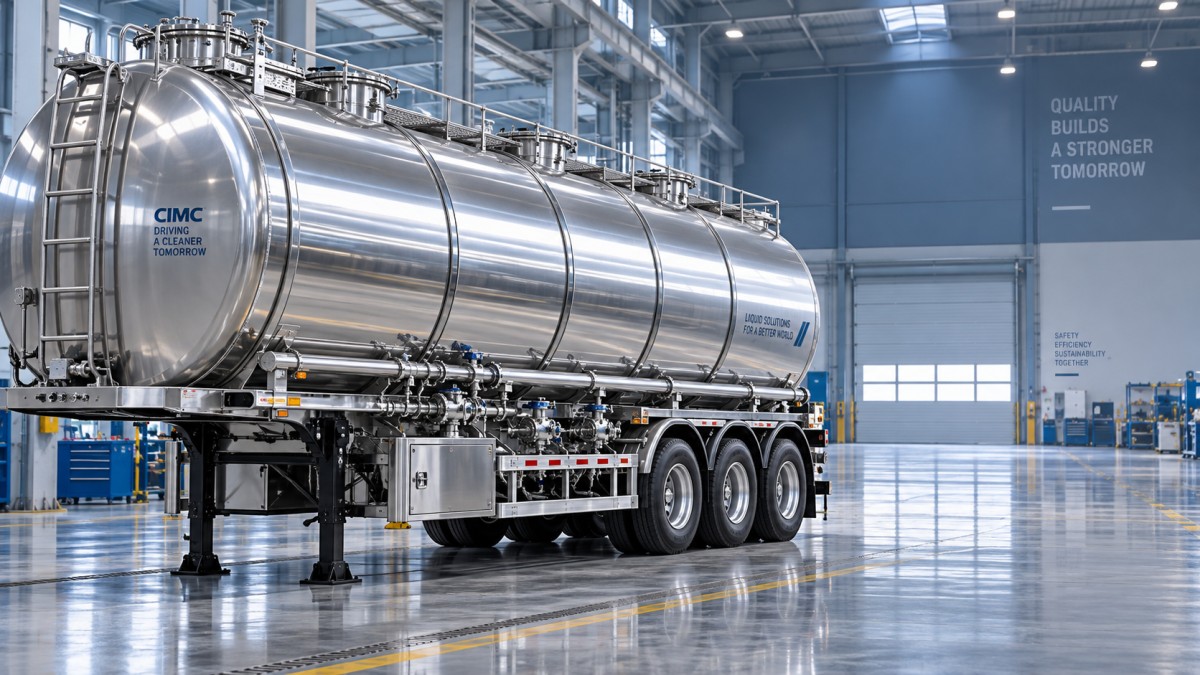
Usable capacity also differs from nominal capacity. Expansion space, product operating temperature, compartment layout, and safe filling limits reduce the liquid volume that can be loaded in normal service. For temperature-sensitive products, thermal expansion and insulation performance may matter as much as the headline litre figure. A quotation should state gross tank volume, working volume, compartment volumes, and the assumptions used for each.
Compartment design affects both revenue flexibility and operating control
More compartments allow different grades or deliveries to be carried on one route, but they reduce layout simplicity and add valves, piping, cleaning points, and potential leakage locations. The right number is driven by delivery pattern, not by a general preference for multi-compartment tanks.
For fuel distribution, segregated compartments can support multiple product grades or customer drops. For food-grade service, compartments can help separate batches, but each additional chamber needs to be cleanable, drainable, and protected from cross-contamination. For chemical service, cargo segregation must be assessed against the specific substances and cleaning procedures rather than assumed from physical separation alone.
Baffles deserve equal attention. Their function is to limit liquid surge during acceleration, braking, and cornering. The design must balance stability with cleanability and drainage. Poorly considered internal arrangements can leave residual liquid after discharge, complicate washing, and create product loss or contamination concerns. Drawings should show compartment dimensions, baffle positions, access openings, discharge points, and slope toward outlets.
Axle configuration is a route-specific decision
Axle count alone does not define carrying capability. The trailer’s legal and practical payload depends on axle spacing, suspension type, tyre load rating, braking system, kingpin load, road restrictions, and tractor-trailer combination. A tri-axle tanker may suit higher payload operations, but it is not automatically the best choice where routes include narrow compounds, weak paved surfaces, frequent tight turns, or limits on axle-group loading.
Fixed mechanical suspension is often valued for simplicity and familiarity in demanding repair environments. Air suspension can improve ride quality, protect sensitive cargo systems, assist dock and loading-height control, and support lift-axle functions where permitted and useful. It also introduces additional valves, air lines, and maintenance dependencies. The correct decision depends on route quality, workshop capability, spares availability, and the commercial value of reduced tyre wear or improved cargo protection.
Clarify whether axle ratings are design ratings or approved operating ratings under the applicable regulations. Also request component make and model details rather than accepting broad references to “heavy-duty axles.” The same discipline applies to brakes, tyres, landing gear, kingpin, rims, and suspension. These are service-critical components, and a low initial price may conceal weak availability of replacement parts in the operating region.
Safety equipment must match the loading and discharge method
Tank safety is not limited to a manhole cover and rear bumper. The equipment package should follow the product hazard and operating process: top loading or bottom loading, gravity discharge or pump discharge, depot loading or field delivery, and the expected level of operator interaction.
For flammable liquids, the specification may need provisions such as suitable earthing arrangements, emergency shut-off functionality, protected piping, vapour-control interfaces where required, and appropriate fire-safety equipment. The exact legal requirements depend on the jurisdiction and cargo classification, so they should be checked against the destination country’s transport, roadworthiness, and dangerous-goods rules before the purchase order is released.
For food and dairy applications, the focus shifts toward hygienic construction, sealed access points, insulation, temperature management where specified, and cleaning compatibility. Insulation should be evaluated by its construction and expected operating conditions, not simply by the presence of an insulated outer skin. Procurement should ask what insulation material is used, how it is protected from moisture ingress, how external cladding is joined, and whether the design permits inspection and repair after damage.
A configuration such as the 20 m³ Stainless Steel Insulated Milk Tanker Truck illustrates why application-specific review matters. Its 20,000 L capacity, three compartments, 316L stainless-steel tank construction, and tri-axle air suspension are meaningful only when assessed against milk collection routes, hygienic cleaning requirements, loading density, milk-run delivery pattern, and the available maintenance support for the suspension and braking system. The same capacity and axle count would not automatically be the right specification for fuel or chemical transport.
Compare quotations on delivered specification, not headline price
A custom tanker trailer quotation should be converted into a comparison sheet with identical technical and commercial fields. This prevents a lower figure from appearing competitive simply because critical items have been omitted or described vaguely. The comparison should include tank dimensions, material certificates where applicable, capacities, compartment arrangement, running gear brands and ratings, brake configuration, piping and valve types, safety accessories, paint or cladding system, testing scope, documentation, warranty terms, and delivery conditions.
Commercial terms require the same scrutiny. Confirm whether the quoted price includes design approval drawings, pre-delivery inspection, pressure or leak testing where applicable, shipping preparation, spare parts, commissioning support, and export documentation. When equipment will be imported, responsibility for conformity documents, customs classification, port handling, inland transport, and destination-country registration should be unambiguous.
Warranty language should identify covered components, exclusions for consumables, claim procedure, labour responsibility, and parts lead time. A long warranty period has limited value if replacement valves, seals, brake parts, or suspension components cannot be sourced promptly. For fleet use, an initial spare-parts package often deserves consideration, particularly for proprietary fittings or parts with long import lead times.
Review the manufacturer’s engineering control before committing
Custom work creates specification risk at the drawing stage. Before production, the approved drawing package should show the tank layout, structural arrangement, axle positions, kingpin location, piping route, valve arrangement, access equipment, electrical system, and overall dimensions. Any deviation from the agreed specification should require written approval rather than being handled as a production-side substitution.
Inspection points should be agreed before manufacture starts. Depending on the tank type and applicable requirements, these may include material traceability, weld inspection, dimensional checks, pressure or leak testing, suspension and brake installation checks, and final function testing of valves and safety equipment. The objective is not to impose paperwork for its own sake; it is to ensure that the delivered tanker corresponds to the operating assumptions used to select it.
The strongest purchase decision is one that ties tank material to actual chemical or food compatibility, capacity to density and legal loading, axles to route conditions, and price to the full delivered specification. That approach reduces the chance of buying a trailer that is inexpensive at delivery but restrictive, non-compliant, or costly to keep in service.
Get Quote Form
Please complete the form below, and our product experts will contact you within one business hour. All inquiry details are kept strictly confidential and used solely to provide you with a precise solution.
✅ 24/7 Engineer Online Support | Ready for any technical inquiries.
✅ Full Export Documentation Support | We provide full set of shipping documents to ensure smooth customs clearance.
LOGO
This stunning beach house property is a true oasis, nestled in a serene coastal community with direct access to the beach.
Opening Hours
Monday - Friday : 9AM to 5PM
Sunday: Closed
Closed during holidays
Contact
+18888888888
hezuo@eyingbao.com123 West Street, Melbourne Victoria 3000 Australia
Request a Free Quote Today
Need mainstream models or custom specs? Our engineers are ready.
Contact us today for a lasting partnership!