


Products
News
- ▶ Which Custom Tanker Trailer Options Help Distributors Serve More End Users?
- ▶ Designing Custom Tanker Trailers for Remote Sites and Uneven Road Conditions
- ▶ Key Safety Specifications to Review Before Ordering a Custom Tanker Trailer
- ▶ Custom Tanker Trailer Buying Checklist: Tank Material, Capacity, and Axles
- ▶ What Buyers Should Know About 45m³ Single-Compartment Stainless Steel Oil Tanker Truck Configuration
Designing Custom Tanker Trailers for Remote Sites and Uneven Road Conditions
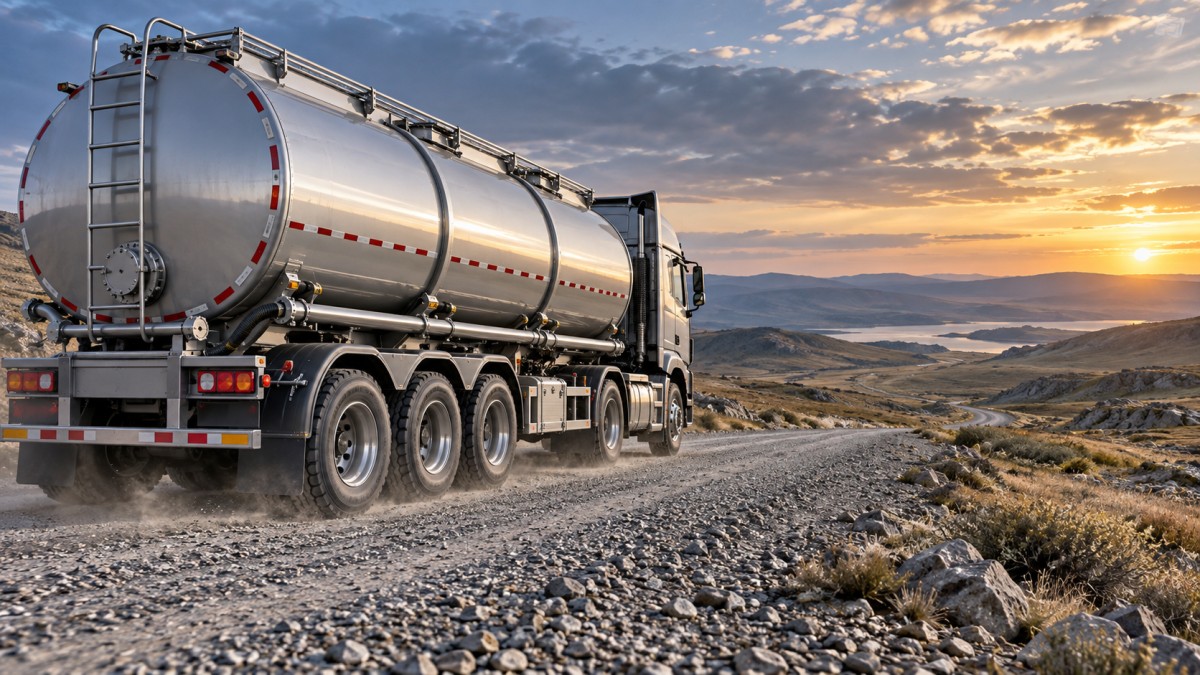
Remote fuel and liquid supply routes expose tanker trailers to forces that are rarely visible on a paved-road specification sheet: repeated frame twist on rutted tracks, abrupt wheel drops at washouts, high center-of-gravity movement on side slopes, and long distances between inspection points. A Custom Tanker Trailer for this work begins with the route rather than nominal tank capacity. The tank, chassis, suspension, axle arrangement, and discharge layout must work as one system under the actual road profile and loading cycle.
Uneven roads do not apply a single large impact; they create thousands of smaller load reversals. A trailer that appears adequate when parked at full capacity may develop mounting stress, suspension looseness, tire damage, or compartment surge problems after repeated travel over corrugation and soft shoulders. The design objective is stable liquid containment and controlled load transfer, without adding unnecessary dead weight that reduces usable payload.
Start with the route and delivery cycle
Route assessment should distinguish between isolated rough sections and a route that remains poor for most of the trip. A short construction access road may justify localized protection around vulnerable components. A long unsealed route changes the basis for chassis strength, suspension travel, tire selection, tank compartmenting, and maintenance access.
Useful route inputs include the steepest approach and departure angles, recurring cross-fall, surface type, expected pothole or rut depth, turning space at the delivery point, bridge or culvert restrictions, and whether the trailer will queue while fully loaded on uneven ground. Seasonal changes deserve attention as well. A firm dry track can become deeply rutted after rain, while loose sand may require a different tire pressure practice and recovery plan than compacted gravel.
The delivery cycle matters as much as the route. A tanker that regularly departs partly loaded behaves differently from one that is consistently full. Partial loads create free-surface movement inside each compartment, which can shift longitudinally during braking or laterally on a cambered track. Multiple drops on one run also change axle loading as compartments empty. These conditions should be mapped before selecting compartment sizes and discharge sequencing.
Tank geometry and compartment arrangement
A larger volume does not automatically suit a remote project. Total capacity must remain compatible with permitted gross combination weight, tractor capability, road geometry, and the ability to control liquid surge. For oil transport, longitudinal baffles and correctly arranged compartments reduce the distance over which liquid can move during acceleration, braking, and changes in grade. Their arrangement should support the intended products and delivery sequence rather than merely divide the stated volume into equal sections.
Three compartments can be practical where separate grades or delivery points are required, but compartment volume needs to be reviewed against axle loading throughout unloading. Emptying the forward or rear compartment first can materially change kingpin and axle-group loads. A discharge order that is convenient at the site may create an unfavorable weight shift on the return journey if no planning rule exists.
Tank shell thickness should never be read as a standalone measure of durability. Shell material, end-plate thickness, vessel diameter, saddle spacing, reinforcement placement, baffle attachment, and welding quality all affect how the tank responds to road-induced flexing. Carbon steel remains appropriate for many petroleum applications when the cargo compatibility, corrosion environment, coating approach, and maintenance practice are aligned. Areas around saddles, manholes, outlet connections, and baffle interfaces deserve particular scrutiny because local stress tends to concentrate there.
Chassis stiffness must be balanced with controlled movement
A remote-road trailer needs a chassis that resists permanent deformation while allowing the suspension to articulate over uneven ground. Excessive rigidity in one part of the assembly can transfer stress into another part, especially where the tank is supported on saddles. The aim is to manage frame deflection and prevent uncontrolled relative movement between tank and chassis, not to make every component as stiff as possible.
Cross-members, main beam design, suspension brackets, landing gear mounting zones, and rear bumper supports should be reviewed against the actual points where the trailer is likely to strike, twist, or be pulled during recovery. Reinforcement is valuable when it addresses a defined load path. Adding plate indiscriminately increases tare weight and can create abrupt stiffness transitions that concentrate fatigue loads at the edge of a reinforced area.
Heavy-duty mechanical suspension is often selected for demanding routes because it is straightforward to inspect and repair where specialized service facilities are limited. Its suitability depends on correct equalization, bushing condition, hanger alignment, and the ability of the suspension to keep tires in contact with an irregular surface. A reinforced arrangement with 70 mm suspension pins, for example, should still be assessed as part of the full bracket, pin, bushing, and beam system. Pin diameter alone does not establish off-road durability.
Air suspension may offer ride benefits on certain routes, but it requires reliable air-system maintenance and protection from damage. The choice should reflect access to parts, the severity of track conditions, expected repair intervals, and the tractor-trailer operating discipline. Mixing suspension assumptions with an unsuitable axle or tire configuration commonly leads to uneven tire wear and recurring alignment problems.
Axles, tires, and ground clearance work together
Axle capacity describes only one limit. Three 13-ton axles, for example, must be evaluated with the tank's loaded center of gravity, fifth-wheel load, suspension ratings, wheel-end components, tire load index, and the distribution of cargo across compartments. A configuration can appear adequate in total rated capacity while placing an unfavorable load on one axle group during travel or unloading.
Wide-base tires such as 385/65R22.5 can be useful where flotation, stability, and tire availability support their use. Their performance is influenced by wheel fitment, inflation management, surface sharpness, sidewall exposure, and axle alignment. A larger tire does not solve poor ground clearance if the lowest components remain outlet valves, pipework, landing gear braces, or rear protection members. Conversely, increasing ride height without considering center-of-gravity effects can reduce stability on cross-slopes.
Ground clearance should be assessed at full suspension compression, not only with an empty trailer on level ground. Inspect the likely contact points during a crest transition: rear lower pipework, landing gear, spare-wheel carrier, discharge manifolds, and mudguard supports are frequent concerns. Protective routing and guarded valves are usually more useful than a heavy external structure that blocks access for inspection or repair.
Protect the liquid system without making it difficult to service
Remote-site operation exposes hoses, valves, fittings, and electrical connections to dust, vibration, standing water, and accidental contact with terrain. The liquid system should use a layout that keeps exposed components above the likely strike zone while leaving clear access for draining, isolation, and leak inspection. Valve guards need drainage openings; enclosed guards that trap mud and moisture can accelerate corrosion and conceal small leaks.
Pipe supports deserve the same attention as the pipe itself. Long unsupported runs transmit vibration into threaded connections, flanges, and valve bodies. Supports should prevent chafing while allowing for controlled movement caused by frame flex. Hoses need secure stowage away from hot surfaces, sharp edges, and tire spray. Electrical conduit should be clamped at suitable intervals and protected where it crosses structural members.
Dust ingress is often mistaken for a simple housekeeping issue. Fine dust can obscure seepage around fittings, hide cracks near brackets, and contaminate cap seals. A practical inspection routine uses cleaned surfaces around critical joints, followed by reinspection after a representative run. This separates an active leak from residue left by filling or prior maintenance.
Use a loading condition matrix before approving drawings
Approved design drawings should reflect several real operating states, not just a single full-load view. Review the trailer at full load, each likely partial-load combination, empty return condition, maximum steering angle, suspension articulation, and the planned discharge sequence. The review should also include tractor coupling height and landing gear clearance on the site surface.
- Full tank on rough ground: confirms clearance, tank support loads, and the expected suspension working range under maximum mass.
- Partly filled compartments on slopes: exposes liquid surge and axle-load shifts that a total-capacity calculation cannot show.
- Site unloading position: verifies that hose paths, valve access, and drain points remain usable without placing equipment in a wheel track or low drainage area.
- Empty travel back over the same route: identifies components that rattle, over-articulate, or suffer impact when the suspension response changes with reduced mass.
A configuration such as the 34 m³ 3-Compartment Carbon Steel Oil Tanker illustrates why specification items must be read together. Its 34,000 L capacity, 4 mm carbon-steel tank shell, 5 mm end plates, three compartments, three 13-ton axles, and 385/65R22.5 tires form a defined starting arrangement. Whether it suits a particular remote route still depends on cargo density, legal loading limits, saddle design, drawbar height, discharge requirements, terrain clearance, and the compartment loading plan.
Prevent fatigue through early inspection points
Remote-road damage often begins as a small movement rather than an immediate failure. Fresh paint cracking around brackets, polished metal at clamp interfaces, a recurring loose fastener, uneven tire shoulder wear, or damp dust accumulating at a fitting can reveal a developing problem. Inspection intervals should be linked to route severity and early operating experience, with attention focused on tank saddles, suspension hangers, axle alignment, pipe supports, landing gear mounts, and electrical clamps.
After the first period of operation on a new route, it is useful to compare left and right tire temperatures after travel, verify fastener retention, inspect bushing displacement, and examine the tank-to-chassis interfaces for rubbing. These observations are more actionable when recorded against load state and route condition. A defect found only on fully loaded runs points toward a different cause than one that appears during empty returns.
A well-designed Custom Tanker Trailer does not remove the constraints of a poor road. It makes those constraints visible in the specification: where mass is carried, how liquid moves, which components need protection, and where routine inspection can catch movement before it becomes a delivery interruption.
Get Quote Form
Please complete the form below, and our product experts will contact you within one business hour. All inquiry details are kept strictly confidential and used solely to provide you with a precise solution.
✅ 24/7 Engineer Online Support | Ready for any technical inquiries.
✅ Full Export Documentation Support | We provide full set of shipping documents to ensure smooth customs clearance.
LOGO
This stunning beach house property is a true oasis, nestled in a serene coastal community with direct access to the beach.
Opening Hours
Monday - Friday : 9AM to 5PM
Sunday: Closed
Closed during holidays
Contact
+18888888888
hezuo@eyingbao.com123 West Street, Melbourne Victoria 3000 Australia
Request a Free Quote Today
Need mainstream models or custom specs? Our engineers are ready.
Contact us today for a lasting partnership!