


Products
News
- ▶ Evaluating Compartment Split Ratios in a 20 m2 Fuel Tanker Truck
- ▶ What Can a 20 m2 2-Compartment Fuel Tanker Truck Carry on One Delivery Run?
- ▶ Which Custom Tanker Trailer Options Help Distributors Serve More End Users?
- ▶ Designing Custom Tanker Trailers for Remote Sites and Uneven Road Conditions
- ▶ Key Safety Specifications to Review Before Ordering a Custom Tanker Trailer
Evaluating Compartment Split Ratios in a 20 m2 Fuel Tanker Truck
A two-compartment fuel tanker is often specified as “20 m2” in informal purchase requests, although tanker volume should normally be confirmed in cubic metres (m³) or litres. Before comparing split ratios, establish whether the requested capacity means 20 m³ nominal tank volume, 20,000 litres calibrated delivery volume, or another local convention. That distinction affects legal payload, axle loading, and the usable capacity of each compartment.
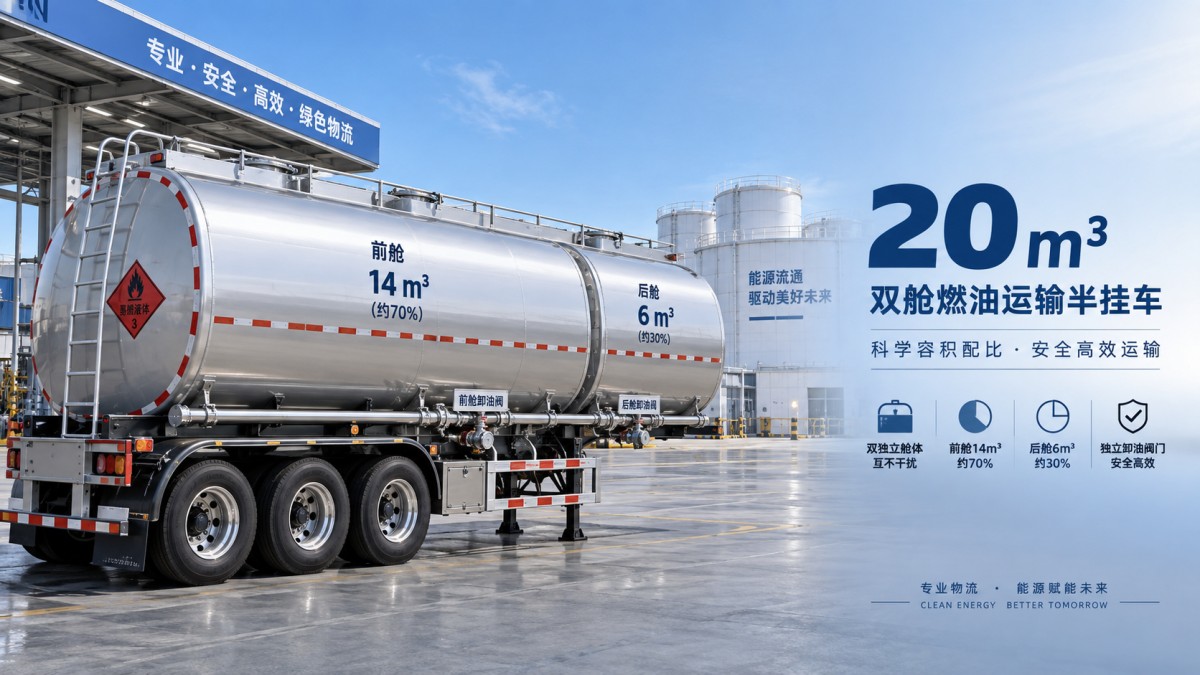
The core purchasing decision is simple: the best split ratio is not the most even one; it is the ratio that matches the products, typical order sizes, and unloading sequence on the intended route. A 20 m³ two-compartment tanker may work well as 10,000 L + 10,000 L for similar-volume deliveries, but a 12,000 L + 8,000 L or 14,000 L + 6,000 L layout can reduce partial loads when one fuel grade consistently moves faster than the other. The wrong ratio can leave a truck returning with one compartment partly full while the other product is repeatedly short.
Start with the delivery pattern, not the tank drawing
Procurement teams sometimes begin by requesting two equal chambers because the design is easy to describe. Equal volume is practical only when both compartments are expected to carry comparable quantities and are replenished at similar intervals. In fuel distribution, that is not always the operating reality.
A tanker carrying petrol and diesel, for example, may see different demand profiles by location, season, customer type, or depot allocation. A fleet serving stations may need one larger compartment for the consistently higher-volume grade. A distributor making mixed deliveries to smaller sites may value a more balanced split because it avoids carrying too much of a single product. The split should therefore be based on dispatch records or expected order bands rather than on an assumed preference for symmetry.
For a 20 m2 2-Compartment Fuel Tanker Truck, ask the operations team to identify the following before finalizing the chamber volumes:
- Which two products will normally be transported, and whether they can ever change during the tanker’s service life.
- The usual quantity delivered per stop for each product.
- Whether the vehicle makes one large delivery, several medium deliveries, or multiple small drops per route.
- How frequently each grade is loaded as a full compartment versus topped up or dispatched as a partial load.
- Whether depot loading racks, site tanks, meters, hoses, and couplings impose separate product-handling requirements.
How common split ratios behave in service
These examples are capacity concepts, not final construction dimensions. Actual volumes must allow for the agreed tank design, calibration method, internal fittings, manhole arrangement, baffles or surge-control features, and the applicable requirement for maximum filling level. Buyers should not assume that a nominal 20 m³ shell produces exactly 20,000 litres of saleable or calibrated delivery capacity.
The hidden cost of an unsuitable ratio
The most visible consequence is poor load utilization. A dispatcher may have enough total fuel volume on board but still be unable to fulfil an order because the required grade is trapped in the smaller compartment. The vehicle then makes an additional trip or returns with an unusable residual quantity. This is especially relevant where loading terminal access, driver time, or delivery windows are constrained.
Split ratio also affects product segregation. Each compartment needs a clearly separated product path: suitable loading points, outlet valves, discharge piping, hose management, and identification. A larger chamber does not simply hold more liquid; it may require a discharge arrangement that supports its intended delivery rate without making the smaller compartment awkward to empty. Procurement specifications should state whether each compartment requires independent bottom loading, top loading, separate outlet connections, meter compatibility, or dedicated hose stowage.
Another concern is vehicle balance. Tank engineers determine the location and shape of compartments so that loaded axle weights remain within the approved design and local road limits. Buyers should avoid treating the ratio as only a commercial volume choice. A 14 m³ front chamber and 6 m³ rear chamber will not behave like the reverse arrangement. The compartment sequence, bulkhead positions, suspension configuration, kingpin loading, and axle group all need review against the fully loaded and partly discharged conditions.
Nominal capacity, payload, and density must be checked together
Fuel is generally lighter than water, but its density varies by product and temperature. The vehicle’s permitted gross weight, tare weight, and axle limits determine how much can legally be carried. A nominal 20 m³ tanker may be volume-limited in one application and weight-limited in another, depending on the transported liquid and the chassis-tank combination.
Ask for the manufacturer’s weight schedule showing at least the empty trailer mass, designed gross combination assumptions, axle capacities, kingpin load, and anticipated loading condition. Do not approve a compartment ratio solely from a litre calculation. A design that appears efficient at full volume may require a lower fill level if axle loading becomes excessive under the actual tractor and road regulations.
This is also where material selection becomes relevant. Aluminum alloy tanks can reduce tare weight compared with steel construction, which may be useful where legal payload margin is tight. The benefit still needs to be evaluated against the full specification, intended fuel type, maintenance conditions, and local approval requirements; lower tare weight does not remove the need for an axle-load calculation.
A practical approval sequence for procurement
- Define the products and route mix. State the normal fuel grades, expected quantity range per delivery, and whether the vehicle is dedicated to two products or must remain adaptable.
- Select a provisional split. Use actual dispatch patterns where available. If demand is uncertain, avoid an extreme ratio that limits future use.
- Confirm compartment order and discharge arrangement. Identify which chamber sits forward or rearward, each outlet location, valve type, loading system, and product-separation method.
- Request a drawing and volume schedule. The approved design should show nominal and calibrated capacities, bulkhead positions, manholes, piping, and relevant chassis dimensions.
- Review loaded and partially unloaded axle conditions. This is essential when one compartment is much larger, because delivery sequence can change weight distribution.
- Match the tanker to local requirements. Confirm the applicable rules for petroleum transport, safety equipment, markings, grounding provisions, emergency shut-off arrangements, inspection, and calibration.
When a two-compartment layout is the wrong answer
Two compartments are efficient when the operator mainly distributes two grades in predictable proportions. They become restrictive when routes need three or more products, when customers frequently request sharply different combinations, or when low-volume specialty products must remain segregated. In those cases, additional compartments may reduce residual stock and improve route flexibility, although each extra chamber adds operational complexity and can reduce the maximum quantity available for one product.
For fleets that also operate higher-capacity units, a multi-compartment tanker can be a useful comparison point. For example, the 40 m³ 5-Compartment Aluminum Alloy Oil Tanker Semi-Trailer uses a 5454 aluminum alloy tank and a tri-axle configuration. Its five-compartment layout is designed for a different distribution profile: more separated product allocations and greater total capacity, rather than replacing the simpler route logic of a 20 m³ two-compartment unit.
Questions that should be resolved before issuing the purchase order
Confirm whether “20 m³” refers to gross geometrical volume or calibrated compartment volume. Specify the target split in litres, not only as a percentage. Require the supplier to show the permitted fill level, compartment positions, tank material, shell and end-plate details where relevant, chassis and suspension arrangement, and the expected axle-load distribution. Also define the exact fuel products, because compatibility of seals, valves, hoses, and internal treatment should be aligned with the intended cargo.
A well-chosen split ratio should let the vehicle leave the depot with both compartments near their practical load level, complete its normal delivery sequence without product shortage, and remain compliant as each chamber is discharged. That is a more reliable purchasing standard than choosing two equal compartments by default.
Get Quote Form
Please complete the form below, and our product experts will contact you within one business hour. All inquiry details are kept strictly confidential and used solely to provide you with a precise solution.
✅ 24/7 Engineer Online Support | Ready for any technical inquiries.
✅ Full Export Documentation Support | We provide full set of shipping documents to ensure smooth customs clearance.
LOGO
This stunning beach house property is a true oasis, nestled in a serene coastal community with direct access to the beach.
Opening Hours
Monday - Friday : 9AM to 5PM
Sunday: Closed
Closed during holidays
Contact
+18888888888
hezuo@eyingbao.com123 West Street, Melbourne Victoria 3000 Australia
Request a Free Quote Today
Need mainstream models or custom specs? Our engineers are ready.
Contact us today for a lasting partnership!