


Products
News
- ▶ Avoiding Palm Oil Solidification During Long-Haul Tanker Transportation
- ▶ Cleaning Standards for Food-Grade Stainless Steel Palm Oil Tanker Trailers
- ▶ Estimating Heat Loss and Delivery Costs for 38 m3 Palm Oil Tanker Routes
- ▶ Stainless Steel Grades to Compare for a 38 m3 Insulated Palm Oil Tanker
- ▶ Why Insulation Matters When Transporting Palm Oil in a 38 m3 Tanker
Avoiding Palm Oil Solidification During Long-Haul Tanker Transportation
A palm oil shipment can look perfectly routine when it leaves the loading terminal: clean product, documented temperature, sealed manholes, and a scheduled delivery window. The risk often emerges several hundred kilometres later. Overnight cooling, long queues at a border crossing, an unplanned stop, or a poorly insulated shell can pull the cargo temperature below its workable range. What arrives is no longer a freely flowing liquid, but a partially solidified load that takes time, energy, and careful handling to recover.
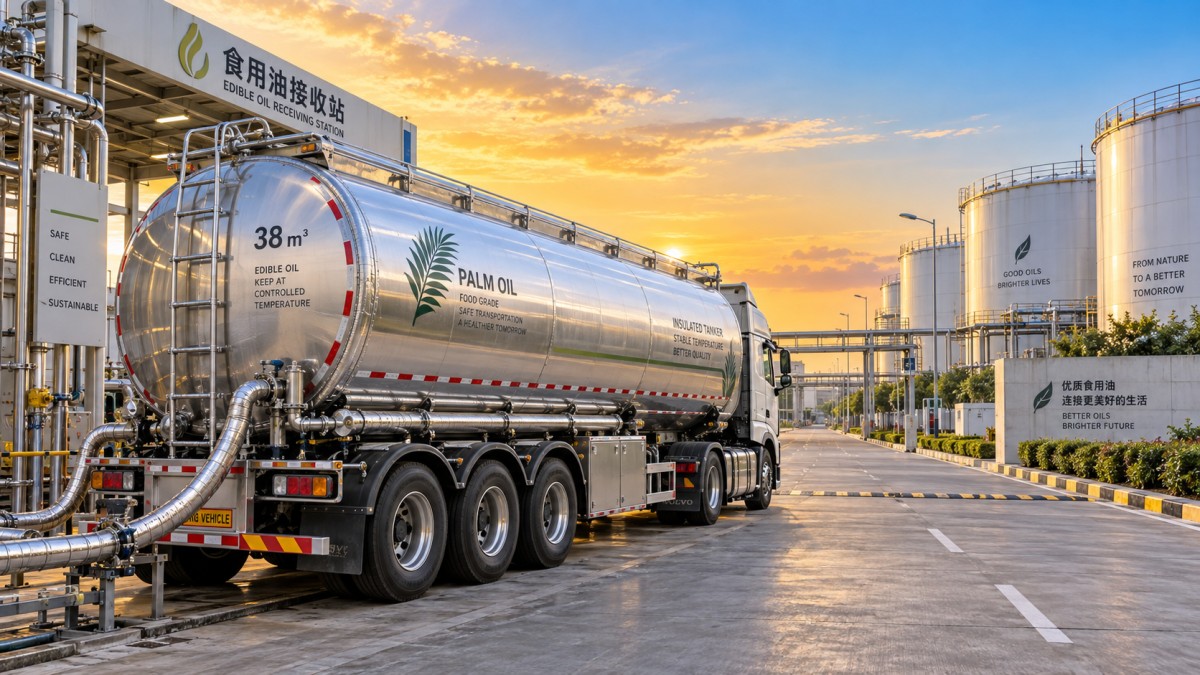
For project managers responsible for liquid logistics, this is more than a vehicle issue. It affects unloading schedules, receiving-tank availability, demurrage exposure, driver planning, product quality management, and the credibility of the entire supply chain. A 38 m3 Stainless Steel InsulatedPalm Oil Tanker is often selected not simply for capacity, but because its insulation and stainless-steel construction support a more controlled transport process across long, hot-and-cold, or operationally unpredictable routes.
Why palm oil solidifies on the road
Palm oil is temperature-sensitive. Its flow behaviour changes as it cools, and the exact handling temperature depends on the grade, blend, refinery requirements, and receiving facility procedures. If a tanker loses heat steadily during a long journey, crystals can begin forming against the tank wall and in lower areas of the vessel. By the time the vehicle reaches destination, the cargo may be thick, unevenly warmed, or difficult to discharge.
The problem is rarely caused by one factor alone. More often, it is the combined effect of a loading temperature set too close to the lower operating limit, insufficient insulation, extended parking, cold night conditions, and no practical plan for reheating before unloading. A route that works reliably in daytime conditions may become a problem when a vehicle waits for six hours at a checkpoint or arrives after the receiving terminal has closed.
For East African, West African, and Saudi Arabian operations, managers should avoid assuming that a generally warm climate eliminates the risk. Coastal nights, elevated inland routes, seasonal weather changes, and wind exposure can still create significant heat loss. Delays add another layer of uncertainty.
Start with a temperature window, not just a loading temperature
A common operational mistake is treating the loading temperature as a single pass-or-fail number. A better approach is to define a complete temperature window for the journey: the target temperature at loading, the expected heat loss along the route, the lowest acceptable arrival temperature, and the practical heating capability available at destination.
This calculation should be agreed among the product owner, loading terminal, transporter, and receiving site. If the receiving facility has limited heating capacity, the tanker must do more of the thermal work during transit. If the tanker is expected to wait before discharge, the arrival target should leave enough margin for that delay.
- At loading: confirm product temperature, not merely the terminal’s standard setting.
- During dispatch: record departure time, ambient conditions, route length, and expected stops.
- Before unloading: verify the cargo temperature at the designated measurement point and follow the receiver’s approved procedure.
- After exceptions: investigate unusually long delays, low-temperature arrivals, or slow discharge times before they become repeated losses.
A temperature log creates accountability. It also turns vague statements such as “the cargo became too cold on the way” into useful operational evidence: where the delay occurred, how quickly temperature fell, and whether insulation or heating capacity needs adjustment.
Insulation is a system, not a cosmetic layer
Good insulation slows heat transfer; it does not create heat. That distinction matters when specifying a palm oil tanker. The tank shell, insulation material, outer cladding, end sections, manholes, valves, pipework, and access points all influence the final thermal performance. A well-insulated barrel can still lose heat rapidly through poorly protected fittings or damaged outer cladding.
For a 38 m³ stainless steel insulated palm oil tanker, project teams should ask practical questions during specification and inspection:
- Is the insulation thickness appropriate for the planned route duration and ambient conditions?
- Does the external cladding protect insulation from rain, road debris, ultraviolet exposure, and mechanical damage?
- Are outlet valves and discharge lines arranged to minimise cold spots and retained product?
- Can the insulation be inspected and repaired without creating long equipment downtime?
- Are tank supports and external attachments designed so that insulation continuity is not unnecessarily compromised?
Stainless steel is especially relevant for edible-oil transport because it offers strong corrosion resistance and supports hygienic cleaning practices. However, material selection alone does not prevent solidification. Thermal design, surface condition, cleaning discipline, and daily operating control all need to work together.
When insulation alone is not enough: heating provisions
On shorter routes with reliable unloading appointments, insulation may be sufficient to preserve flowability. Long-haul routes are different. When travel time is variable or ambient temperatures can fall for extended periods, a tanker with an appropriate heating arrangement may be the safer operational choice.
Heating systems should be specified around the available energy source and site infrastructure. Depending on the operation, this may involve thermal-oil coils, steam coils, or another approved heating configuration. The goal is controlled, even warming—not rapid overheating. Excessive or poorly managed heat can affect product condition, increase energy use, and create avoidable safety concerns.
Project managers should ensure that the heating design is compatible with cleaning access, discharge routing, and maintenance plans. Ask how the system will be pressure-tested, how condensate or heat-transfer media will be managed where applicable, and whether drivers and depot staff understand the correct sequence for heating and unloading. A heating system that cannot be operated consistently in the field offers little protection when a load is already cooling.
Operational habits that make the tanker design work
Even a carefully specified tanker can lose its advantage through poor dispatch control. The simplest habits often produce the strongest result.
Reduce idle time after loading. Dispatch the vehicle promptly once the load is sealed and documentation is complete. A loaded tanker sitting in a yard for hours begins consuming its thermal margin before the journey has truly started.
Plan parking with temperature in mind. Where possible, avoid exposed locations during extended stops. Wind and nighttime cooling can accelerate heat loss, particularly around fittings and external pipework.
Do not open manholes unnecessarily. Opening access points introduces heat loss and may create hygiene or contamination risks. Temperature checks should follow the approved method and be limited to what is operationally necessary.
Keep the discharge path ready. Before the tanker arrives, confirm that receiving tanks, pumps, hoses, and personnel are prepared. Delaying a warm tanker at the gate or unloading bay can be as damaging as a delay on the highway.
Train drivers to report exceptions early. A driver who reports an unplanned overnight delay gives the operations team time to alert the receiver, revise the unloading plan, or arrange heating support. Silence until arrival usually makes recovery more expensive.
Choosing capacity: maximise payload without losing route resilience
A 38 m³ configuration can be a sensible balance where site access, axle-load restrictions, product demand, and turnaround time all matter. But capacity should never be considered independently from route conditions. A larger load has more thermal mass and may cool more slowly in some circumstances, yet it can also require more time to unload and may face tighter access limitations. Smaller or differently configured units may suit regional distribution where frequent drops are required.
Fleet planning also often involves more than one liquid product. A company transporting palm oil may operate dedicated food-grade equipment alongside fuel distribution assets, each with very different material, compartment, safety, and thermal requirements. For example, a 45 m³ 5-Compartment Carbon Steel Fuel Tanker is designed around multi-product fuel delivery needs, with a 45,000 L capacity, five compartments, and a three-axle arrangement. It should not be treated as a substitute for a dedicated stainless-steel edible-oil tanker, but it illustrates why fleet specifications must match the cargo and delivery model rather than follow a one-size-fits-all purchasing decision.
A pre-trip review for project teams
Before approving a long-haul palm oil movement, review the shipment as a controlled thermal operation. Confirm the grade and required handling range; check the actual loading temperature; assess the journey duration including realistic delay allowances; inspect insulation and valve protection; verify heating availability if required; and make sure the consignee can receive the load without delay.
It is equally important to define what happens if the cargo arrives colder than planned. Who authorises heating? What equipment is available? How will the product be checked before discharge? Clear escalation procedures prevent drivers from improvising under pressure and help protect both the cargo and the equipment.
Protecting flowability protects the whole schedule
Palm oil solidification is not an unavoidable feature of long-distance transport. It is usually a planning and equipment-matching issue that can be managed through realistic temperature margins, robust insulation, suitable heating options, disciplined dispatch, and prepared unloading sites.
For operations moving edible oils across demanding routes, the right 38 m³ stainless steel insulated tanker is part of a wider control strategy. When the tanker specification and the operating plan are aligned, the cargo is more likely to arrive flowable, discharge on time, and keep the project schedule moving without costly recovery work.
Get Quote Form
Please complete the form below, and our product experts will contact you within one business hour. All inquiry details are kept strictly confidential and used solely to provide you with a precise solution.
✅ 24/7 Engineer Online Support | Ready for any technical inquiries.
✅ Full Export Documentation Support | We provide full set of shipping documents to ensure smooth customs clearance.
LOGO
This stunning beach house property is a true oasis, nestled in a serene coastal community with direct access to the beach.
Opening Hours
Monday - Friday : 9AM to 5PM
Sunday: Closed
Closed during holidays
Contact
+18888888888
hezuo@eyingbao.com123 West Street, Melbourne Victoria 3000 Australia
Request a Free Quote Today
Need mainstream models or custom specs? Our engineers are ready.
Contact us today for a lasting partnership!