


Products
News
- ▶ Building High-Volume Fuel Distribution Plans Around a 45 m3 Semi Trailer
- ▶ Pre-Delivery Inspection Points for a 45 m3 Fuel Semi Trailer
- ▶ Calculating Total Ownership Cost for a 45 m3 Fuel Semi Trailer Fleet
- ▶ 45 m3 Fuel Semi Trailer Selection: Payload Limits, Axles, and Road Rules
- ▶ How a 42 m2 Carbon Steel Fuel Tanker Supports Depot-to-Station Deliveries
Pre-Delivery Inspection Points for a 45 m3 Fuel Semi Trailer
A pre-delivery inspection for a 45 m3 fuel semi trailer should end with evidence that every fuel-contacting boundary, load-bearing connection, and safety function is ready for its intended road service. A clean exterior and a successful static leak test are not enough. Small defects at manhole seals, compartment valves, vapor lines, brake adjustments, or electrical routing can remain hidden until the first loading, braking event, or rough-road cycle.
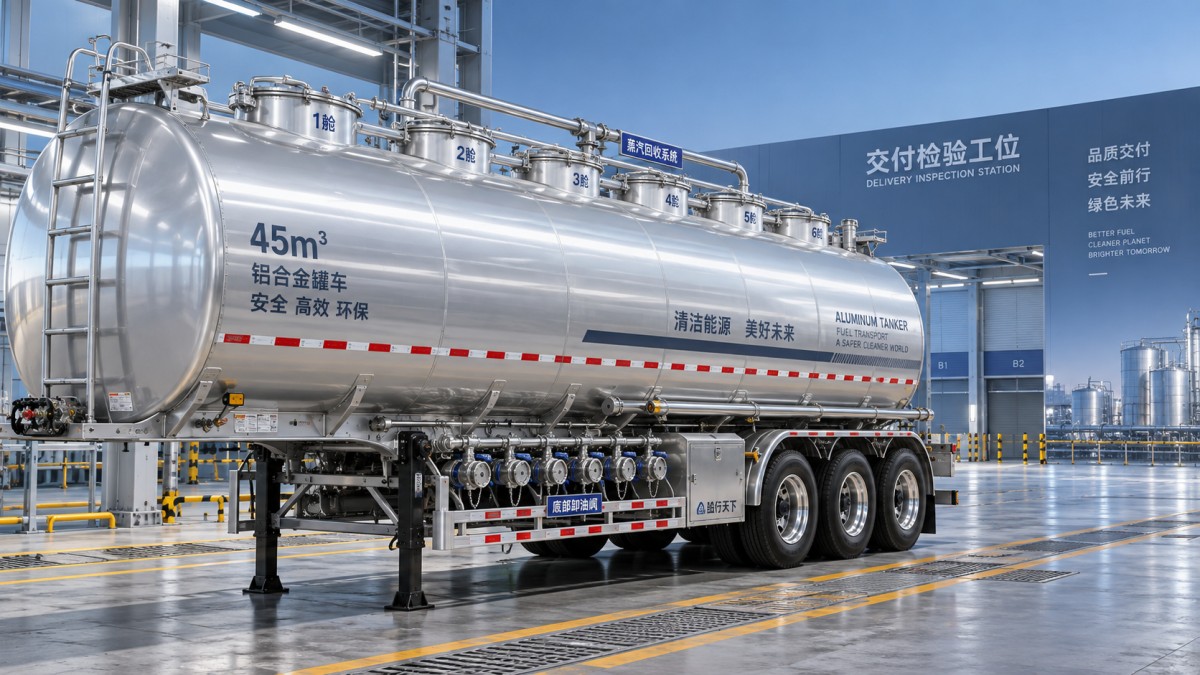
Start with the build specification and the as-built configuration. Capacity, compartment arrangement, axle layout, tire size, tank material, suspension type, and discharge arrangement must match the approved order documentation. This avoids a common handover error: inspecting a component against a general tanker expectation rather than against the trailer actually delivered. A six-compartment tanker, for example, requires each compartment to be identified and tested as an independent containment space where the design calls for separate loading, discharge, and vapor paths.
Tank Shell, End Plates, and Weld Condition
Inspect the tank before focusing on attached equipment. The shell should be free from dents, sharp gouges, creases, heat discoloration outside weld zones, and distortion around supports or baffle locations. Surface marks are not all equal. A light handling scuff in paint differs from a deep score that removes material or creates a stress raiser. Any damage near a longitudinal seam, circumferential seam, end plate, manhole neck, or mounting saddle deserves closer examination.
For an aluminum alloy tank, inspection must account for the material and fabrication method. A 5454 aluminum alloy shell does not present corrosion in the same way as carbon steel, but white deposits, pitting, contamination from incompatible metal contact, or damage beneath a coating still need assessment. Painted surfaces should be continuous around weld transitions, brackets, ladder mounts, and areas exposed to road spray. Paint cannot be treated as proof that the substrate is undamaged.
Review welds under sufficient light. Look for incomplete fusion indications, undercut, porosity, overlap, cracks, abrupt weld starts and stops, and irregular profiles that could retain liquid or contaminate cleaning operations. Weld appearance alone cannot establish soundness, so it should be considered together with applicable production records and the pressure or tightness-test result. Pay particular attention to nozzle-to-shell welds and bracket welds; these locations combine vibration with local loads from piping and accessories.
Verify Containment by Compartment
A 45,000 L tank should not be treated as one large vessel during final inspection when it is divided into compartments. Confirm the number and sequence of compartments, then inspect the internal and external features associated with each one. The aim is to establish that product cannot migrate between compartments and that the intended compartment can be loaded, vented, measured, and discharged without opening an unintended path.
- Manholes and covers: Check that each cover sits evenly on its sealing surface, closes without forcing, and has complete fasteners or locking hardware. A cover that closes only when bolts are tightened aggressively can indicate a distorted lid, damaged gasket, or misaligned neck.
- Gaskets: Verify correct seating, continuity, cleanliness, and compatibility with the fuel to be carried. A sound gasket can still leak when twisted, pinched, hardened, or contaminated with paint, weld debris, or packaging residue.
- Compartment separation: Examine accessible bulkhead areas and validate compartment isolation through the specified test method. A level change or pressure response in an adjacent compartment is a release issue, not a minor adjustment item.
- Dip and level provisions: Confirm that compartment markings correspond to the documented sequence and that any gauge, dip tube, or sensor fitting is secure and sealed.
Pressure testing must follow the tank design and applicable procedure. Excessive test pressure can damage a tank or create misleading deformation; insufficient pressure may fail to reveal a weak seal. The result should identify the test medium, the tested section, the duration, and any corrective work performed before retest. For multi-compartment units, a pass result should be traceable to each compartment rather than recorded only as a single tank-level statement.
Valves, Pipework, and Vapor Recovery
Fuel leaks frequently originate from interfaces rather than from the main tank shell. Inspect bottom outlets, internal emergency valves where fitted, external discharge valves, adapters, flanges, elbows, drain points, and flexible connections. Each valve should move through its full intended range without binding, and the closed position must provide a positive seal. Handles and actuation linkages need clear indication of their operating position; ambiguous valve orientation creates avoidable loading and unloading errors.
Check that pipework is independently supported and does not rely on valve bodies, couplings, or hose connections to carry its weight. There should be clearance from tires, suspension travel, sharp frame edges, and moving landing-gear components. A pipe may appear correctly installed with the trailer parked, yet contact an axle, air suspension component, or guard when the suspension changes height. Inspect clearance with the suspension in the relevant condition where practical.
Vapor recovery lines require the same attention as liquid lines. Caps, couplings, seals, and shut-off valves must be complete and protected from ingress. Verify that connections are clearly distinguished from product discharge connections where the design requires it. A vapor line that is cross-connected, left uncapped, or fitted with a damaged seal can compromise vapor handling and allow contamination into a clean compartment.
On a configuration such as the 45 m³ 6-Compartment Painted Aluminum Alloy Fuel Tanker with Vapor Recovery, the inspection record should identify all six compartment pathways rather than recording the vapor system as a single generic item. The relationship between each manhole, vapor point, bottom valve, and outlet matters when a fault is later traced to one compartment.
Chassis Attachment and Running Gear
Tank integrity is affected by how the tank is supported. Inspect mounting saddles, restraint brackets, frame members, cross-members, and fasteners for correct seating, missing hardware, weld damage, and signs of contact between the tank and chassis. There should be no unapproved packing material, loose shims, or uneven saddle contact that concentrates load in a small area. Examine areas around the front support and rear restraint carefully because longitudinal forces from braking and acceleration transfer through these locations.
Confirm the kingpin type, mounting bolts, and surrounding structure against the approved configuration. The kingpin must show no cracking, excessive paint build-up on the coupling surface, or damage to bolts and locking hardware. The trailer should be coupled to a compatible tractor during functional inspection when possible, allowing verification of coupling engagement, landing-gear clearance, and hose routing in turning positions.
For a tri-axle arrangement, inspect axle identification, suspension attachment, U-bolts or equivalent fasteners, air lines, shock absorbers where fitted, and lift-axle movement. A front lift axle needs to raise and lower without fouling guards, tires, brake hoses, or the chassis. Tire specification and condition should match the supplied configuration; tires of the same nominal size can still differ in load rating or tread pattern. Confirm correct inflation only against the applicable tire and axle documentation, not a generic fleet value.
Braking, Air Supply, and Electrical Function
Brake inspection should combine a visual review with a functional test. Check air reservoirs, drain points, pipework, couplings, and protective routing for damage or air loss. Listen for leaks after the system is charged, then observe pressure retention according to the established test procedure. Brake chambers, push rods, slack adjusters, drums, and foundation-brake hardware should be free from interference and securely mounted.
Manual slack adjusters require deliberate adjustment verification. Similar push-rod travel on one axle does not prove uniform brake condition across the trailer. Inspect each brake position and ensure the adjustment is within the brake component requirements. A brake that is adjusted too tightly can drag and overheat; excessive stroke can delay braking response. These opposite defects can both be missed during a short stationary air test.
Connect the trailer electrical system to a compatible tractor and test stop lamps, tail lamps, turn indicators, hazard lamps, license-plate lamp, side markers, and any required warning functions. Inspect cable protection from the front connection to the rear light assemblies. Wires routed near sharp aluminum edges, suspension movement, or heat sources may pass a delivery test but fail after a short period of road vibration. Grounding points should be clean, tight, and protected from corrosion.
Safety Equipment and Handover Evidence
Inspect the ladder, walkway, handrails, anti-slip surfaces, mudguards, underride protection, wheel chocks, fire-extinguisher mounts, reflective markings, and warning labels as installed items, not merely as accessories supplied with the trailer. A loose handrail or poorly secured extinguisher bracket becomes a road hazard even though it does not affect the tank pressure test. Access equipment must be secure enough for routine top access and free from sharp edges that could damage protective clothing or hoses.
Verify that drain outlets, low points, and spill-sensitive areas are clean and free of manufacturing debris. Remove loose fasteners, metal particles, sealing fragments, abrasive residue, and packaging material from compartments and pipework before release. Foreign material can obstruct valves, contaminate the first load, or damage seals during initial service.
The final record should connect observations to a clear disposition: accepted, corrected and retested, or withheld pending repair. Include the trailer identification, compartment layout, test records, component serial references where relevant, and photographs of repaired areas. A delivery release should be withheld when containment, braking, coupling, vapor handling, or electrical safety remains unverified; these are operating functions, not cosmetic completion items.
Get Quote Form
Please complete the form below, and our product experts will contact you within one business hour. All inquiry details are kept strictly confidential and used solely to provide you with a precise solution.
✅ 24/7 Engineer Online Support | Ready for any technical inquiries.
✅ Full Export Documentation Support | We provide full set of shipping documents to ensure smooth customs clearance.
LOGO
This stunning beach house property is a true oasis, nestled in a serene coastal community with direct access to the beach.
Opening Hours
Monday - Friday : 9AM to 5PM
Sunday: Closed
Closed during holidays
Contact
+18888888888
hezuo@eyingbao.com123 West Street, Melbourne Victoria 3000 Australia
Request a Free Quote Today
Need mainstream models or custom specs? Our engineers are ready.
Contact us today for a lasting partnership!