


Products
News
- ▶ When Does a Higher-Priced Oil Tanker Trailer Reduce Downtime and Repair Risk?
- ▶ Comparing Oil Tanker Trailer Quotes: A Checklist for Like-for-Like Pricing
- ▶ How Tank Material, Axles, and Safety Systems Affect Oil Tanker Trailer Prices
- ▶ How to Prevent Overloading and Stability Issues with a 45 m3 Fuel Semi Trailer
- ▶ Building High-Volume Fuel Distribution Plans Around a 45 m3 Semi Trailer
Comparing Oil Tanker Trailer Quotes: A Checklist for Like-for-Like Pricing
A low oil tanker trailer price can be a genuine commercial advantage, but only when the quotation covers the same transport duty, safety equipment, and delivery scope as the alternatives. For procurement teams, the most expensive mistake is comparing two headline figures that describe different trailers.
Fuel tanker quotations often look similar at first glance: a stated volume, three axles, standard tires, and a list of fittings. The cost differences may sit in details that affect payload, operating permits, loading and unloading time, maintenance exposure, or the ability to use the trailer on a specified route. A like-for-like review should therefore begin by converting each supplier quote into one technical and commercial comparison sheet.
Start with the operating duty, not the quoted capacity
Capacity is usually the first number in an offer, but it is not enough to establish whether two tanker trailers are comparable. A 40,000-litre trailer designed for long-haul fuel distribution may require a different tank construction, chassis strength, braking package, and suspension specification than a similar-volume unit used on shorter, paved regional routes.
Before reviewing prices, define the transport task in practical terms:
- Product carried: diesel, gasoline, aviation fuel, mixed petroleum products, or another liquid with different material and sealing requirements.
- Required payload and legal gross combination weight for the intended country or corridor.
- Loading and discharge method, including bottom loading, top loading, gravity discharge, pumping, and vapor-return connections.
- Route conditions: paved highway, mixed road surfaces, steep gradients, high ambient temperatures, or remote maintenance access.
- Operating model: a dedicated single-product fleet, multi-product distribution, depot-to-station delivery, or cross-border transport.
A single-compartment tank can be a sensible choice for dedicated bulk fuel movements, while a multi-compartment arrangement may be necessary for deliveries involving several fuel grades. Comparing those two configurations solely by litres and price creates a false benchmark. Compartments add fabrication complexity, internal bulkheads, piping, valves, and inspection points; they also change how the trailer supports a distribution operation.
Put tank construction on the same line of the comparison sheet
The tank body is usually one of the largest cost drivers in an oil tanker trailer quote. Material type, shell thickness, end-plate thickness, welding quality requirements, and internal layout all affect both initial cost and serviceability.
Ask suppliers to state the tank material by grade, not simply as “stainless steel” or “carbon steel.” The selected material needs to match the transported product, operating environment, cleaning practice, and the buyer's corrosion-life expectations. Material thickness should be specified separately for the shell and end plates. A quote with a lower price may use thinner material, a different grade, or a simplified reinforcement arrangement.
For example, a 41,000-litre single-compartment stainless steel configuration may specify a 4 mm 304 stainless steel tank shell and 5 mm end plates. Those values should be compared directly with every competing offer, together with the stated tank volume and compartment count. It is not useful to compare a 41 m3 unit against a nominally similar tanker if one supplier includes a different material grade or does not identify the plate thickness.
Buyers should also clarify whether the quoted volume is geometric capacity, usable capacity, or an approximate designation. The difference matters when fleet planning, payload calculations, and fuel delivery scheduling are based on the quoted figure.
Separate safety equipment from optional accessories
Safety equipment is often presented as a long list, but the list must be read item by item. Terms such as “complete safety system” or “standard tanker equipment” are too broad for price comparison. Procurement teams need the actual scope: what is installed, how it is operated, and whether it is included in the quoted price.
A practical comparison should identify the following items separately:
- Vapor recovery connections and associated pipework.
- Emergency shut-off arrangements and valve operating method.
- Bottom valves, discharge outlets, manholes, and sealing provisions.
- Overfill protection provisions where required for the loading system.
- Fire extinguishers, grounding arrangements, safety rails, ladders, and anti-slip access surfaces.
- ABS, brake type, brake chamber arrangement, and slack adjusters.
Vapor recovery is a good example of why a headline oil tanker trailer price can be misleading. A trailer equipped with a vapor recovery system may cost more than a basic configuration, yet it may be necessary where the loading terminal or customer delivery process requires vapor handling. Removing it to reduce the purchase price can later produce an operational mismatch rather than a saving.
The same principle applies to braking. “Air brakes” does not establish equivalent specification. Confirm whether ABS is included, whether the trailer uses drum or disc brakes, and whether slack adjusters are manual or automatic. These choices affect price, service routines, spare-parts planning, and the technical fit with the tractor fleet.
Compare chassis, axles, suspension, and tires as a package
Axle count alone does not define carrying capability or durability. Two three-axle tanker trailers can have different axle ratings, suspension systems, wheel-end components, tire brands or specifications, and chassis reinforcement. The lower-priced unit may be suitable for its stated design load, but it should not be assumed to match another quote intended for rougher roads or higher axle loading.
Request the axle rating for each axle, the suspension type, pin and bushing dimensions where relevant, tire size and quantity, landing gear specification, and kingpin type. These parts determine how the trailer interfaces with tractors, workshop stock, road conditions, and local repair capability.
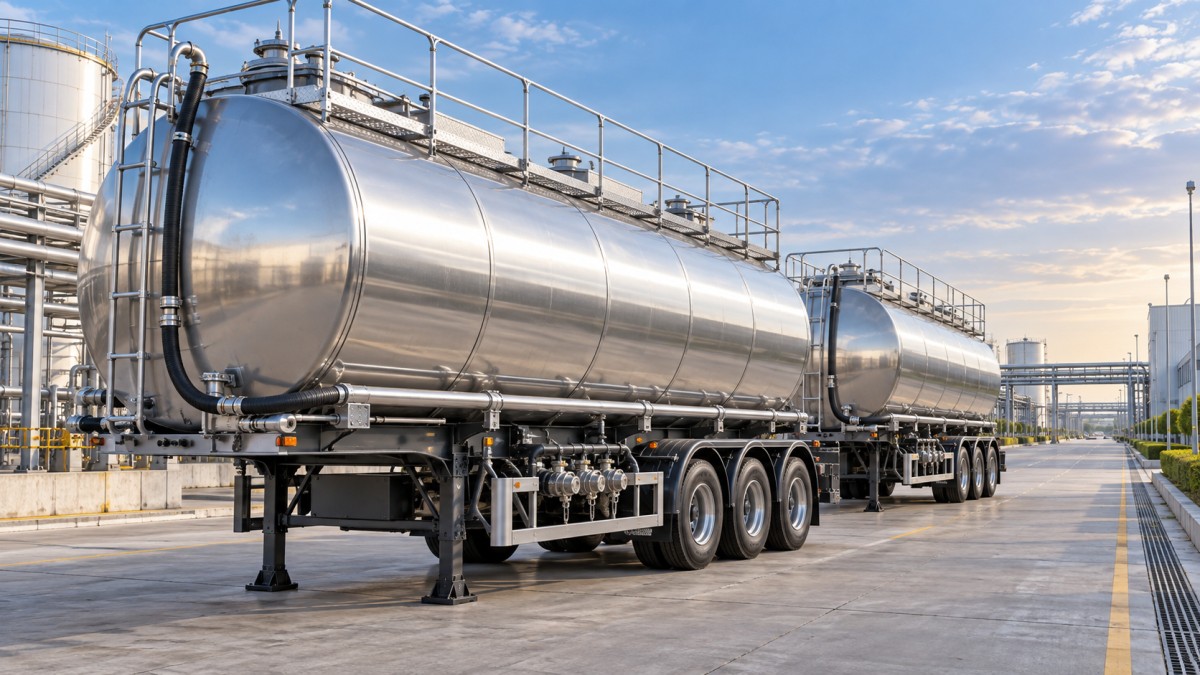
As one reference point, the 41 m³ Single-Compartment Stainless Steel Tanker Truck with Vapor Recovery System is configured with three 13-ton axles, 12R22.5 tires, mechanical suspension with 70 mm pins, independently operated landing gear, and a 50# bolt-on kingpin. That does not make it the correct specification for every route. It shows the level of detail a quotation should expose before pricing can be compared responsibly.
For operations on difficult road surfaces, a buyer may place greater value on chassis robustness, suspension durability, tire availability, and common service parts than on a small initial price difference. Conversely, specifying a heavy-duty configuration for a predictable paved-road operation can add cost without producing proportional value.
Check what the price includes after the trailer leaves the factory
Many apparent price gaps come from commercial scope rather than trailer specification. A procurement comparison should separate ex-works equipment price from all costs required to place a compliant, usable trailer into the fleet.
Freight and destination charges deserve particular attention for tanker trailers because their dimensions, shipping method, and delivery condition can alter logistics cost. A supplier's quoted price may exclude inland transport, port charges, customs handling, destination assembly, or local inspection requirements. These are commercial items, but they can materially change the landed cost comparison.
Use a quote-normalization sheet before negotiating
The most effective next step is to prepare a single worksheet with one column per supplier and fixed rows for every material, component, safety device, document, delivery term, and excluded item. Do not allow vague entries such as “as standard” to remain unresolved. Replace them with a specified component, a named technical parameter, or an explicit exclusion.
Once the specifications are normalized, the negotiation becomes more productive. Buyers can ask why one offer is lower, decide whether the difference is acceptable, and request revisions against a defined baseline. They can also avoid paying for features that do not support the intended fuel-distribution model.
The right purchasing decision is rarely the lowest figure on the first page of a quotation. It is the offer whose tank design, running gear, safety equipment, compliance scope, and delivery costs match the operation being funded. That is the basis on which an oil tanker trailer price becomes a usable cost decision rather than an incomplete number.
Get Quote Form
Please complete the form below, and our product experts will contact you within one business hour. All inquiry details are kept strictly confidential and used solely to provide you with a precise solution.
✅ 24/7 Engineer Online Support | Ready for any technical inquiries.
✅ Full Export Documentation Support | We provide full set of shipping documents to ensure smooth customs clearance.
LOGO
This stunning beach house property is a true oasis, nestled in a serene coastal community with direct access to the beach.
Opening Hours
Monday - Friday : 9AM to 5PM
Sunday: Closed
Closed during holidays
Contact
+18888888888
hezuo@eyingbao.com123 West Street, Melbourne Victoria 3000 Australia
Request a Free Quote Today
Need mainstream models or custom specs? Our engineers are ready.
Contact us today for a lasting partnership!