


Products
News
- ▶ How Tank Material, Axles, and Safety Systems Affect Oil Tanker Trailer Prices
- ▶ How to Prevent Overloading and Stability Issues with a 45 m3 Fuel Semi Trailer
- ▶ Building High-Volume Fuel Distribution Plans Around a 45 m3 Semi Trailer
- ▶ Pre-Delivery Inspection Points for a 45 m3 Fuel Semi Trailer
- ▶ Calculating Total Ownership Cost for a 45 m3 Fuel Semi Trailer Fleet
How to Prevent Overloading and Stability Issues with a 45 m3 Fuel Semi Trailer
A 45 m3 fuel semi trailer becomes unsafe long before a driver feels that it is “too full.” The main risks come from excess gross weight, poor axle loading, liquid surge, and a center of gravity that does not match the road and operating conditions. A sound safety process therefore starts with verified weight data and loading controls, not with visual estimates at the depot.
For fuel transport, stability is a system outcome. Tank geometry, suspension condition, fifth-wheel connection, tire capacity, braking balance, compartment layout, filling level, route profile, and driver behavior all affect the result. A trailer can remain within a nominal volume limit yet still create a rollover or axle-overload risk if those factors are not controlled together.
Start with mass, not tank volume
The “45 m3” description refers to volume, not permitted payload. Fuel density changes by product and temperature, while the allowable transported mass depends on the tractor, trailer, axle arrangement, tire ratings, local road limits, and the approved vehicle configuration. Treating a tank’s stated capacity as its legal loading target is one of the most common control failures.
Quality and safety teams should establish a loading matrix for each vehicle combination. It should identify the maximum acceptable product mass, the expected mass on each axle group, and any operating restrictions linked to route or equipment configuration. The loading operator needs a clear instruction: stop filling at the controlled mass limit, even when unused tank volume remains.
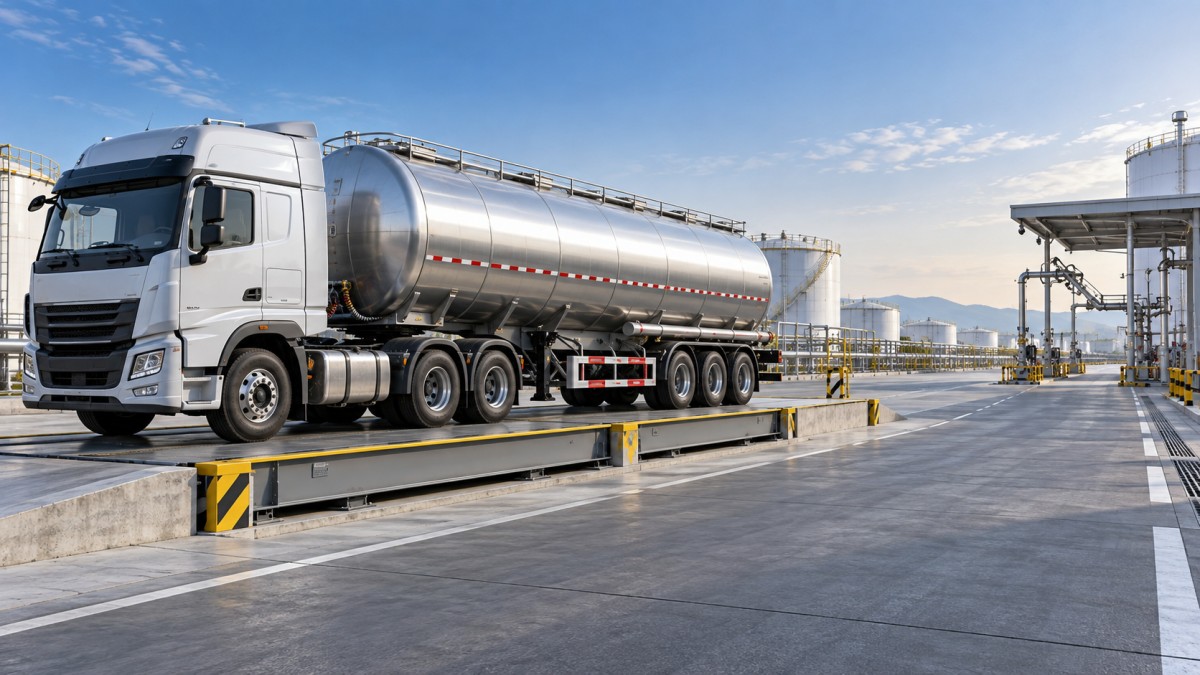
Use a weighbridge or a reliable load-measurement process at defined points in the operation. A practical sequence is to record the empty combination weight, confirm the product loaded, verify the loaded gross weight, and investigate any meaningful difference between calculated and measured values. Repeated discrepancies can reveal meter calibration problems, unrecorded equipment changes, retained product, or inconsistent loading practices.
Axle distribution matters as much as total weight
A compliant gross vehicle weight does not guarantee that every axle is compliant. With a fuel tanker, the fifth-wheel load and rear axle-group load can shift according to tank position, fill condition, trailer attitude, and suspension response. An overloaded axle group reduces tire and brake margin, increases heat generation, and may make the combination less predictable during emergency braking.
Do not rely on a single fully loaded scale ticket to validate a 45 m3 fuel semi trailer. Check the configuration at the fill levels that occur in normal dispatch, including partial loads and return movements. Partial loads deserve special attention because liquid movement is more pronounced when the free surface is large.
Loading controls should also prevent operators from compensating for a difficult axle reading by moving the problem elsewhere. Adjusting fifth-wheel position, suspension settings, or loading practice without engineering approval can create a new imbalance. The proper response is to confirm the designed axle-load distribution and correct the root cause: loading sequence, tank layout, tractor-trailer matching, or unsuitable operating limits.
Control liquid surge before it becomes a rollover event
Fuel does not behave like solid cargo. During braking, acceleration, lane changes, and turns, the liquid mass continues moving after the vehicle begins to change direction. This surge can push lateral force higher at exactly the point when the trailer is already near its stability limit.
Internal baffles or compartment divisions reduce free liquid movement, but they do not remove the need for careful loading and driving. Their condition must be verified during manufacture, repair, and periodic inspection. A damaged or poorly secured internal structure can affect both surge control and tank integrity.
Single-compartment tankers require especially disciplined management of partial-fill operation. They may be suitable where one product grade is carried in dedicated routes, but the operating team should define which fill ranges and route conditions need extra control. Tight roundabouts, uneven road shoulders, steep crossfalls, sudden avoidance maneuvers, and high-speed descents increase the consequences of surge.
Driver instruction should be specific rather than generic. “Drive carefully” is not a control. Drivers need clear expectations for corner entry speed, braking before rather than during a bend, safe spacing, lane-change restraint, and reduced speed on poor road surfaces. Dispatchers should not schedule tanker routes in a way that rewards speed at the expense of these controls.
Inspect the stability-critical hardware as a connected system
Tank condition is only one part of stability. A low center of gravity can be undermined by worn suspension components, uneven ride height, mismatched tires, loose wheel fasteners, degraded shock absorbers, or brake imbalance. These defects may be gradual, so a basic walk-around inspection alone is not enough.
Build the inspection program around failure modes that affect handling:
- Suspension and axles: Check for abnormal ride height, broken or worn components, leakage, loose fasteners, and signs that one side carries load differently from the other.
- Tires and wheels: Match tire specification across each axle position, control inflation pressure, inspect tread and sidewalls, and address irregular wear before it becomes a heat or handling issue.
- Brakes: Confirm that the tractor and trailer braking systems respond consistently. A pulling condition or uneven brake effort can destabilize the combination during hard braking.
- Coupling: Examine the kingpin, fifth wheel, locking mechanism, air and electrical connections, and any clearance issue that could affect articulation.
- Tank supports and shell: Look for cracks, corrosion, distorted supports, loose mounting points, and leakage around fittings. Structural damage can change how the tank transfers load to the chassis.
Inspection records are more useful when they capture trends. A recurring tire issue on one axle, repeated brake adjustment on one wheel end, or persistent uneven ride height should trigger a maintenance investigation rather than repeated routine corrections.
Specify the trailer around the actual operating route
A tanker selected only by capacity can be a poor fit for the work. The route may include rough access roads, frequent urban turns, long highway distances, high ambient temperatures, or loading sites with uneven ground. Each condition changes the margin needed for tires, suspension, chassis strength, braking, and tank configuration.
For example, a lower-volume unit may provide a more manageable payload and stability margin where road restrictions or poor surfaces limit practical loading. A larger-capacity tanker may suit dedicated, well-controlled routes, but it needs matching tractor specifications and disciplined weight control. Capacity should follow the allowable mass and operating environment, not commercial pressure to maximize litres per trip.
When reviewing a tanker design, ask for the approved drawing, axle configuration, tank material details, and the intended loading assumptions. A 42 m³ Single-Compartment Carbon Steel Fuel Tanker, for example, is specified with a 42,000 L capacity, three axles, a 5 mm carbon-steel tank shell, 6 mm end plates, and a 50# bolt-on kingpin. Those details help define the equipment baseline, but they do not replace a vehicle-combination weight assessment or route-specific operating limits.
Close the gap between loading, dispatch, and maintenance
Overload prevention often fails because each department sees only one part of the journey. The loading team sees volume and product availability. Dispatch sees delivery demand. Maintenance sees defects after they develop. Safety sees incidents and near misses. The control process needs one shared release decision before the vehicle leaves site.
A useful pre-dispatch release should confirm:
- Correct product and documented loaded mass;
- Acceptable gross and axle-group weights for the combination;
- No active defect affecting tires, brakes, suspension, coupling, tank integrity, or emergency equipment;
- A suitable route and delivery plan for the current load condition;
- Driver awareness of any partial-load, weather, road, or site-access restriction.
Near misses should be treated as early warnings. A trailer that leans excessively on a turn, activates braking intervention unexpectedly, suffers repeated tire overheating, or produces unusual surge complaints may not yet have had an incident, but its operating margin may already be too narrow. Review the load record, fill level, route, vehicle condition, and driver report together before returning it to the same duty.
Do not confuse a stronger tank with a safer operation
Tank shell thickness and end-plate construction are important for structural durability, but they do not make overloading acceptable. Excess mass still raises axle loads, braking demand, tire stress, and rollover exposure. Likewise, a three-axle trailer does not automatically have adequate capacity for every load; axle ratings and the complete tractor-trailer configuration determine the practical limit.
The most reliable approach is simple in principle: define the permitted loading mass for each approved combination, verify it at dispatch, maintain the systems that preserve handling, and adjust operating limits when route conditions become more demanding. That approach protects the tanker, but more importantly, it gives drivers a vehicle that behaves predictably when they need it to.
Get Quote Form
Please complete the form below, and our product experts will contact you within one business hour. All inquiry details are kept strictly confidential and used solely to provide you with a precise solution.
✅ 24/7 Engineer Online Support | Ready for any technical inquiries.
✅ Full Export Documentation Support | We provide full set of shipping documents to ensure smooth customs clearance.
LOGO
This stunning beach house property is a true oasis, nestled in a serene coastal community with direct access to the beach.
Opening Hours
Monday - Friday : 9AM to 5PM
Sunday: Closed
Closed during holidays
Contact
+18888888888
hezuo@eyingbao.com123 West Street, Melbourne Victoria 3000 Australia
Request a Free Quote Today
Need mainstream models or custom specs? Our engineers are ready.
Contact us today for a lasting partnership!