


Products
News
- ▶ Aluminum Tanker Trailer Maintenance: Preventing Galvanic Corrosion at Joints
- ▶ How an Aluminum Oil Tanker Trailer Can Increase Legal Payload Capacity
- ▶ Aluminum Oil Tanker Trailers: Evaluating Weight Savings Against Initial Cost
- ▶ Why Baffle Design Matters in Carbon Steel Oil Tanker Trailer Stability
- ▶ What Tank Testing Should Be Required for a Carbon Steel Oil Tanker Trailer?
Aluminum Tanker Trailer Maintenance: Preventing Galvanic Corrosion at Joints
Aluminum Tanker Trailer Maintenance: Preventing Galvanic Corrosion at Joints
For a quality-control or safety manager, corrosion on an aluminum tanker is rarely just a cosmetic concern. A small white deposit around a fastener, fitting, or mounting bracket can indicate a joint that is retaining water, losing its protective barrier, or allowing an electrochemical reaction to develop. If left unaddressed, localized attack may reduce wall thickness, damage seals, compromise attachments, and create conditions that demand an unplanned repair or a more detailed integrity assessment.
This is particularly relevant to an aluminum oil tanker trailer because its tank body, piping supports, manhole assemblies, landing gear interfaces, chassis components, and electrical hardware may combine several metals in one working environment. Aluminum itself develops a natural oxide film, but that film is not a guarantee against joint corrosion. The risk rises when aluminum contacts a more noble metal and an electrolyte—typically rainwater, road spray, wash water, condensation, or contaminated residue—bridges the connection.
The practical objective is not to eliminate every mixed-metal joint. That would be unrealistic in a road tanker. The objective is to ensure that each joint is properly isolated, sealed, drained, accessible for inspection, and repaired before corrosion becomes structural or affects containment-related equipment.
Why Corrosion Concentrates at Joints
Galvanic corrosion requires three conditions: dissimilar conductive materials, electrical contact between them, and an electrolyte. Remove any one of these conditions and the reaction is interrupted. In practice, however, joints often create all three. A stainless-steel bolt can be electrically connected to aluminum through a bracket; water can enter the joint through a cracked seal; dirt can then hold moisture in place long after the trailer has left wet conditions.
The visible pattern is often localized rather than uniform. Look for chalky or powdery white corrosion products, paint blistering at edges, staining beneath fittings, fretting around bolt heads, pitting close to washers, or a narrow corroded line where a bracket meets the shell. These signs need interpretation. Surface oxidation on exposed aluminum is not automatically a defect, but corrosion emerging from a crevice, a sealed overlap, or a load-bearing attachment deserves a closer review.
Fuel does not usually create the electrolyte needed for galvanic activity in the same way as water, but transport operations expose trailers to many other sources of moisture. Coastal air, salted or dusty roads, frequent exterior washing, pressure washing around joints, and long idle periods can all increase wet-time. In hot regions, repeated condensation and drying cycles may be as relevant as rainfall. Inspection plans should reflect the actual route and wash environment rather than relying only on calendar intervals.
Start with the Joints That Matter Most
Not every joint carries the same consequence. A useful inspection program separates containment-critical locations from general external hardware. Prioritize manhole and access-cover mounting areas, valve and piping supports, vapor-recovery connections, discharge hardware, tank-to-frame interfaces, grounding points, ladder and walkway brackets, and locations where equipment has been retrofitted. Retrofitted accessories are especially worth checking because an otherwise sound tank can be affected by a poorly isolated new mounting point.
During a routine walk-around, check whether the joint remains dry and clean. Then inspect more closely during scheduled maintenance: remove accumulated debris, examine sealant continuity, assess washer condition, and look beneath removable covers where water may be trapped. Do not use aggressive scraping or abrasive tools on aluminum surfaces without confirming that the method will not damage the protective finish or introduce deep scratches.
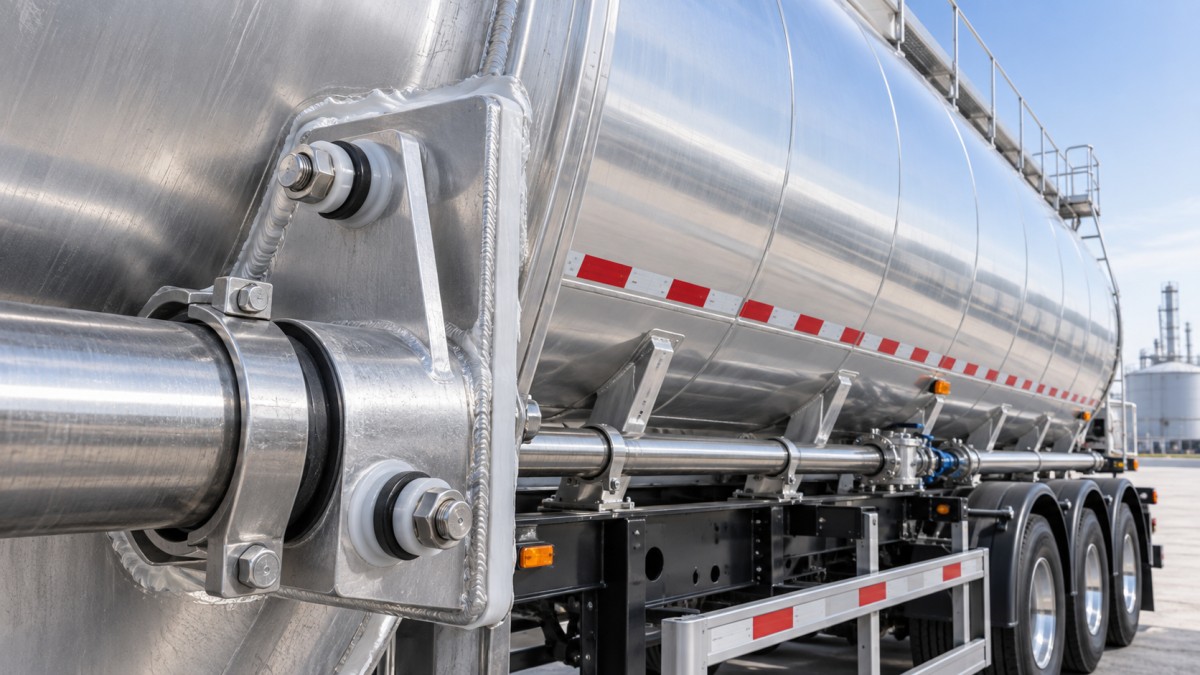
For quality records, photographs with location references are more useful than a simple “corrosion found” note. Record the joint type, materials involved where known, condition of paint or coating, evidence of moisture entry, and whether the issue is stable, progressing, or associated with a loose fastener. Trend data helps distinguish a one-time wash-water problem from a repeated design, sealing, or drainage failure.
Isolation Is More Reliable Than Repeated Cleaning
Cleaning corrosion products without correcting the interface only resets the clock. The more durable repair approach is to restore the barrier between dissimilar metals and prevent water from remaining in the joint. Depending on the joint design and service requirements, this may involve non-conductive bushings, sleeves, washers, isolating pads, compatible sealants, protective coatings, or a revised fastener arrangement.
Fastener selection should be treated as an engineering decision, not a store-room substitution. The material, coating, washer system, torque requirement, joint loading, and exposure conditions all matter. Stainless steel is often selected for strength and durability, but direct stainless-to-aluminum contact in a wet joint needs proper isolation. Likewise, a coated carbon-steel fastener can become problematic once its coating is damaged. If a replacement differs from the original bill of materials, maintenance teams should confirm its suitability with the trailer manufacturer or the approved repair documentation.
Sealants need equally careful handling. A sealant should be compatible with aluminum, the coating system, and the transported product environment. It must also be applied to a properly prepared surface. Sealing over trapped moisture, loose oxidation products, or failing paint can create a hidden crevice where corrosion continues unseen. Where a joint requires drainage, do not block designed drain paths in the name of better sealing.
Repair Decisions: When a Joint Needs More Than Touch-Up
A light surface deposit on a non-critical bracket may be manageable through cleaning, finish restoration, and improved joint sealing. The decision changes when pitting is visible, metal loss is suspected, a fastener no longer seats correctly, paint has lifted extensively, or the affected location is close to a tank opening, support point, or liquid-handling connection. At that stage, a competent assessment should establish whether the issue is limited to external hardware or involves the tank structure.
Avoid field repairs that introduce unapproved welding, drilling, or mixed-metal attachments near the tank shell. Repair work on a fuel tanker also requires safe isolation, cleaning, gas-free procedures where applicable, and compliance with the operator’s local safety rules. The correct sequence is often slower than an improvised fix, but it protects both the equipment and the people working around it.
Maintenance Starts with a Serviceable Tanker Design
Corrosion prevention should be reviewed at specification stage, not only after delivery. A tanker design that provides accessible joints, sensible drainage, compatible interfaces, and maintainable protective finishes makes inspection more credible in daily fleet use. Material selection also needs to match the intended duty cycle and transport environment.
For example, the 45 m³ 6-Compartment Painted Aluminum Alloy Tanker with Vapor Recovery System uses a 5454 aluminum alloy tank body, with a stated 5.5 mm shell thickness and 7 mm end plates. Its six-compartment configuration and vapor-recovery system make joint condition around access, vapor, and product-handling equipment a relevant part of preventive maintenance. The paint system should be inspected not only across broad panels but also at edges, fasteners, supports, and interfaces where coating damage can begin.
Shandong ORNN Vehicle Co., Ltd. has worked in semi-trailer and transport equipment manufacturing for 17 years, producing tanker, chemical liquid, dump, flatbed, and lowbed equipment for different transport duties. Across East Africa, West Africa, and Saudi Arabia, service conditions can vary sharply by road contamination, wash practice, humidity, and fleet maintenance capability. That is why a corrosion-control plan should be agreed alongside the tanker specification, including preferred joint materials, replacement fasteners, coating repair methods, and inspection access.
A Practical Control Routine
A workable routine does not need excessive paperwork, but it should be consistent. Include joint checks in pre-service visual inspections; carry out a more detailed review after seasonal wet periods, exterior damage, modifications, or unusual exposure; and inspect immediately if staining, loose hardware, or sealant failure appears. Wash the trailer using methods appropriate for painted aluminum surfaces, then allow joints and concealed areas to dry rather than leaving moisture trapped under covers or around fittings.
The key question for every finding is simple: what allowed moisture and electrical contact to persist here? When that question leads to better isolation, restored coating, sound sealing, and a documented reinspection date, galvanic corrosion becomes a controllable maintenance issue rather than a recurring source of tanker downtime.
Get Quote Form
Please complete the form below, and our product experts will contact you within one business hour. All inquiry details are kept strictly confidential and used solely to provide you with a precise solution.
✅ 24/7 Engineer Online Support | Ready for any technical inquiries.
✅ Full Export Documentation Support | We provide full set of shipping documents to ensure smooth customs clearance.
LOGO
This stunning beach house property is a true oasis, nestled in a serene coastal community with direct access to the beach.
Opening Hours
Monday - Friday : 9AM to 5PM
Sunday: Closed
Closed during holidays
Contact
+18888888888
hezuo@eyingbao.com123 West Street, Melbourne Victoria 3000 Australia
Request a Free Quote Today
Need mainstream models or custom specs? Our engineers are ready.
Contact us today for a lasting partnership!