


Products
News
- ▶ Aluminum Alloy Oil Tanker Truck Is Better Than Carbon Steel Oil Tanker Truck
- ▶ Preventing Product Contamination in Stainless Steel Oil Semi Trailer Tanks
- ▶ 304 vs. 316 Stainless Steel for Oil Semi Trailers: Where Each Grade Fits
- ▶ Selecting Stainless Steel Grades for Oil Semi Trailer Tank Applications
- ▶ Can Aluminum Oil Tanker Trailers Withstand Rough Roads and High-Cycle Use?
Aluminum Alloy Oil Tanker Truck Is Better Than Carbon Steel Oil Tanker Truck
Aluminum Alloy Oil Tanker Truck Is Better Than Carbon Steel Oil Tanker Truck—But the Operating Profile Decides
For fuel transport operators, tanker material is not a cosmetic specification. It affects legal payload, fuel consumption, cleaning requirements, corrosion risk, repair methods, and how long the trailer remains productive between major overhauls. In many fuel-distribution applications, an aluminum alloy oil tanker truck has a clear operational advantage over a carbon steel oil tanker truck because it reduces tare weight and resists the environmental corrosion that gradually weakens conventional steel equipment.
That does not mean carbon steel is automatically the wrong choice. A tanker trailer is a working asset, not a material contest. Route conditions, cargo type, axle limits, workshop capability, local regulations, expected annual mileage, and the fleet’s loading practice all matter. The right comparison is not simply “aluminum versus steel,” but which tanker gives the operator the most reliable cost per delivered litre over its service life.
Why Lower Tare Weight Changes the Economics
The most immediate advantage of aluminum alloy is lower self-weight. A lighter tank body can leave more of the permitted gross vehicle mass available for fuel. For fleets making repeated depot-to-station runs, even a modest payload gain per trip can become meaningful over a year. The benefit is strongest where axle-load enforcement is consistent and operators are already close to legal weight limits.
Lower weight also affects the whole vehicle combination. It may reduce stress on tyres, suspension components, and the tractor under comparable operating conditions. It does not remove the need for proper load distribution: compartment arrangement, fill level, centre of gravity, and axle spacing still determine whether a loaded semi-trailer performs safely. But starting with a lighter tanker gives designers and fleet managers more room to balance capacity with compliance.
The actual payload advantage must be calculated from approved drawings, tank volume, installed equipment, chassis configuration, and the legal limits in the destination market. Pumps, discharge piping, vapour-recovery equipment, spare-wheel carriers, fire-safety equipment, and insulation can all change the final tare weight. Buyers should request the completed trailer weight rather than relying only on the nominal tank material.
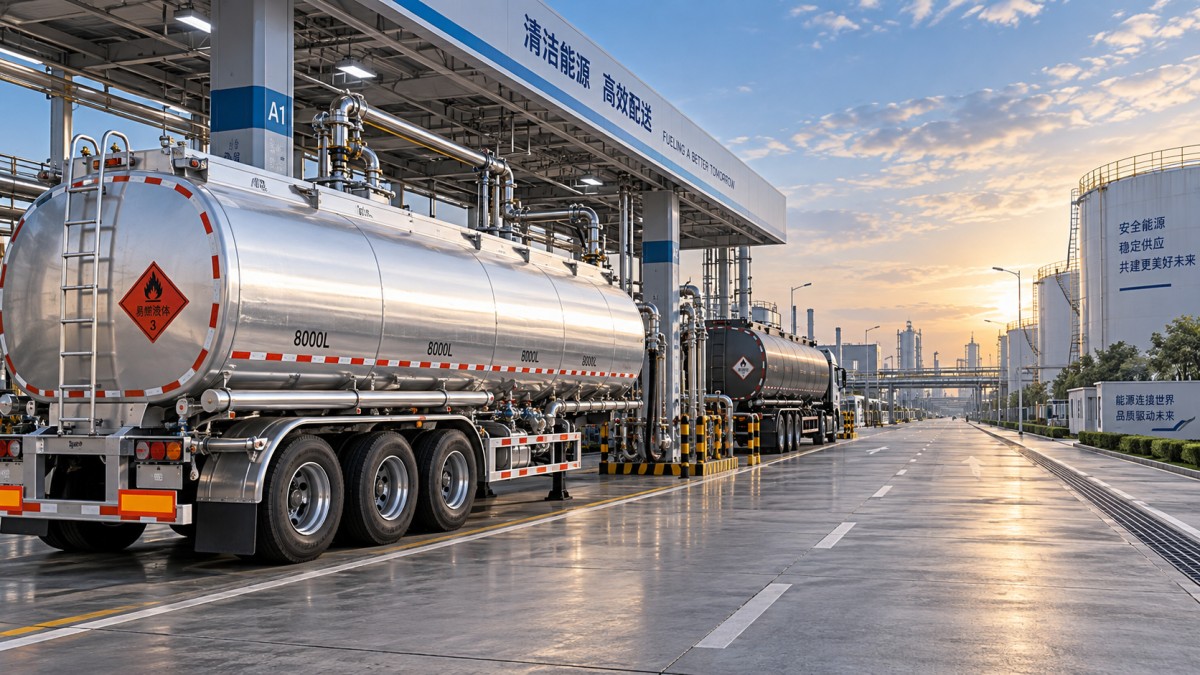
Corrosion Resistance Is Often the Longer-Term Difference
Fuel itself is only part of the corrosion picture. Tanker trailers also face rainwater, road spray, humidity, coastal air, dust, cleaning chemicals, and water trapped around brackets or external fittings. In East Africa, West Africa, and Saudi Arabia, fleets may encounter very different combinations of heat, salinity, seasonal rain, and rough-road exposure. These conditions can make exterior corrosion management a recurring maintenance issue for carbon steel tankers.
Aluminum alloy naturally develops a protective oxide layer, which is why it is widely considered for fuel tanks where long-term corrosion resistance is a priority. It is not maintenance-free. Damage to surfaces, unsuitable cleaning agents, poor isolation between dissimilar metals, or neglected fittings can still create problems. The practical advantage is that aluminum generally avoids the same pattern of rust development associated with exposed carbon steel, particularly around the tank shell and structural interfaces.
For operators with long replacement cycles, corrosion resistance can be more valuable than the initial material difference. A tanker that remains structurally sound and presentable is easier to inspect, maintain, and retain in service. However, the chassis, suspension, landing gear, and external pipework still require corrosion protection regardless of whether the tank barrel is aluminum or steel.
Aluminum Is Not Simply “Stronger” or “Safer”
Material comparisons are often oversimplified. Aluminum alloy and carbon steel behave differently under fabrication, vibration, impact, and repair. Aluminum tank construction requires suitable alloy selection, competent welding procedures, careful stress management, and a design that accounts for repeated road loading. Carbon steel is familiar to many workshops and can be easier to repair in locations where aluminum welding expertise is limited.
That local repair reality should not be ignored. A fleet operating far from major cities may value the availability of steel repair capability. Conversely, a high-utilization fleet with organized preventive maintenance may place greater value on the lower weight and corrosion resistance of aluminum. Safety comes from the entire tanker system: properly designed compartments and baffles, secure manholes and valves, reliable braking and suspension, sound electrical protection, disciplined loading, and trained drivers. Tank material alone cannot compensate for weak engineering or poor operating control.
Where Carbon Steel Still Makes Practical Sense
Carbon steel remains a workable and often sensible option for certain oil-transport projects. It can suit fleets whose priority is a robust, familiar configuration, especially when payload limits do not make tare weight critical or when the operator has established steel-maintenance resources. It can also be selected when a project specification, budget structure, or local servicing network points in that direction.
A useful reference configuration is the 34 m³ 3-Compartment Carbon Steel Oil Tanker. Its 34,000 L capacity and three-compartment layout show why carbon steel tankers remain relevant for multi-grade fuel delivery. The tank shell is specified at 4 mm carbon steel with 5 mm end plates, while the three 13-ton axles and reinforced heavy-duty mechanical suspension with 70 mm pins are intended for demanding transport work. Specifications such as 385/65R22.5 tyres and final overall dimensions still need to be assessed against route conditions and approved design drawings.
The important point is that a well-configured carbon steel tanker is not an inferior product by default. It is a different commercial and maintenance decision. The mistake is choosing it only because its purchase price appears lower, without estimating coating upkeep, corrosion exposure, extra tare weight, and downtime over the planned service period.
A Better Way to Compare Tanker Materials
Before selecting an aluminum alloy or carbon steel oil tanker truck, procurement teams should compare the same operating scenario rather than comparing brochure descriptions. Start with the fuel grades to be carried and the number of compartments required. Then confirm the permitted gross and axle loads on the actual routes, including any cross-border requirements. A large nominal volume has little value if the trailer cannot legally carry it at the intended fuel density.
Next, examine the maintenance environment. Is the fleet based near a workshop capable of aluminum repair? Are routes coastal, humid, or heavily exposed to road spray? How frequently is the tanker washed, and what cleaning products are used? These questions are more useful than a generic claim that one material always lasts longer.
Finally, separate the tank body decision from the semi-trailer specification as a whole. Axles, suspension, braking system, kingpin, landing gear, piping, valves, compartment design, and chassis reinforcement need to match the duty cycle. A light aluminum barrel fitted to an unsuitable running gear package will not deliver the expected return; neither will a heavy steel tank built without enough attention to corrosion protection and load distribution.
Selecting for the Route, Not the Sales Sheet
For high-mileage fuel distributors and logistics fleets working under tight weight controls, aluminum alloy tankers are often the stronger long-term choice. Their lower tare weight supports transport efficiency, while their corrosion resistance reduces one of the persistent maintenance concerns in demanding climates. The higher initial investment should be evaluated against payload opportunity, anticipated utilization, and the planned ownership period.
For projects that rely on straightforward steel repair, operate with less weight sensitivity, or require a proven heavy-duty steel configuration, carbon steel can remain appropriate. Shandong ORNN Vehicle Co., Ltd., with 17 years in semi-trailers and transport equipment, works across fuel, chemical liquid, general cargo, and heavy-equipment transport applications. Experience serving operators, oil companies, fuel distributors, logistics fleets, and dealers in East Africa, West Africa, and Saudi Arabia reinforces a simple purchasing lesson: the best tanker is the one whose material, capacity, running gear, and maintenance plan all fit the route it will actually run.
A final specification review should therefore include local axle limits, fuel grades, compartment volumes, workshop capability, corrosion exposure, and the required delivery configuration. That is where the aluminum-versus-carbon-steel decision becomes a defensible operational choice rather than a guess based on initial price.
Get Quote Form
Please complete the form below, and our product experts will contact you within one business hour. All inquiry details are kept strictly confidential and used solely to provide you with a precise solution.
✅ 24/7 Engineer Online Support | Ready for any technical inquiries.
✅ Full Export Documentation Support | We provide full set of shipping documents to ensure smooth customs clearance.
LOGO
This stunning beach house property is a true oasis, nestled in a serene coastal community with direct access to the beach.
Opening Hours
Monday - Friday : 9AM to 5PM
Sunday: Closed
Closed during holidays
Contact
+18888888888
hezuo@eyingbao.com123 West Street, Melbourne Victoria 3000 Australia
Request a Free Quote Today
Need mainstream models or custom specs? Our engineers are ready.
Contact us today for a lasting partnership!