


Products
News
- ▶ How axle weight limits affect loading a six-compartment oil tanker
- ▶ What to check in a six-compartment tanker quotation
- ▶ How vapor recovery works on a six-compartment oil tanker
- ▶ Why a six-compartment tanker valve may leak after unloading
- ▶ Which dangerous goods rules apply to a six-compartment oil tanker?
How axle weight limits affect loading a six-compartment oil tanker
A six-compartment tanker can be within its total gross weight limit and still overload an axle or axle group. The loading plan therefore has to account for both the mass of fuel and where that mass sits in relation to the tractor and trailer axles. Start with an empty-vehicle weighing, convert each planned compartment volume into mass using the relevant fuel density, and use an approved loading chart or verified axle-load calculation to choose the distribution. Confirm the result on a weighbridge before the vehicle enters the road.
A tank's 45,000 L capacity describes available volume, not an automatic legal payload. The permitted load is constrained by the applicable route limits, the vehicle's plated ratings and the actual empty axle weights. A change of tractor, fuel grade or delivery sequence can change the usable load even when the same trailer is used.
From compartment volume to axle load
Fuel is loaded in litres, while axle limits are expressed in mass. For each compartment, multiply the planned volume by the fuel density at the relevant temperature and in compatible units. For example, if a loading document gives a density of 0.84 kg/L for the condition used in the calculation, 5,000 L represents 4,200 kg of product. This is an illustrative calculation, not a density to assume for every diesel delivery.
Repeat the calculation for all six compartments and add the product masses. Include the actual tare mass of the complete combination, including the tractor, trailer, driver, fuel in the tractor tanks, hoses, fittings and other equipment carried. The resulting gross mass must remain within every applicable gross vehicle and combination limit. It must also remain within the ratings of the relevant components and axle groups.
Where density is quoted at a reference temperature and the meter records volume at another temperature, use the terminal's documented temperature-corrected method. Do not multiply an observed volume by a density at a different reference condition without the appropriate correction. Allow for the permitted filling level and thermal expansion as specified for the product and tank; physical tank capacity is not a target to exceed.
The 45 m³ 6-Compartment Aluminum Alloy Oil Tanker Semi-Trailer has six compartments and a tri-axle arrangement. Its listed axles each have a 13-tonne capacity, but adding those ratings does not establish the legal cargo allowance or the permissible load for the axle group. The tank, suspension, tyres, tractor, coupling and route restrictions must also be considered.
Where the fuel sits changes the result
A semi-trailer transfers part of its weight through the kingpin to the tractor and the remainder to the trailer axle group. Loading a compartment farther forward generally transfers a greater share of that compartment's mass to the tractor through the coupling. Loading farther rearward generally increases the share carried by the trailer axles. The exact shares depend on the compartment's centre of mass, axle positions, coupling position and vehicle geometry.
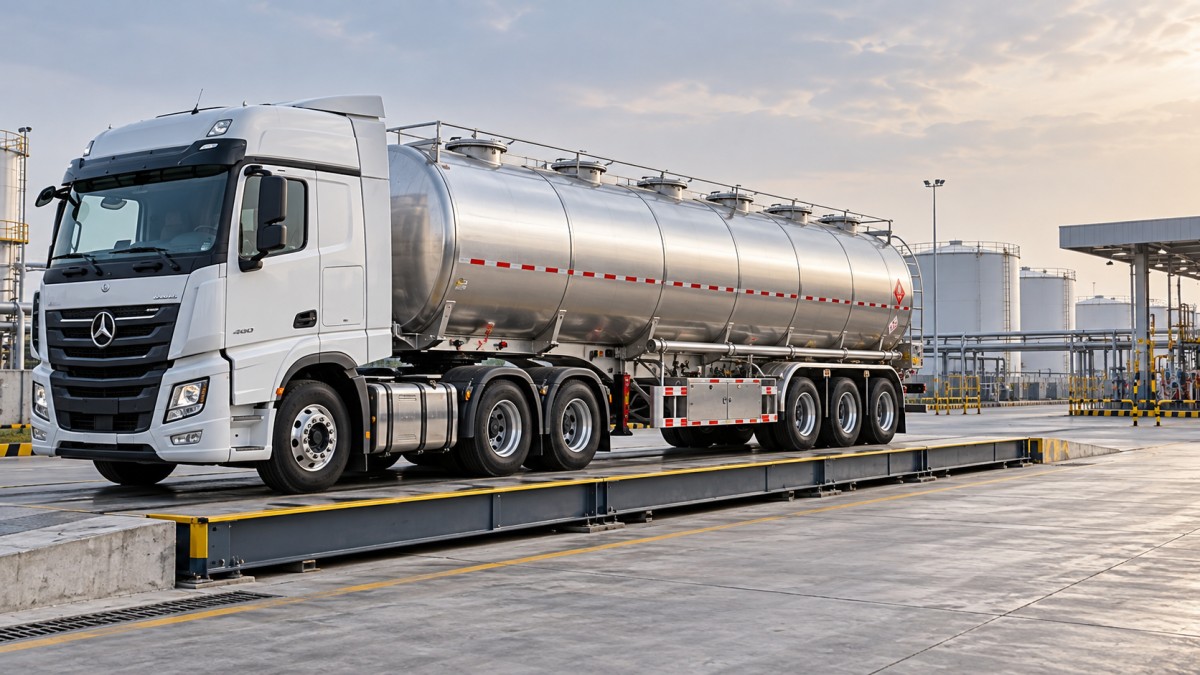
This distinction matters when the gross combination mass is acceptable but one group is close to its limit. Moving some planned product from a rear compartment to an appropriate forward compartment may reduce trailer axle-group load, but it will also increase coupling load and change tractor axle loads. A tractor drive axle that is already near its limit may leave little room for that adjustment. The effect on the steering axle depends on the tractor's geometry and coupling position, so it should be calculated or measured rather than assumed.
Compartment numbers alone do not show their leverage. A tank drawing or loading chart should identify compartment capacities and positions. Two chambers containing the same number of litres can impose different axle loads if they are at different locations, and equal volumes of different products can have different masses. Use the actual loading arrangement, not a rule such as filling the front three or rear three compartments first.
Using a loading chart
A vehicle-specific chart may give permissible compartment combinations, axle-load contributions or a method for calculating them. It is useful only when its assumptions match the combination being loaded: tractor configuration, coupling position, suspension condition, compartment layout and tare weights all matter. A chart prepared for one tractor is not automatically valid after a tractor change.
For a calculation based on measured axle-load contributions, add the empty axle weights to the predicted contribution from each planned compartment. Compare the result separately with the applicable steering axle, drive axle, trailer axle and axle-group limits, as well as gross limits and equipment ratings. Leave a practical margin for measurement uncertainty, density variation and equipment carried. If the chart does not cover the intended combination or loading pattern, obtain a suitable calculation or controlled weighing rather than estimating from compartment position alone.
Set the load before opening the loading valves
Record the compartment number, intended product, target volume and calculated product mass on the loading plan. Use the terminal's product identification and tank procedures to prevent cross-contamination. A compartment's permitted fill level and remaining capacity must be confirmed before assigning a volume; an axle calculation cannot make an overfilled chamber acceptable.
Weighing the empty combination provides a starting point. Record the tractor steering axle, drive axle or drive group, and trailer axle group where the scale arrangement permits. An empty weight from an earlier trip can be misleading after a tractor swap, maintenance, a change in onboard equipment or a different quantity of fuel in the tractor tanks. Residual liquid in the trailer also belongs in the starting weight and must be accounted for in the compartment plan.
Before loading begins, compare the calculated final weights with both legal limits on the intended route and the vehicle's plated or documented limits. Apply the most restrictive relevant limit. Axle spacing and the way local rules define axle groups can affect the allowed mass, so a single figure copied from an axle specification is insufficient. Confirm the route requirements, including any jurisdictions crossed, before fixing the final quantities.
During loading, use the terminal's metering and compartment controls to keep the actual quantities aligned with the plan. If a compartment receives a different volume or a different product is substituted, recalculate the affected masses and axle distribution before treating the plan as valid. A small volume correction in a rear compartment has a different axle effect from the same correction near the front.
Mixed products and partial compartments
Six compartments offer flexibility for separate products and deliveries, but each additional product adds a density and a delivery constraint. A compartment carrying a denser fuel contributes more mass per litre than one carrying a lighter product. Swapping their positions without recalculating can shift weight between the tractor and trailer even though total litres remain unchanged.
Partial filling also needs attention. Liquid movement during braking, acceleration and cornering affects handling, and the acceptable fill condition depends on the tank's design, compartment arrangement, product and applicable requirements. Follow the tank documentation and relevant operating rules for permitted filling levels. Do not assume that six compartments eliminate surge or that a particular partial-fill percentage is universally safe.
Axle compliance is a static measurement; it does not by itself establish that the load is stable under every driving condition. Keep compartment closures secured, use the specified loading and unloading procedures, and drive with the handling characteristics of the actual load in mind.
Plan for the delivery sequence, not only departure
A six-compartment delivery route can begin with compliant axle weights and develop an overload after the first discharge. Removing fuel from a forward compartment reduces the load transmitted through the coupling relative to the trailer group; removing product from a rear compartment can have the opposite distribution effect. The exact change requires the vehicle-specific calculation. Gross weight falls after a delivery, but an individual axle or group can still exceed its limit.
Calculate or otherwise verify the load state after each planned drop, particularly when a large compartment is emptied while others remain full. The sequence may need to change, or the initial distribution may need adjustment, to keep every road leg within limits. Product segregation and the customer's required delivery quantities still apply; do not transfer fuel between compartments unless the equipment, product procedures and applicable rules permit it.
Unexpected changes deserve the same treatment. A refused delivery, a split delivery or a change of destination can leave a different pattern of full and empty chambers from the one assessed at loading. Before continuing, compare the remaining compartment quantities with the approved load states or obtain a new axle weighing. A lighter gross weight alone is not proof that every axle is legal.
Use the weighbridge to confirm the real combination
After loading, weigh the combination on a suitable calibrated scale using the facility's procedure. Obtain the individual axle or axle-group readings needed for the route, as well as the gross combination weight. If the platform cannot capture the required groups at once, follow its approved positioning method: slopes, brakes, suspension articulation and poor alignment can distort readings. Keep the vehicle in the condition required by the scale procedure.
Compare the measured figures with the predicted loading plan. A discrepancy may come from an incorrect tare, an actual volume or density different from the planned value, a compartment assignment error, scale positioning or a change in vehicle configuration. Investigate a material difference before departure instead of treating the gross reading as the only pass or fail.
If a limit is exceeded, stop and revise the load through the terminal's authorized procedures. Removing product from the overloaded end can help, but it also changes the load on other axles; calculate and weigh the revised arrangement again. Do not rely on shifting the tractor or changing suspension settings unless the vehicle instructions and applicable rules expressly permit the adjustment and the resulting axle loads are verified.
The listed configuration includes air suspension and a front lift axle. Its operating position must follow the vehicle instructions and applicable road requirements. Do not assume that a raised axle leaves the same axle-group capacity available, or that lowering it automatically makes an overweight load compliant. Weigh the vehicle in the configuration in which it will travel.
Get Quote Form
Please complete the form below, and our product experts will contact you within one business hour. All inquiry details are kept strictly confidential and used solely to provide you with a precise solution.
✅ 24/7 Engineer Online Support | Ready for any technical inquiries.
✅ Full Export Documentation Support | We provide full set of shipping documents to ensure smooth customs clearance.
LOGO
This stunning beach house property is a true oasis, nestled in a serene coastal community with direct access to the beach.
Opening Hours
Monday - Friday : 9AM to 5PM
Sunday: Closed
Closed during holidays
Contact
+18888888888
hezuo@eyingbao.com123 West Street, Melbourne Victoria 3000 Australia
Request a Free Quote Today
Need mainstream models or custom specs? Our engineers are ready.
Contact us today for a lasting partnership!