


Products
News
- ▶ How vapor recovery works on a six-compartment oil tanker
- ▶ Why a six-compartment tanker valve may leak after unloading
- ▶ Which dangerous goods rules apply to a six-compartment oil tanker?
- ▶ How aluminum tanker weight affects allowable fuel payload
- ▶ How to confirm the tank volume in a 50 m2 fuel tanker listing
How vapor recovery works on a six-compartment oil tanker
How vapor recovery works on a six-compartment oil tanker
Vapor recovery on a six-compartment oil tanker controls hydrocarbon vapors displaced during loading and unloading, helping operators reduce emissions and manage fire risks. For technical evaluators considering a 45 m2 6-CompartmentAluminum Alloy Oil TankerSemi-Trailer, understanding how compartment vents, vapor collection piping and recovery connections work together is essential. The practical question is not simply whether a trailer has a vapor outlet, but whether its entire flow path is compatible with the products, operating sequence and terminals it will serve.
One specification deserves clarification before any engineering review: “m2” denotes area, not tank capacity. If the intended capacity is 45 m³, it should be confirmed in the approved drawings and compartment schedule rather than inferred from the product name. Capacity, filling limits and axle loads are separate checks.
The vapor path during bottom loading
When fuel enters a compartment, it occupies space previously held by a mixture of air and hydrocarbon vapor. In a closed loading arrangement, that displaced mixture passes through the compartment’s vapor vent into a collection manifold. From there, it travels through the trailer’s vapor recovery connection and the terminal’s vapor hose to the terminal recovery or treatment system.
The terminal equipment may recover hydrocarbons or treat the vapor by another approved method; the trailer itself does not necessarily perform that treatment. Its job is to provide a controlled, sufficiently sized and leak-tight path between each active compartment and the terminal connection.
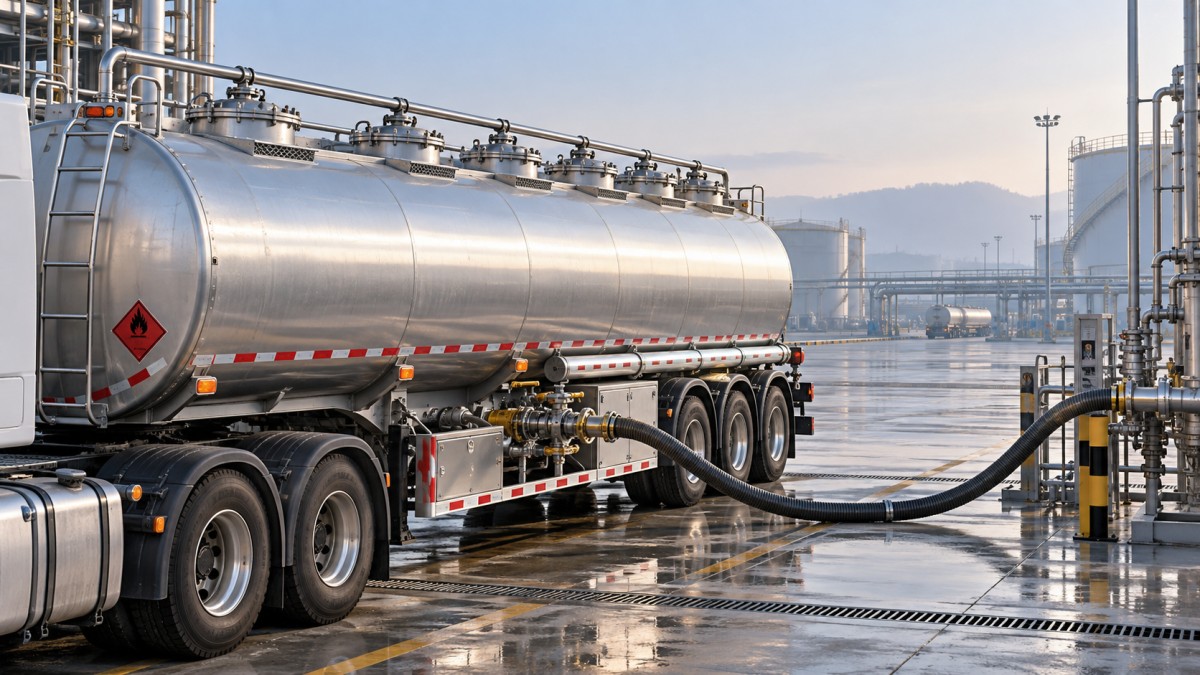
Six compartments make the arrangement more involved than a single tank with one vent. Each compartment needs a defined path for vapor, but the paths may join a common manifold before reaching the terminal. The design must account for which compartments can be loaded simultaneously, how their vapor valves open, and whether the manifold can carry the combined flow without excessive backpressure.
A closed manhole cover is part of that flow path. If a cover seal leaks, displaced vapor can escape before it reaches the recovery hose. Conversely, if a vapor valve fails to open or the terminal connection is obstructed, pressure can rise in the compartment. A recovery system therefore depends on both containment and an unobstructed outlet.
What changes during unloading?
During delivery, liquid leaving a compartment must be replaced by gas. Without an adequate path for incoming gas, a vacuum can develop and potentially damage the tank or interrupt discharge. Depending on the site and trailer configuration, replacement gas may enter through an approved venting arrangement or be returned from the receiving tank through a vapor balance connection.
Vapor balancing is not the same as sending vapors to a terminal recovery unit. In a balanced delivery, vapor displaced from the receiving tank can return to the trailer as fuel is discharged. Whether that arrangement is required or available depends on the product, receiving installation and applicable local rules. Evaluators should not assume that a loading-terminal vapor connection automatically makes every unloading site compatible.
The pressure and vacuum relief devices remain protective safeguards, not substitutes for a properly designed operating flow path. Their settings and capacity must be compatible with the tank design and applicable requirements. Normal loading or unloading should not rely on a relief valve repeatedly opening to compensate for an undersized or blocked line.
Six compartments, one manifold: where problems appear
A shared manifold reduces the number of external connections, but it also introduces interactions between compartments. When products with different specifications are carried together, vapor communication through a common line may be relevant to product quality and operational approval. The extent of that risk depends on the products, valve arrangement and loading sequence; the piping diagram should make the available isolation clear.
The manifold should also be reviewed for liquid accumulation. Condensate, residual fuel or an unfavorable pipe routing can restrict the vapor passage or reach a connection where liquid is not expected. Ask how the design manages low points and how inspection or maintenance is performed safely. A visually tidy pipe run is not evidence that it will drain or remain clear in service.
Valve operation matters just as much. Some systems use interlocks or pneumatic controls to coordinate vapor valves with loading equipment. The evaluator should establish what happens on loss of air supply or control signal, which valves close, and how an operator can identify a fault. The answer must come from the actual control logic, not from a generic component list.
Terminal compatibility is more than a matching coupling
A vapor adaptor that physically connects to a hose is only the starting point. The terminal and trailer must also agree on the allowable pressure range, expected loading rates, connection position and operating sequence. A terminal may have its own permissives for bonding, overfill prevention or vapor connection status. These should be checked against the proposed trailer equipment before fabrication is finalized.
A useful technical review normally asks for the following documents and answers:
- A compartment layout and piping diagram showing each vapor valve, common line, isolation point and external connection.
- The intended products, maximum simultaneous loading configuration and design basis for vapor-line sizing and pressure drop.
- Connection type, location and accessibility, checked against the actual loading and delivery sites.
- Details of overfill protection, bonding provisions and any interlocks required by the terminal or operating procedure.
- Tank design pressure and vacuum limits, relief-device specifications and the method used to verify leak tightness.
- Applicable standards, inspection records and approval documents for the destination and intended service.
These documents should describe the delivered configuration, including optional components. A general brochure may show a vapor recovery system without establishing the valve positions, pipe sizes or connection standard on a particular trailer.
Standards and safety checks need a project-specific basis
Standards may address different parts of the problem: tank construction, equipment interfaces, vapor recovery performance, electrical equipment and operational controls. For example, EN 13081 addresses vapor collection adaptors for road tankers, while EN 13082 covers vapor transfer valves. Their relevance, edition and required conformity should be confirmed for the destination and the particular equipment. Referencing a standard does not establish that a trailer or component is certified to it.
National dangerous-goods rules, terminal specifications and the requirements of the local authority or operator may impose additional conditions. This is especially important for fleets working across borders or supplying several terminals: a vehicle accepted at one site is not automatically accepted everywhere.
Hydrocarbon vapor can form a flammable mixture with air. Closed vapor handling reduces uncontrolled releases, but it does not eliminate ignition risk. Bonding and grounding arrangements, appropriate electrical equipment, control of ignition sources and site procedures remain necessary. Flame arresters, where specified, require careful selection and maintenance; their presence should not be assumed, and they are not a substitute for the rest of the safety system.
How to assess the system before and after delivery
Before approving a design, trace the path from each compartment to the terminal interface on the drawings. Check the worst credible loading arrangement rather than just a single compartment operating alone. The manufacturer or system designer should demonstrate that expected pressure losses, valve capacities and relief provisions remain within the tank and terminal limits.
At delivery, compare installed equipment with those drawings. Identify each compartment valve and verify its actuation and indication using the agreed procedure. Inspect accessible seals, hoses, caps and fittings, and review the results of the specified leak and functional tests. Tests should be performed by competent personnel using an approved method; improvised pressure testing can itself create a hazard.
In service, recurring faults may be less dramatic than a failed loading operation. A damaged adaptor seal, sticking valve, obstructed line or poorly seated manhole can undermine recovery while the vehicle still appears usable. Maintenance records should make it possible to distinguish a trailer fault from a terminal hose or control-system fault, especially when the same vehicle visits multiple sites.
Do not transfer specifications between different liquid cargos
A liquid tanker’s material and insulation do not determine its suitability for gasoline vapor recovery. The 38 m³ Stainless Steel Insulated Palm Oil Tanker, for example, is a single-compartment insulated design for liquid and palm oil transport, with a 304 stainless steel tank body. Its 38,000 L capacity and cargo application are different from a six-compartment fuel trailer. Vapor controls, fittings and approvals must be assessed for the actual cargo and service rather than carried over from that specification.
Shandong ORNN Vehicle Co., Ltd. manufactures fuel and chemical liquid tanker trailers alongside other semi-trailers, and has 17 years of industry experience. For projects involving operators in East Africa, West Africa or Saudi Arabia, the practical starting point is the same: establish the products, compartment capacities, destination requirements and terminal interfaces, then use those inputs to review the proposed drawings and test documentation before ordering.
Get Quote Form
Please complete the form below, and our product experts will contact you within one business hour. All inquiry details are kept strictly confidential and used solely to provide you with a precise solution.
✅ 24/7 Engineer Online Support | Ready for any technical inquiries.
✅ Full Export Documentation Support | We provide full set of shipping documents to ensure smooth customs clearance.
LOGO
This stunning beach house property is a true oasis, nestled in a serene coastal community with direct access to the beach.
Opening Hours
Monday - Friday : 9AM to 5PM
Sunday: Closed
Closed during holidays
Contact
+18888888888
hezuo@eyingbao.com123 West Street, Melbourne Victoria 3000 Australia
Request a Free Quote Today
Need mainstream models or custom specs? Our engineers are ready.
Contact us today for a lasting partnership!