


Products
News
- ▶ How to confirm the tank volume in a 50 m2 fuel tanker listing
- ▶ When is a four-compartment carbon steel tanker a practical choice?
- ▶ How does corrosion develop inside a carbon steel fuel tanker?
- ▶ How to inspect a carbon steel fuel tanker for internal corrosion
- ▶ Can a four-compartment carbon steel tanker deliver multiple grades?
How to confirm the tank volume in a 50 m2 fuel tanker listing
A listing for a 50 m2 4-Compartment Carbon Steel Fuel Tanker does not, by itself, establish the tank’s capacity. Square metres measure area, while tanker capacity is expressed as a volume, normally in cubic metres or litres. The seller may intend “50 m³,” equivalent to 50,000 litres, but that interpretation should be confirmed in the quotation and technical documents before the price is compared or an order is placed.
The next question is what the stated 50,000 litres represents. A supplier may quote the full geometric capacity of the tank, a nominal capacity at a defined filling level, or a usable loading capacity under specified conditions. Those figures can differ. For a four-compartment trailer, the buyer also needs the capacity and intended filling limit of each compartment, not just a total printed in a listing.
First, turn “50 m2” into a written volume specification
Ask the supplier to replace the ambiguous unit in the offer with a capacity expressed in both cubic metres and litres. One cubic metre equals 1,000 litres, so 50 m³ equals 50,000 litres. Request a statement identifying whether that figure is the tank’s geometric capacity or another defined capacity, and whether it includes all four compartments.
Keep the wording precise. “50 m³ tanker” is a useful description, but it is not yet a complete purchase specification. A quotation should state which capacity is being promised and the reference conditions used to determine it. If the supplier uses terms such as “gross,” “nominal,” “net” or “usable,” ask for their definitions; those words should not be assumed to mean the same thing in every offer.
It is also worth checking the number against the rest of the listing. A capacity expressed in square metres may be a typing error, a mistranslation or a field populated with the wrong unit. It could also refer to an area elsewhere in the specification. Until the seller explains it, changing “m2” to “m³” in the buyer’s own comparison sheet creates a risk of treating an assumption as an agreed fact.
Reconcile the four compartments with the total
For a multi-compartment fuel trailer, ask for a compartment schedule in litres, identified by position from front to rear. Each entry should state the capacity basis and, where applicable, the intended maximum filling level. The four figures should add up to the stated total on the same basis.
For example, four equal compartments of 12,500 litres would add up to 50,000 litres. That is an arithmetic example, not a specification to infer from a four-compartment listing. The actual allocation may be unequal to suit delivery quantities, product separation or vehicle loading requirements. A buyer who needs to deliver several grades of fuel should agree the split before approving the design.
Check whether the quoted compartment figures describe capacity up to a reference fill level or capacity to the highest internal point. A supplier’s four geometric volumes should not be added together and compared with another supplier’s four operating volumes as though they were identical. Ask for any allowance for expansion or other filling restrictions to be shown separately and explained for the intended products and operating conditions.
Also ask how the supplier treats connecting pipework and discharge fittings. These volumes may be relevant to delivery or measurement, but the quotation should make clear whether they are included in any stated figure. Consistent boundaries matter when the trailer is bought to meet a defined delivery volume.
Use drawings to check the capacity claim
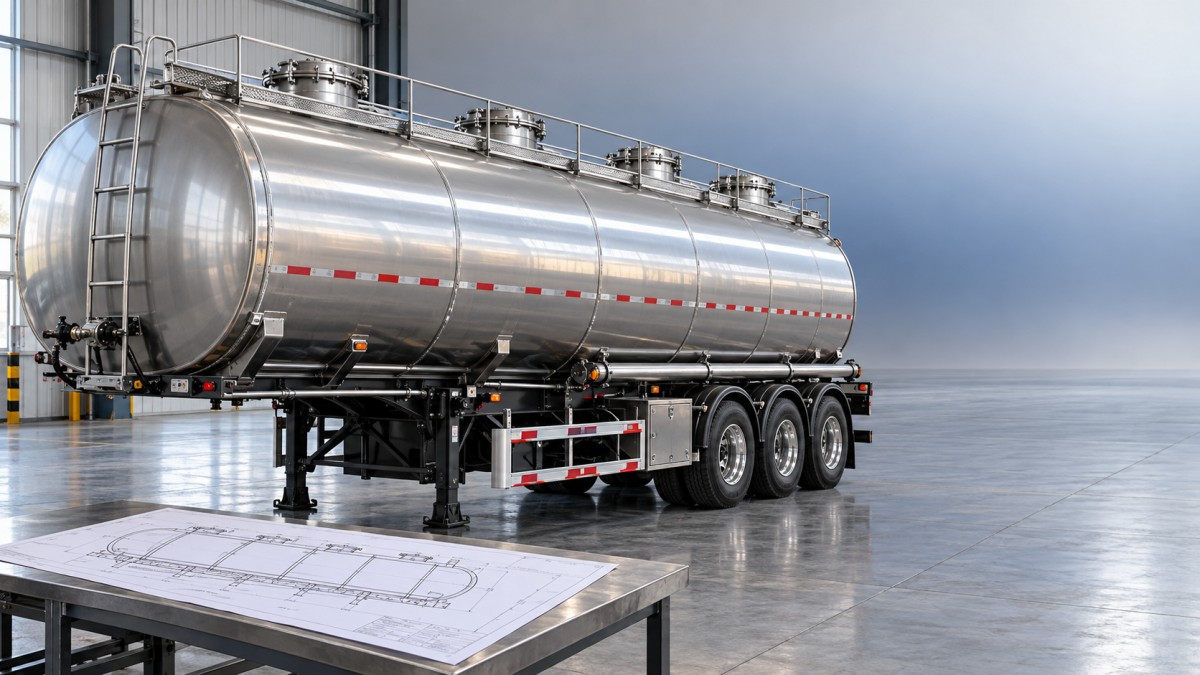
Request the proposed tank drawing and compartment layout before treating the volume as settled. The drawing should identify the tank’s internal geometry, compartment boundaries, relevant dimensions and the capacity assigned to each section. Match its revision number and design description to the quotation. If a drawing is revised after the order, the capacity schedule should be revised with it.
External dimensions can provide a rough sense check, but they are not enough to prove capacity. A fuel tanker may have a shaped cross-section, curved ends and internal partitions. Wall thickness and internal features also affect the space available for liquid. Multiplying the outside length, width and height gives the volume of a surrounding rectangular box, not the tanker’s actual internal volume.
A drawing is especially useful when comparing trailers described with similar headline figures. The 50 m³ 4-Compartment Carbon Steel Fuel Tanker, for example, is specified with a total capacity of 50,000 litres and four compartments. Its overall dimensions are to follow approved design drawings. A buyer would still need the proposed compartment allocation and the capacity basis on those drawings before deciding whether the arrangement meets a particular delivery schedule.
For that specification, the stated tank body material is 5 mm carbon steel and the end plates are 6 mm carbon steel. Those details are useful for identifying what is being quoted, but material thickness does not confirm the internal volume. Conversely, a matching capacity figure does not establish that two quotations describe identical tank construction. Keep the capacity comparison and construction comparison linked to the same drawing revision.
Where a supplier provides a capacity calculation, ask whether it uses internal dimensions and accounts for the tank shape and compartment geometry. The calculation should reconcile with the compartment schedule. It is reasonable to ask the supplier to explain a discrepancy rather than assume a small difference is harmless: it may reflect rounding, a different fill reference, a design change or a mistake.
Agree how the finished tank will be measured
Design documents describe the tank to be built; calibration or measurement records describe the capacity of the tank that is actually presented for measurement. Ask the supplier what documents will be supplied at delivery, who will perform the measurement, what method will be used and whether the documents will identify each compartment individually.
A useful calibration record should make the measurement basis clear and identify the trailer or tank to which it applies. Depending on the method and intended use, it may include a table relating liquid level to volume for each compartment. Ask whether the document records volume at a defined reference level, how temperature is handled where relevant, and whether any correction or measurement tolerance is stated.
Do not assume that a calibration certificate automatically establishes legal approval for every destination or commercial use. If the trailer will be used for transactions based on measured fuel quantities, check the destination’s applicable metrology requirements and whether the proposed calibration body and documentation will be accepted. That question can affect delivery timing and cost, so it belongs in the purchase discussion rather than being left until the trailer arrives.
The contract should also address what happens if measured capacity differs from the agreed specification. Define the capacity basis, the acceptance method and any permitted tolerance in writing. The supplier and buyer can then assess the result against the same requirement, rather than negotiate after fabrication over which figure was intended.
Separate tank capacity from legal payload
Even if the finished tank holds 50,000 litres at the agreed reference level, it does not follow that the trailer can legally carry that volume of every fuel on every route. The allowable load depends on the vehicle combination, its unladen mass, axle and gross weight limits, load distribution and the rules applicable to the journey. Fuel density also affects the mass of a given volume.
Ask the supplier for the expected unladen mass and axle-load information for the proposed configuration, then assess it against the tractor and routes in the purchasing plan. A three-axle trailer configuration is one part of that assessment, not proof that a full tank will be permissible. Check loading across individual compartments as well as the total: a partial load concentrated in the wrong position can produce an unsuitable axle distribution.
This distinction matters for cost comparisons. A larger nominal tank may appear to offer more litres per trip, yet the usable volume for a particular fuel or route may be lower because of weight or filling limits. Compare suppliers using the volume that can be carried under the buyer’s intended conditions, while keeping the tank’s measured capacity as a separate specification.
Compare quotations on the same basis
When offers arrive, place the capacity statements side by side before comparing price. A practical comparison should identify:
- The total capacity in litres and the supplier’s definition of that figure.
- The capacity and intended filling limit of each numbered compartment.
- The drawing and revision supporting the quoted arrangement.
- The proposed measurement or calibration documents and their delivery stage.
- The expected unladen mass and information needed to assess legal payload.
- The acceptance method and any agreed tolerance for the finished tank.
If one quotation says “50,000 L” and another says “50 m³ usable,” the numbers look equivalent but the offers may not be. Ask each supplier to state geometric capacity, any specified operating limit and the conditions behind those figures. Only then can a price difference be assessed against the same carrying requirement.
Before issuing the purchase order, replace the original “50 m2” wording wherever it appears in the commercial documents. The agreed capacity, compartment schedule, drawing revision and measurement requirements should follow the order through to delivery. That gives both parties a clear basis for resolving the question the listing left open.
Get Quote Form
Please complete the form below, and our product experts will contact you within one business hour. All inquiry details are kept strictly confidential and used solely to provide you with a precise solution.
✅ 24/7 Engineer Online Support | Ready for any technical inquiries.
✅ Full Export Documentation Support | We provide full set of shipping documents to ensure smooth customs clearance.
LOGO
This stunning beach house property is a true oasis, nestled in a serene coastal community with direct access to the beach.
Opening Hours
Monday - Friday : 9AM to 5PM
Sunday: Closed
Closed during holidays
Contact
+18888888888
hezuo@eyingbao.com123 West Street, Melbourne Victoria 3000 Australia
Request a Free Quote Today
Need mainstream models or custom specs? Our engineers are ready.
Contact us today for a lasting partnership!