


Products
News
- ▶ How does corrosion develop inside a carbon steel fuel tanker?
- ▶ How to inspect a carbon steel fuel tanker for internal corrosion
- ▶ Can a four-compartment carbon steel tanker deliver multiple grades?
- ▶ How tank wall thickness affects a carbon steel tanker's payload
- ▶ What drives maintenance costs for a carbon steel fuel tanker?
How does corrosion develop inside a carbon steel fuel tanker?
Corrosion inside a carbon steel fuel tanker often begins where water, fuel contaminants and oxygen come into contact with unprotected metal. In a 50 m2 4-Compartment Carbon Steel Fuel Tanker, water can collect at low points in individual compartments, making routine inspection and drainage essential. For maintenance teams, understanding how condensation, microbial growth and stagnant water contribute to corrosion is the first step toward identifying early damage, preventing leaks and planning effective maintenance.
One clarification matters before inspection planning: “m2” normally denotes area, not tank capacity. If the designation is intended to describe volume, confirm whether it should read m³ against the tanker’s nameplate and drawings. The corrosion mechanisms are similar regardless, but compartment capacity, geometry and access arrangements determine where water accumulates and how each section can be inspected.
Why fuel alone is rarely the whole problem
Clean hydrocarbon fuel does not generally corrode carbon steel in the same way that an aqueous contaminant can. The problem begins when a separate water phase reaches the steel. Water provides an electrolyte through which electrochemical reactions can occur: iron dissolves at anodic sites, while a corresponding reaction occurs elsewhere on the surface. Oxygen dissolved in the water commonly supports this process, although some corrosion mechanisms can continue where oxygen is limited.
Water can enter with a contaminated load, through inadequate cleaning or drying, or through openings and seals that do not exclude rain. Temperature changes can also cause moisture from air in the vapor space to condense on internal surfaces. The amount formed depends on humidity, temperature and operating conditions; condensation should not automatically be blamed for every wet compartment.
Once present, free water usually settles beneath the fuel. A tanker may be emptied of its saleable load while still retaining a small amount of water and sediment in a sump, around an outlet or behind an internal feature. A compartment that sits unused after washing may be particularly vulnerable if it was not adequately dried.
Where corrosion tends to start
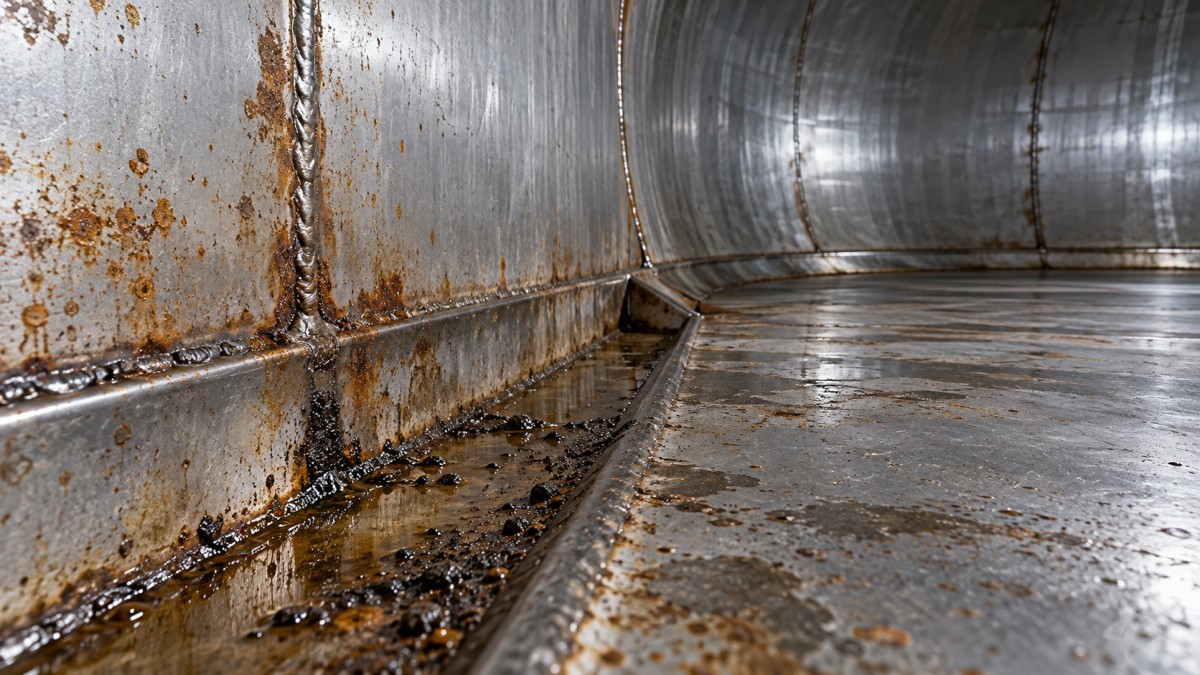
The bottom of a compartment is an obvious inspection target, but “check the bottom” is not specific enough for a useful maintenance record. Look at the geometry: the lowest point when the trailer is parked, the area around the discharge sump, and places where baffles or fittings interrupt drainage. Parking slope can change where water rests, so the lowest point shown on a drawing may not always be where residue is found in service.
Weld toes, lap areas, attachment points and crevices deserve attention because deposits or water can remain there. Corrosion can also develop at the fuel-water interface, where conditions differ from those on surrounding surfaces. In a coated tank, a scratch or damaged edge can expose steel while the rest of the coating looks sound.
General surface rust is not the only concern. Localized pitting can remove significant wall thickness over a small area, and a deposit may conceal the pit beneath it. A visually modest patch should therefore be treated as a reason to assess the underlying metal, not simply as a cosmetic defect.
The role of microbes and deposits
Microorganisms can live in water associated with fuel systems, often concentrating at the fuel-water interface or in deposits on internal surfaces. Their activity may contribute to microbiologically influenced corrosion by changing local chemistry or creating conditions beneath a biofilm that differ from the surrounding liquid. Dark sludge, unusual deposits or recurring water contamination may justify investigation, but none of these signs alone proves that microbes caused the damage.
Fuel quality, storage conditions and the presence of water all affect the risk. Maintenance staff should avoid treating a suspected microbial problem as a simple matter of adding a chemical. Any treatment must be compatible with the fuel, tank materials, downstream equipment and applicable procedures. Removing water and deposits, identifying the source and verifying the result remain part of the solution.
Sediment also matters without microbial activity. Dirt and corrosion products can trap moisture against steel and make visual inspection unreliable. When deposits repeatedly reappear in one compartment, compare its loading history, cleaning records and seals with those of the other compartments before assuming that all four have the same problem.
A practical inspection sequence
Routine checks begin outside the tank. Review previous findings, recent fuel contamination reports, repair history and the product carried in each compartment. Note seepage, staining or damaged fittings, while recognizing that an intact exterior does not rule out internal pitting.
Where the design provides a safe, approved way to check or drain water, follow the operator’s procedure for each compartment separately. Use suitable containers and control ignition sources. Record which compartment produced water or sediment, rather than entering a single result for the entire trailer. Disposal must follow the site’s environmental and waste-handling requirements.
Internal inspection is a different task. A fuel tanker compartment is a confined space with potential flammable, toxic and oxygen-deficient atmospheres. Emptying the fuel does not make it safe to enter. Entry requires a site-specific permit and a competent team using appropriate isolation, cleaning, ventilation, atmospheric testing, continuous monitoring where required, and rescue arrangements. Never rely on smell or a single gas reading to declare the compartment safe.
Where possible, use suitable remote visual equipment to investigate accessible areas without entry. The equipment and method must be appropriate for the hazardous atmosphere and the operator’s controls. Remote viewing can help locate deposits or coating damage, but it does not necessarily establish remaining wall thickness.
What to document when damage is found
A useful report identifies the compartment, position relative to a fixed feature, size and appearance of the affected area, and whether the surface was cleaned before examination. Photographs with a scale help future comparisons. Record evidence of coating disbondment, pits, weld-area damage or deposits separately; each may call for a different response.
If metal loss is suspected, a competent inspector can select an appropriate thickness-measurement method and map readings around the affected area. Ultrasonic thickness measurement is commonly used, but surface condition, curvature, coating and access can influence results. A few widely spaced readings may miss a narrow pit. Compare measurements with the original design information and the applicable inspection or repair criteria, not with an assumed universal minimum thickness.
When to remove a compartment from service
A leak, suspected through-wall defect or unexplained loss of containment requires prompt isolation and escalation under the operator’s emergency and maintenance procedures. For a deep pit or uncertain thickness, the decision is less visible but no less important: restrict use until a qualified person assesses the remaining material, the location of the damage and the applicable acceptance criteria.
Do not grind away corrosion or apply a patch merely to improve the appearance before the defect is assessed. Cleaning can be necessary for inspection, but uncontrolled metal removal can alter the evidence and reduce remaining thickness. Welding on a tank that has carried fuel introduces serious fire and explosion risks and must only be performed under an approved repair procedure after proper preparation and authorization.
After repair, retain the inspection map, measurements, repair details and any required examination or leak-test records. These documents establish a baseline for the next inspection and help distinguish a recurring water problem from a single isolated defect.
Coatings, material choice and their limits
An internal lining can separate steel from water and contaminants, but only if the specified system is suitable for the fuel and remains intact. Compatibility, surface preparation, application conditions and inspection of the finished lining all matter. A blistered or lifted lining can conceal corrosion; painting over the visible damage without investigating what lies underneath is not a sound repair strategy.
Aluminum tank construction is another design option, not a repair for an existing steel compartment. The 45 m³ 6-Compartment Painted Aluminum Alloy Tanker with Vapor Recovery System uses 5454 aluminum alloy and has six compartments. Its vapor recovery system addresses vapor handling; it should not be mistaken for a means of removing water or preventing internal corrosion. Aluminum also requires attention to fuel compatibility, water contamination and material-specific inspection and repair methods.
Shandong ORNN Vehicle Co., Ltd., a semi-trailer manufacturer with 17 years of industry experience, supplies tanker designs for fuel and other liquid transport applications. For fleets operating in East Africa, West Africa or Saudi Arabia, the useful maintenance question is not simply which material is preferred: it is whether the chosen configuration, inspection access, spare parts and documentation suit the fuel, operating environment and local requirements.
Use the right requirements for the actual tanker
Inspection intervals, allowable metal loss, repair authorization and return-to-service testing should come from the applicable jurisdiction, the tank’s design and construction documents, and the fleet operator’s procedures. Requirements can differ with the product carried and where the vehicle operates. A general cargo-tank standard or a storage-tank inspection practice should not be assumed to apply unchanged to every road tanker.
Before scheduling the next inspection, confirm the tank identification, compartment arrangement, material, original thickness information, lining specification if fitted, and previous repairs. Then use the water and defect history to decide where closer examination is needed. The most effective prevention measure is often the least dramatic one: find out why water keeps entering a particular compartment and correct that source before it creates another hidden pit.
Get Quote Form
Please complete the form below, and our product experts will contact you within one business hour. All inquiry details are kept strictly confidential and used solely to provide you with a precise solution.
✅ 24/7 Engineer Online Support | Ready for any technical inquiries.
✅ Full Export Documentation Support | We provide full set of shipping documents to ensure smooth customs clearance.
LOGO
This stunning beach house property is a true oasis, nestled in a serene coastal community with direct access to the beach.
Opening Hours
Monday - Friday : 9AM to 5PM
Sunday: Closed
Closed during holidays
Contact
+18888888888
hezuo@eyingbao.com123 West Street, Melbourne Victoria 3000 Australia
Request a Free Quote Today
Need mainstream models or custom specs? Our engineers are ready.
Contact us today for a lasting partnership!