


Products
News
- ▶ How tank wall thickness affects a carbon steel tanker's payload
- ▶ What drives maintenance costs for a carbon steel fuel tanker?
- ▶ How to check a four-compartment fuel tanker's pressure test records
- ▶ What can a 45 m3 single-compartment oil tanker truck carry?
- ▶ Is a 45 m3 single-compartment tanker suitable for short routes?
How tank wall thickness affects a carbon steel tanker's payload
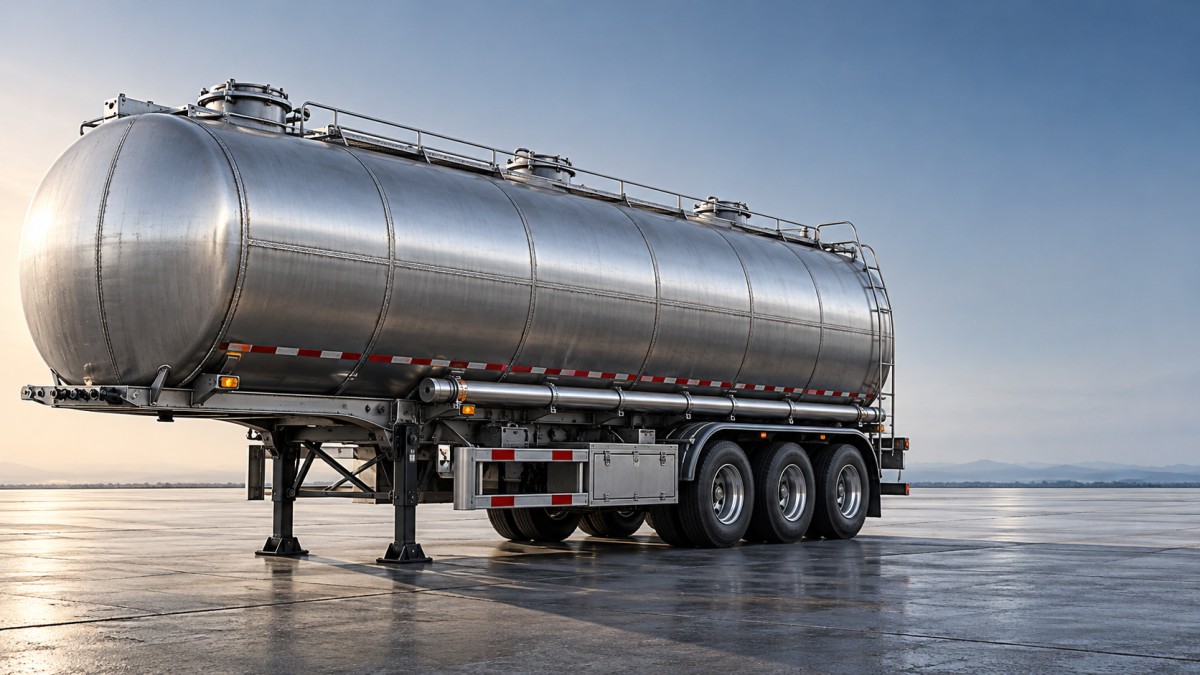
Thicker carbon steel plate increases a tanker’s empty weight, but it does not automatically reduce the fuel volume carried on every trip. The effect depends on whether the vehicle is limited by weight, tank volume, axle loads or a combination of all three. For a buyer comparing a 50 m2 4-Compartment Carbon Steel Fuel Tanker, the first point to resolve is the unit: m² describes area, not tank capacity. If the intended capacity is 50 m³, the tanker holds 50,000 litres at its stated geometric capacity; the permitted operating fill may be lower.
The useful question is therefore not simply how much one millimetre of steel weighs. It is how much additional finished-vehicle mass a thickness change creates, where that mass is distributed, and whether the remaining design still meets the relevant structural and transport requirements.
How a thickness change adds weight
For a steel plate of known area, the calculation is straightforward:
Change in plate mass = plate area × change in thickness × steel density.
Use consistent units: area in square metres, thickness in metres and density in kilograms per cubic metre. As an illustrative calculation, carbon steel density can be taken as approximately 7,850 kg/m³. Increasing the thickness of one square metre of plate by 1 mm therefore adds about 7.85 kg before allowances for fabrication.
Suppose the shell plates affected by a proposed change have a developed area of 100 m². Increasing only those plates by 1 mm adds approximately 785 kg of steel. That is a worked example, not a claimed shell area or weight for a particular 50 m³ tanker. A smaller affected area produces a smaller increase; changing the ends and internal plates as well adds more.
The calculation also assumes the same geometry. A redesigned vessel may need different supports, welds or reinforcement, so the change in finished tare mass can differ from the plate-only estimate. Ask the manufacturer for both the area-based calculation and the resulting vehicle mass.
Which plates are actually getting thicker?
A specification that says “6 mm tank” is incomplete. The cylindrical or shaped shell, end plates, compartment bulkheads and internal surge-control plates can have different thicknesses and functions. A comparison is useful only when both proposals identify the same components.
The shell usually accounts for a substantial area, so a uniform shell increase can have a noticeable effect on tare mass. End plates and compartment bulkheads cover less area individually, but their total contribution matters, particularly when several plates are changed together. Reinforcement around openings and supports can add mass without appearing in the headline shell thickness.
Compartment bulkheads separate products or loads; surge-control plates limit liquid movement where required by the design. They should not be treated as interchangeable, and the presence of four compartments does not by itself establish the number or geometry of every internal plate. Obtain a drawing or plate schedule showing each component, its material and nominal thickness.
Also distinguish nominal plate thickness from the thickness available after forming, any specified manufacturing allowance and the minimum permitted in service. These are different figures. An apparently heavier proposal may include an allowance or detail that another proposal omits, rather than simply using excess steel.
When does lower tare translate into more payload?
Payload is the mass available for the liquid and any other load after the relevant vehicle operating mass has been accounted for. For an articulated combination, a practical starting point is:
Available payload by mass = applicable combination mass limit − actual operating mass of tractor and empty trailer.
The operating mass should reflect the configuration being assessed, including the tractor, fuel, driver and equipment as applicable. Keep the mass basis consistent when comparing quotations: a bare trailer tare is not the same as a complete combination ready for work.
If the combination is already weight-limited, removing 500 kg of tare can theoretically create up to 500 kg of additional payload under the same overall mass limit. It does not guarantee that the whole saving can be used. An axle or axle group may reach its limit first, and the loading plan must still satisfy any applicable compartment fill restrictions.
If the tanker reaches its permitted fill volume before reaching a mass limit, a lighter tank may provide no additional litres on that trip. It can still provide operating flexibility, but the benefit should not be presented as extra carrying capacity without a loading calculation.
Liquid density connects these two limits. Payload mass divided by the liquid’s density gives an approximate corresponding volume, using density at the relevant temperature and consistent units. Different fuels, and the same fuel at different temperatures, can occupy different volumes for the same mass. The permitted loading volume must also leave any required space for expansion; geometric capacity should not be assumed to be the routine fill volume.
Four compartments make axle distribution part of the answer
Two loading plans with the same total liquid mass can produce different loads at the kingpin and trailer axles. A forward compartment places the load differently from a rear compartment, and partial deliveries change the distribution during a journey. A tanker can be within its total mass limit while an individual axle group is overloaded.
For a meaningful comparison, assess the proposed tanker with the intended tractor and representative compartment loading patterns. Include a fully loaded departure, expected partial loads after deliveries, and any cases where one compartment carries a denser product than another. The manufacturer’s axle-load calculations should show the assumptions used for compartment capacities, liquid density and load positions.
Thickness changes can also affect distribution. Extra steel in the front, rear or internal bulkheads does not necessarily load every axle in the same proportion. For small changes, a simple total-mass estimate may be adequate for screening; for a purchase decision close to an axle limit, use the revised weight distribution.
Why thinner plate is not automatically the better specification
A tanker shell is part of a system that must resist liquid loads, vehicle movement and stresses introduced through its supports. Braking, cornering, road inputs and repeated load cycles all influence the design. Local stresses around manholes, outlets, mounting points and welded joints may govern details even when a broad shell-area calculation suggests that thinner plate would save weight.
Service conditions matter as well. Corrosion, abrasion, maintenance practices and the products carried influence the thickness margin needed throughout the intended life. A nominal thickness that is acceptable in one design cannot be transferred to another without considering geometry, material grade, fabrication and service assumptions.
That does not mean thicker is always better. Additional plate mass consumes weight allowance, and adding thickness without reviewing the rest of the structure may not address the actual stress concentration or deterioration mechanism. The sound comparison is between complete designs that meet the same duty, not between isolated shell numbers.
Route conditions can change the trade-off. A vehicle operating primarily on smooth roads with controlled loading may have a different duty profile from one regularly exposed to rough roads and frequent partial deliveries. Describe the expected routes, load cycles, products and service life when requesting a design; those inputs give the manufacturer a basis for its structural choices.
What to request for a technical comparison
Ask competing suppliers to provide information on the same basis. The most useful package connects the plate schedule to the finished vehicle and its intended load:
- Tank construction: material grade and nominal thickness for the shell, ends, compartment bulkheads, surge-control plates and significant local reinforcement.
- Capacity drawing: total and individual compartment capacities, with the loading assumptions and permitted fill arrangements used for the intended products.
- Mass breakdown: estimated or measured trailer tare, included equipment, and the expected change in mass between thickness options.
- Load distribution: kingpin and axle-group loads for the specified tractor and representative full and partial loading cases.
- Design basis: the applicable regulations and standards identified for the vehicle, route and cargo, together with relevant design and inspection documentation.
Distinguish a calculated mass from a weighbridge measurement of the finished vehicle. Estimates are useful during design, but fittings, piping, running gear and manufacturing variation affect the final result. A measured tare, recorded with the equipment configuration, gives the loading team a stronger basis for setting operating limits.
The design basis should also identify what the thickness figures mean. Ask whether they are nominal starting plate values or minimum values at a stated stage, and how forming, corrosion allowance and inspection are addressed. This prevents two quotations with the same number from being treated as equivalent when their underlying assumptions differ.
Comparing carbon steel with an aluminum alternative
Changing material is a separate decision from reducing steel thickness. Aluminum and carbon steel differ in density and mechanical properties, so an aluminum tank cannot be assessed by substituting one material’s density into an otherwise unchanged steel design. Plate thickness, joint design, supports and the complete trailer specification all affect the resulting tare and service performance.
For a material comparison, the 45 m³ 6-Compartment Aluminum Alloy Oil Tanker Semi-Trailer is an example of a different configuration: it uses 5454 aluminum alloy with a stated 5.5 mm tank body and 7 mm end plates. Its 45,000-litre capacity and six compartments differ from the four-compartment, nominal 50 m³ configuration considered here. Those figures make it a useful reference for the questions to ask, not a like-for-like payload comparison.
A fair material assessment uses finished tare, permitted loading volume, axle distribution, product compatibility and maintenance requirements for each complete vehicle. A lighter material may be attractive when payload is consistently mass-limited; it may offer less direct capacity benefit when the operation is routinely volume-limited.
Before approving a thickness option, establish the intended tank capacity and products, calculate representative loading cases, and compare complete designs against the applicable requirements. The preferred specification is the one that provides usable payload while retaining the structural and service-life margins required for the actual duty.
Get Quote Form
Please complete the form below, and our product experts will contact you within one business hour. All inquiry details are kept strictly confidential and used solely to provide you with a precise solution.
✅ 24/7 Engineer Online Support | Ready for any technical inquiries.
✅ Full Export Documentation Support | We provide full set of shipping documents to ensure smooth customs clearance.
LOGO
This stunning beach house property is a true oasis, nestled in a serene coastal community with direct access to the beach.
Opening Hours
Monday - Friday : 9AM to 5PM
Sunday: Closed
Closed during holidays
Contact
+18888888888
hezuo@eyingbao.com123 West Street, Melbourne Victoria 3000 Australia
Request a Free Quote Today
Need mainstream models or custom specs? Our engineers are ready.
Contact us today for a lasting partnership!