


Products
News
- ▶ How to check a four-compartment fuel tanker's pressure test records
- ▶ What can a 45 m3 single-compartment oil tanker truck carry?
- ▶ Is a 45 m3 single-compartment tanker suitable for short routes?
- ▶ How to check road weight limits for a 45 m3 oil tanker truck
- ▶ How liquid surge affects a single-compartment oil tanker truck
What can a 45 m3 single-compartment oil tanker truck carry?
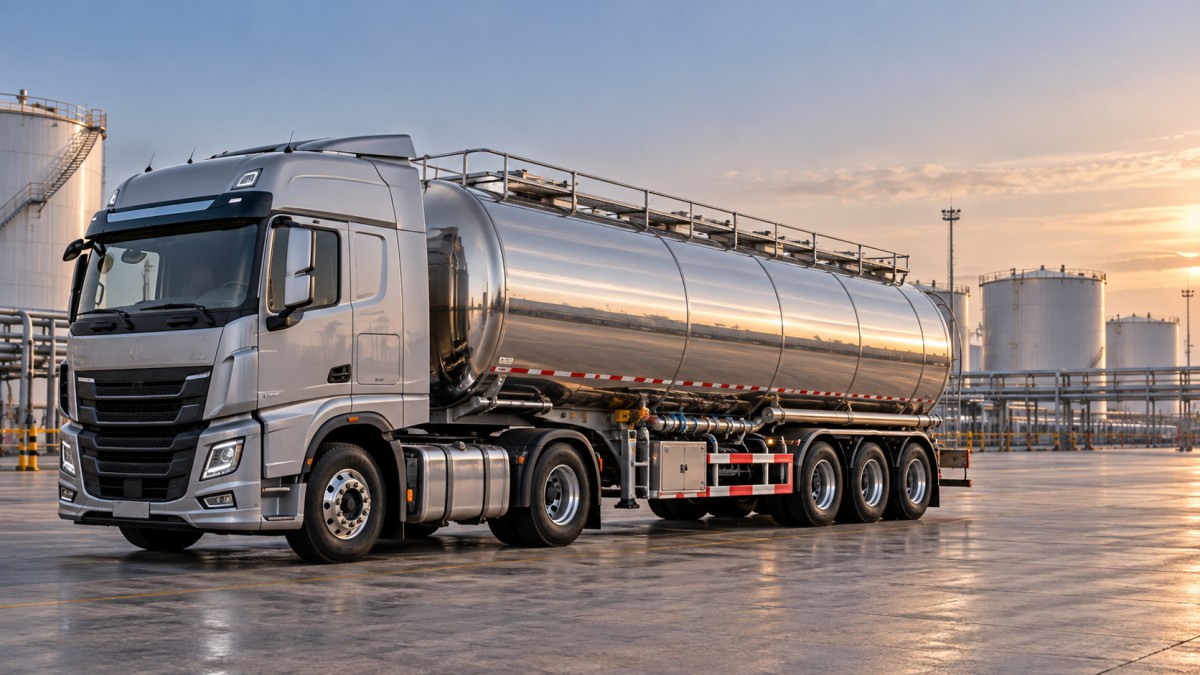
A 45 m3 Single-CompartmentStainless Steel Oil Tanker Truck has a nominal capacity of 45,000 liters and is designed to carry one liquid cargo at a time. That does not mean every liquid is suitable, or that every trip can legally use the full tank volume. The answer depends on the cargo, the tank’s construction, its seals and fittings, and the weight and transport rules that apply along the route.
For someone comparing tanker options, the distinction matters. A vehicle that looks suitable for diesel may need a different specification before it can carry another liquid. Understanding those limits makes it easier to choose equipment that fits the cargo rather than discovering a mismatch after purchase.
What liquids can a 45 m³ single-compartment tanker carry?
A stainless steel oil tanker may be specified for a range of petroleum products, but suitability must be confirmed for the complete tank system and the intended route. Common products to discuss with the manufacturer include:
- Diesel fuel: A common cargo for fuel distribution, subject to suitable tank fittings and the applicable dangerous-goods requirements.
- Gasoline or petrol: A possible cargo where the tanker is specifically designed, equipped and approved for it. Its volatility makes vapor control, ignition prevention and correct loading procedures particularly important.
- Kerosene and jet fuel: Potential cargoes when the vehicle meets the relevant product-handling and cleanliness requirements. Aviation fuel supply chains may impose additional controls.
- Heating oil and certain other petroleum liquids: Possible choices if their properties are compatible with the tank, equipment and operating conditions.
Other liquids should not be assumed suitable simply because the tank is stainless steel. Some chemicals require particular stainless steel grades, specialized seals, different venting or a dedicated chemical tanker. Food-grade liquids, meanwhile, require appropriate hygienic design, cleaning procedures and a suitable cargo history. A tank previously used for fuel should not be treated as ready for edible products without confirmation from the relevant authorities and product operator.
The practical question is therefore not just “What is the tank made of?” It is “Has this exact tanker been designed and accepted for this exact liquid?”
What does one compartment mean in daily operation?
A single-compartment tanker has one main cargo space rather than separate sealed compartments for different products. In normal use, its available capacity is devoted to one compatible liquid. For example, a distributor could use it to move a bulk load of diesel from a terminal to a large customer or storage site.
This arrangement can make sense when the route involves one product and one main delivery. There are fewer separate cargo spaces to manage, and the operator can plan around a single loading and unloading sequence. Internal baffles may still be fitted to reduce liquid movement, but baffles are not necessarily sealed product compartments.
The limitation appears when a delivery schedule calls for several grades or fuels. Diesel and gasoline should not be loaded together into the same cargo space. They would mix, and the resulting product could be contaminated or unusable. Separate loads also require appropriate cleaning and changeover procedures; emptying a tank does not automatically remove all residue.
Does 45,000 liters mean the tanker can always be filled to 45,000 liters?
No. The stated 45 m³ is a volume figure, not a guarantee of the permitted load on every journey. The actual quantity may be lower because of cargo expansion, loading rules, vehicle weight or axle limits. Confirm whether the stated capacity refers to the tank’s total geometric volume or an approved working capacity.
Liquid density provides a useful starting point for estimating cargo mass:
Cargo mass in kilograms = loaded volume in liters × density in kilograms per liter.
For illustration, if a liquid has a density of 0.84 kg/L, 45,000 liters would weigh approximately 37,800 kg. That is the cargo alone. The tractor, trailer, fuel, driver and other equipment also contribute to the vehicle’s gross weight. Actual density varies by product and temperature, so operators should use the relevant product data rather than rely on this example.
Even when the combined vehicle weight appears acceptable, the load must also be distributed within permitted axle and coupling limits. Bridge restrictions, road conditions and local rules can further affect the allowable journey. Transport operators in East Africa, West Africa and Saudi Arabia should check the requirements for each country and route, including any border crossings.
Why stainless steel is only part of the compatibility check
Stainless steel can be specified for tank construction where its material properties suit the intended service. It is not, however, a universal guarantee against corrosion or contamination. Different stainless steel grades behave differently with different liquids, and a product that is compatible with the tank shell may still damage another component.
Before choosing a tanker, ask for the intended cargoes to be reviewed against the complete configuration:
- Tank material and welds: Confirm the specified stainless steel grade and whether it is appropriate for the liquid and expected operating conditions.
- Seals, gaskets and hoses: Check compatibility with the cargo; a suitable shell does not compensate for an unsuitable seal.
- Valves and discharge equipment: Confirm that the loading and unloading arrangement matches the product and receiving site.
- Vents and pressure-related equipment: Verify that the design is appropriate for the cargo and applicable regulations. An atmospheric fuel tanker should not be assumed suitable for pressurized cargo.
- Cleaning and inspection access: Consider how the tank will be inspected, maintained and prepared between cargoes.
Give the manufacturer the product’s safety data sheet or an equivalent specification when available. A precise product name, concentration and expected temperature are more useful than a broad description such as “oil” or “chemical.”
Single compartment or multiple compartments?
The right choice depends less on the largest advertised volume than on how deliveries are organized. A fleet serving one bulk diesel customer may value a single cargo space. A distributor supplying several stations with different products or grades may need independently separated compartments.
For comparison, the 50 m³ 4-Compartment Carbon Steel Fuel Tanker is a fuel-transport option with four compartments for multi-product transport. Its listed specification includes a 5 mm carbon steel tank, 6 mm end plates, three axles and heavy-duty suspension with 70 mm pins. Its 50,000-liter capacity and carbon steel construction make it a different configuration—not a direct substitute for a 45 m³ single-compartment stainless steel tanker.
Multiple compartments add flexibility, but each product must still be compatible with the tank and fittings, and the total load must remain within legal weight limits. They also require careful loading plans to prevent contamination and keep the vehicle correctly balanced.
Questions to ask before selecting a 45 m³ tanker
A short conversation about the intended operation can prevent an expensive specification mistake. Before requesting a quotation or comparing drawings, establish the following:
- Which liquids will it carry? List the exact products and whether the vehicle will remain dedicated to one cargo.
- Where will it operate? Identify loading terminals, delivery locations, road conditions and countries on the route.
- What volume is actually needed? Compare delivery requirements with working capacity, product density and legal payload.
- How will it be loaded and discharged? Check site connections, required hoses and any pump or discharge arrangements.
- What approvals and equipment are required? Confirm applicable dangerous-goods, vehicle registration and operational requirements with the relevant authorities and equipment supplier.
- How will product quality be protected? Plan for cleaning, inspection and cargo changeovers, particularly for sensitive fuels.
Shandong ORNN Vehicle Co., Ltd. manufactures fuel tanker trailers and chemical liquid tanker trailers, among other transport equipment, and has 17 years of industry experience. When discussing a project with a manufacturer, share both the cargo information and the planned route: the same nominal tank capacity can lead to very different equipment choices depending on how the vehicle will be used.
In short, a 45 m³ single-compartment stainless steel tanker is best understood as a bulk vehicle for one compatible liquid at a time. Diesel, gasoline, kerosene and other products may be possible, but none should be assumed suitable without checking the design, fittings, operating limits and local regulations. The useful capacity is the amount that can be carried safely and legally—not simply the number printed on the tank.
Get Quote Form
Please complete the form below, and our product experts will contact you within one business hour. All inquiry details are kept strictly confidential and used solely to provide you with a precise solution.
✅ 24/7 Engineer Online Support | Ready for any technical inquiries.
✅ Full Export Documentation Support | We provide full set of shipping documents to ensure smooth customs clearance.
LOGO
This stunning beach house property is a true oasis, nestled in a serene coastal community with direct access to the beach.
Opening Hours
Monday - Friday : 9AM to 5PM
Sunday: Closed
Closed during holidays
Contact
+18888888888
hezuo@eyingbao.com123 West Street, Melbourne Victoria 3000 Australia
Request a Free Quote Today
Need mainstream models or custom specs? Our engineers are ready.
Contact us today for a lasting partnership!