


Products
News
- ▶ Can a four-compartment carbon steel tanker deliver multiple grades?
- ▶ How tank wall thickness affects a carbon steel tanker's payload
- ▶ What drives maintenance costs for a carbon steel fuel tanker?
- ▶ How to check a four-compartment fuel tanker's pressure test records
- ▶ What can a 45 m3 single-compartment oil tanker truck carry?
Can a four-compartment carbon steel tanker deliver multiple grades?
Yes. A four-compartment carbon steel fuel tanker can carry several fuel grades on the same trip, provided each product is kept in a suitable, isolated compartment and the loading and discharge arrangements prevent cross-contamination. Four compartments do not automatically mean four clean delivery paths: valves, manifolds, hoses and operating procedures all affect whether the right fuel reaches the right receiving tank.
For a project involving deliveries to several sites, a 50 m³ four-compartment tanker can reduce the need to assign a separate vehicle to every grade. Its practical value depends on compartment sizes, delivery volumes, permitted vehicle weights and the equipment available at each loading and receiving point.
How multiple grades are kept separate
The tank is divided into individual compartments by internal partitions. Each compartment can be assigned to a different fuel grade, or several compartments can carry the same grade when demand is uneven. For example, a route could carry two petrol grades and diesel, with the fourth compartment allocated to whichever product has the largest planned demand.
Separation inside the tank is only the starting point. Fuel also passes through loading connections, valves, discharge pipework and hoses. A system that keeps compartments separate in the tank but combines their contents in a common outlet can still transfer residue from one product to another.
When reviewing a proposed tanker, trace the complete route for each product from the loading point to the receiving tank. Establish which components are dedicated and which are shared. The answer affects delivery order, cleaning requirements and the amount of fuel that may remain in the system between drops.
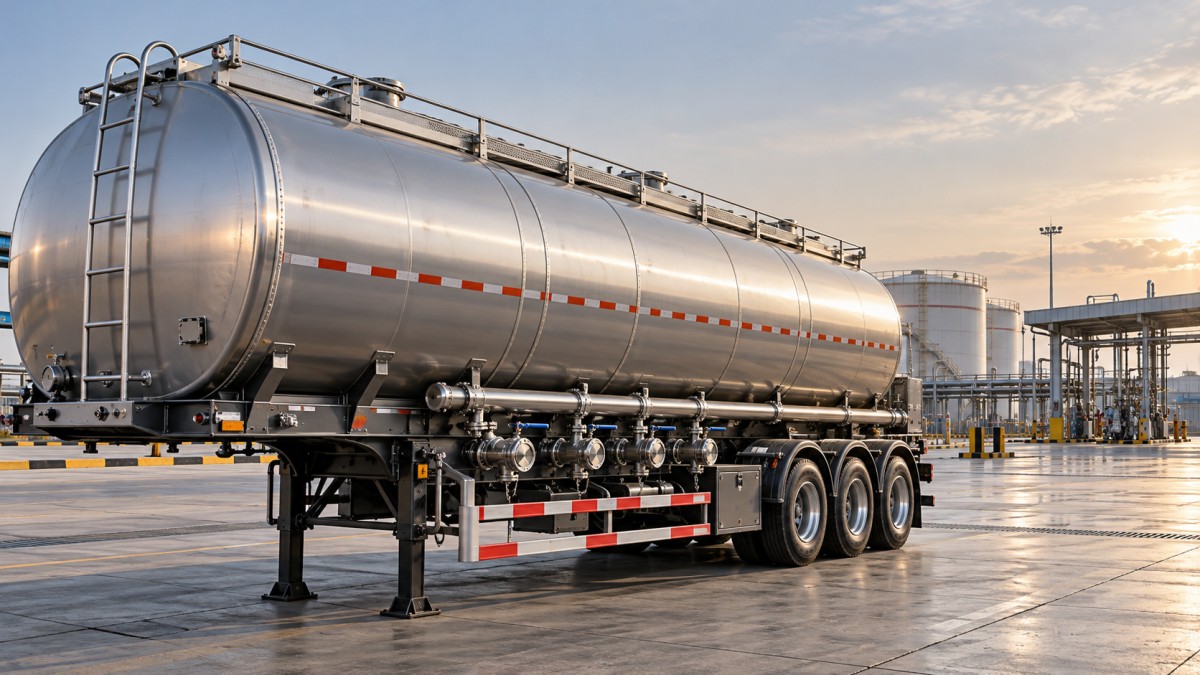
Clearly identified compartment numbers, product labels and valve markings help operators match the physical equipment to the delivery paperwork. They do not replace a checking procedure, but they make errors easier to prevent and detect.
The discharge system can determine whether the plan works
Dedicated discharge outlets and hoses provide a more straightforward way to keep grades apart, especially where a route regularly includes products with strict contamination limits. They also require enough connections, storage space and operator discipline to keep each hose assigned to the correct service.
A shared manifold or hose may be workable for some operations, but it creates a different planning problem. Fuel left in a common line can enter the next receiving tank. The acceptable quantity and type of carryover depend on the products involved and the receiving customer's quality requirements. A delivery sequence that is acceptable for one route should not automatically be assumed suitable for another.
Before selecting shared equipment, define how residual product will be drained, recovered or otherwise handled under the operator's approved procedure. Confirm that the receiving site can accommodate the proposed process and that any flushing product has an approved destination. Flushing should not be treated as a simple way to make an incompatible arrangement acceptable.
Also consider partial deliveries. If one compartment serves more than one stop, the operator needs a reliable way to measure the quantity delivered at each site and identify the fuel remaining. Specify the required metering and documentation arrangements according to the commercial agreement and local requirements; do not assume that compartment capacity alone provides an accurate delivery measurement.
Size compartments around the route, not just the total volume
A 50,000 L nominal tank capacity does not mean that every compartment holds the same volume, or that every litre can be used on every trip. A four-compartment layout should reflect the expected mix of products and drops. Equal compartments may be convenient when demand is balanced, while unequal compartments can fit a route dominated by one grade.
Consider a planned route where three receiving sites need different quantities. A compartment that is too small may require an additional trip even when unused capacity remains elsewhere. A compartment that is too large may travel partly empty because it cannot be filled with another grade without changing the allocation and cleaning arrangements.
Build the compartment plan from expected orders rather than a single ideal load. Review normal demand, foreseeable variations and the smallest practical delivery at each site. If product demand changes frequently, ask whether the compartments and discharge equipment can be reassigned between grades under the operator's cleaning and inspection procedures.
Loading sequence and delivery sequence matter as well. The compartment intended for the first stop must be accessible without disrupting the remaining load. The loading terminal must also be able to fill the planned compartments with the intended grades using compatible connections and procedures.
Check payload and axle loading before committing to 50,000 L
Tank volume is not the same as legal payload. Fuel density, the tractor and trailer's unladen weight, equipment, axle configuration and the applicable road limits all affect how much product can be carried. A tanker may have enough physical capacity for a planned load while the combination cannot carry that load legally on the intended route.
Request a weight and axle-load assessment for representative loading patterns, including a full planned load and the remaining load after each delivery. This is particularly relevant on multi-stop routes: emptying one compartment changes how weight is distributed, and the vehicle can meet a gross weight limit while placing too much load on an individual axle.
Route conditions should also influence the specification. Site access, turning space, bridge and road restrictions, ground conditions at unloading points, and the tractor's coupling and towing capability can all limit the usefulness of a large tanker. A smaller vehicle or a different compartment arrangement may make more deliveries in practice if the sites cannot accommodate the larger combination.
What the tanker specification tells you, and what it does not
The 50 m³ 4-Compartment Carbon Steel Fuel Tanker is a reference point for a project requiring a 50,000 L tank divided into four compartments. Its stated construction uses 5 mm carbon steel for the tank and 6 mm carbon steel for the end plates. The listed configuration includes three axles, a 90# (3.5-inch) bolt-on kingpin and heavy-duty suspension with 70 mm pins; overall dimensions are based on approved design drawings.
Those details help establish the basic vehicle configuration, but they do not define the multi-grade delivery system. Compartment volumes, outlet arrangement, valve controls, hose provision and measurement equipment need to be agreed for the intended work. The tractor must also be compatible with the specified kingpin and the completed trailer's operating requirements.
Carbon steel is a common material for fuel tank construction, but material selection should follow the products being carried. Confirm compatibility of the tank, seals, valves and hoses with each fuel and additive package, as well as any customer requirements for product cleanliness. A design intended for fuel transport should not be assumed suitable for unrelated chemicals or other liquids.
When does a multi-grade tanker make operational sense?
The arrangement is useful when several grades are needed on the same route and their volumes fit the compartment layout. A distributor supplying multiple filling points, or a project supplying different types of equipment from separate receiving tanks, may be able to consolidate deliveries without mixing products.
The benefit is less clear when one grade consistently fills most of the vehicle, when delivery volumes are highly unpredictable, or when sites require incompatible connections. Four compartments can leave unusable capacity on a particular trip, while extra valves and procedures add work for the operator. In some cases, separate vehicles or a different compartment split may be easier to schedule and control.
Multi-grade delivery also depends on the receiving infrastructure. Each receiving tank must have sufficient available capacity and be positively identified before unloading. A correctly isolated tanker cannot prevent contamination if the driver connects to the wrong fill point or a site has mislabelled its tanks.
Turn the route plan into a workable specification
Before approving drawings or placing an order, bring the transport operator, loading terminal and receiving sites into the discussion. A concise specification should address:
- Products and quantities: grades, expected volumes per trip and per stop, and any customer limits on contamination.
- Compartment allocation: individual capacities, intended products and whether reassignment between grades is required.
- Product paths: loading connections, compartment valves, discharge outlets, shared pipework and hose arrangements.
- Delivery control: measurement, documentation, identification, residual-product handling and procedures for partial drops.
- Vehicle operation: tractor compatibility, expected axle loads, route restrictions and access at every loading and unloading site.
- Compliance and safety: applicable transport rules, terminal and site requirements, and the required equipment and operating procedures.
Ask for drawings that show the compartment boundaries and the complete loading and discharge layout, not just the tank's external shape. Review them against an actual planned delivery sequence: where each grade is loaded, which outlet and hose it uses, and what remains after each stop. That exercise will expose many specification gaps before they become scheduling or product-quality problems.
Get Quote Form
Please complete the form below, and our product experts will contact you within one business hour. All inquiry details are kept strictly confidential and used solely to provide you with a precise solution.
✅ 24/7 Engineer Online Support | Ready for any technical inquiries.
✅ Full Export Documentation Support | We provide full set of shipping documents to ensure smooth customs clearance.
LOGO
This stunning beach house property is a true oasis, nestled in a serene coastal community with direct access to the beach.
Opening Hours
Monday - Friday : 9AM to 5PM
Sunday: Closed
Closed during holidays
Contact
+18888888888
hezuo@eyingbao.com123 West Street, Melbourne Victoria 3000 Australia
Request a Free Quote Today
Need mainstream models or custom specs? Our engineers are ready.
Contact us today for a lasting partnership!