


Products
News
- ▶ Which dangerous goods rules apply to a six-compartment oil tanker?
- ▶ How aluminum tanker weight affects allowable fuel payload
- ▶ How to confirm the tank volume in a 50 m2 fuel tanker listing
- ▶ When is a four-compartment carbon steel tanker a practical choice?
- ▶ How does corrosion develop inside a carbon steel fuel tanker?
Which dangerous goods rules apply to a six-compartment oil tanker?
A six-compartment oil tanker is not governed by a separate dangerous goods regime simply because it has six compartments. The applicable rules depend on the jurisdiction, the substances carried, their classification and the tank’s approved design. Each compartment must be suitable for its intended cargo, while the vehicle and its operation must meet the requirements applicable to the complete load.
For a six-compartment aluminum alloy oil tanker semi-trailer described as “45 m2,” the first check is whether the intended capacity is actually 45 m³. Square metres measure area, not volume. That distinction matters when comparing compartment capacities, approval documents, filling limits and vehicle loading calculations. Neither the material nor the stated capacity establishes dangerous goods compliance on its own.
Which rules govern the journey?
The starting point is the law in every jurisdiction where the tanker will operate. Vehicle registration, tank approval and dangerous goods transport are related but separate matters: a trailer accepted for general road use is not automatically approved to carry every petroleum product.
For international road journeys between countries applying ADR, the applicable edition of the Agreement concerning the International Carriage of Dangerous Goods by Road establishes requirements for classification, tank use, marking, documentation, equipment, vehicle approval and driver training. Domestic transport is governed by national law; authorities may apply ADR or different provisions. A route involving a non-ADR country requires a separate assessment of that country’s requirements.
For operations in Saudi Arabia or countries in East and West Africa, ADR should not be assumed to apply merely because a tanker was designed or manufactured to an ADR-related specification. Local transport, vehicle registration, fire safety and petroleum-sector requirements must be checked against the actual route and operating activity. Border crossings can introduce additional obligations, even when the same cargo remains in the same tank.
The UN Model Regulations provide a framework used in many dangerous goods systems, but they are not, by themselves, a road transport approval for a particular vehicle. If a loaded tanker is transported by sea, the applicable maritime requirements, including the International Maritime Dangerous Goods Code where relevant, must also be assessed separately from the road leg.
Classify each product before assessing the tank
“Oil” is not a sufficiently precise description for dangerous goods compliance. Gasoline, diesel fuel, kerosene and other petroleum products can have different classifications and transport conditions. The shipper’s classification and the product safety data sheet provide a starting point, but the transport classification must be established under the rules governing the journey.
For each intended product, record the proper shipping name, UN number, hazard class, packing group where assigned, and any applicable tank provisions. Under ADR, the Dangerous Goods List links an entry to the relevant tank codes, special provisions and other conditions. The assessment should then compare those conditions with the approval and actual configuration of the compartment and its associated equipment.
For example, a tanker intended to carry gasoline in one compartment and diesel in another cannot be cleared solely because both are petroleum fuels. The review must cover each substance and the combination: permitted tank use, product compatibility, applicable segregation requirements, markings and the arrangement of shared loading or discharge equipment.
The six-compartment layout creates six potential cargo decisions, not six independent regulatory exemptions. A compartment that is empty, nominally empty but uncleaned, or carrying residue can still affect the load assessment, documentation and marking requirements.
Tank approval must match the compartment and the cargo
A meaningful compliance review follows the tank approval from the design through to the completed vehicle. Depending on the applicable regime, the evidence may include the type approval or design approval, tank code or other approved description, manufacturer’s documentation, tank plate, initial inspection report and periodic inspection records.
Under ADR, tank codes and special provisions are used to establish whether a tank is suitable for a substance. The code is not a substitute for reviewing the conditions attached to it: construction material, openings, closures, pressure-related design characteristics and equipment can all matter. The operator should also confirm that the approval identifies the relevant tank or compartments and that the information on the plate agrees with the records.
Aluminum alloy and carbon steel require different material assessments. Compatibility depends on the actual substance and tank materials, including seals, gaskets, valves and linings where fitted. A nominal shell thickness alone does not demonstrate that a tank meets a specified standard; approved calculations, fabrication controls, weld quality, testing and the complete equipment arrangement are also relevant.
For comparison, the listed 40 m³ 6-Compartment Carbon Steel Tanker Semi-Trailer is described with a 5 mm carbon-steel tank shell and 6 mm end plates. Those dimensions are useful design inputs, but the supplied specification does not establish a dangerous goods approval or confirm suitability for a particular product or route. Its carbon-steel construction should not be treated as equivalent to approval of an aluminum tanker.
Vehicle equipment needs the same discipline. A specification stating that a trailer has drum brakes without ABS, for example, must be checked against the vehicle approval and the rules applicable to the intended operation. Tank approval alone does not resolve braking, electrical equipment or other vehicle-level requirements.
Six compartments make piping and identification critical
The physical boundary between compartments is only part of product segregation. Cross-contamination can occur through a common manifold, incorrectly aligned valves, retained product in a hose or an inaccurately identified discharge point. Where different products are carried, review the complete liquid path from each compartment to its loading connection, vapor connection and discharge outlet.
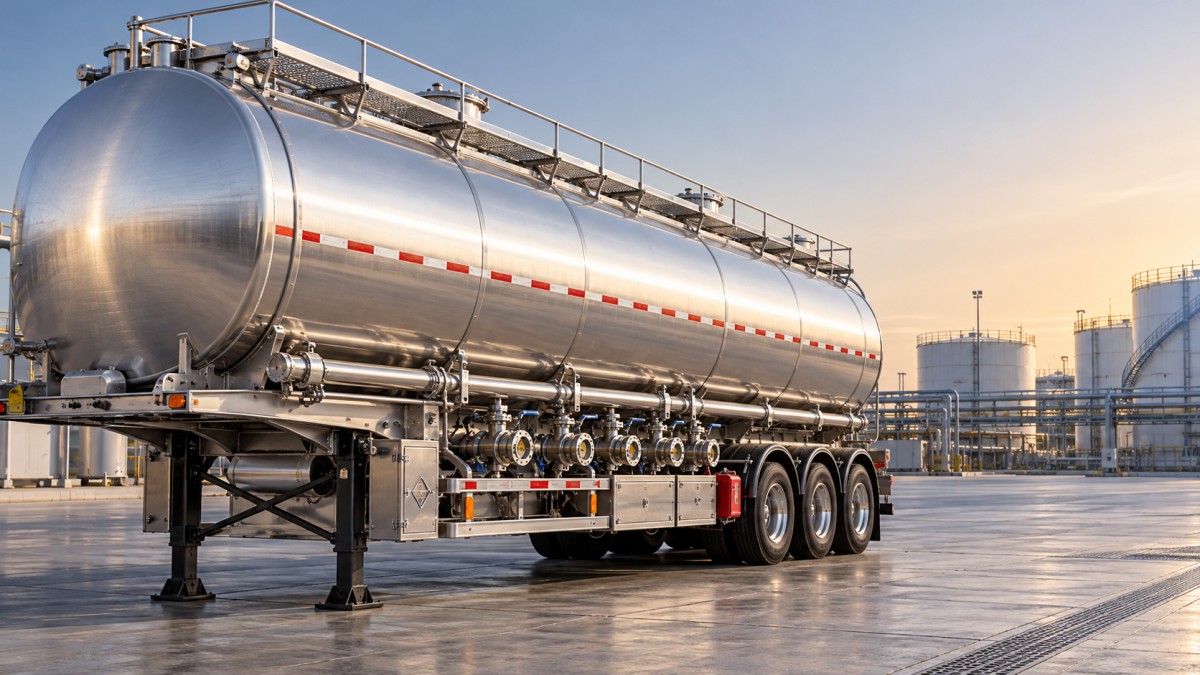
A useful inspection compares the approved drawings with the finished trailer and asks whether an operator can identify, without ambiguity:
- Each compartment and its approved capacity;
- The loading and discharge connections associated with that compartment;
- The valves that isolate it from other compartments or shared pipework;
- Emergency shut-off controls and the equipment they operate;
- Any vapor recovery connections required by the loading facility or applicable rules.
Labels and color coding can support this check, but they do not replace a verified piping layout or positive control of valve positions. Where the design permits a common manifold, procedures need to address retained liquid and the consequences of changing products. Any permitted cleaning, flushing or dedicated-hose arrangement should be consistent with the products and local requirements.
Maximum fill must also be considered compartment by compartment. Thermal expansion, product density, approved capacity and applicable filling limits affect how much can be loaded. A tanker can be below its total nominal volume while an individual compartment is overfilled or an axle is overloaded. The approved loading plan should therefore be checked against individual compartment limits, gross vehicle mass and axle loads.
Marking and placarding reflect the load, not just the trailer
External hazard communication depends on the applicable rules and the substances on board. Under ADR, tank vehicles carrying dangerous goods can be subject to orange plate, hazard identification number, UN number and placarding requirements. The precise arrangement depends on the load and relevant provisions, including rules for tanks with multiple compartments and certain petroleum products.
Do not assume that one permanent label or one set of numbers is correct for every loading pattern. Check which markings are required on the sides, ends or vehicle under the governing rules, and whether a permitted alternative applies to the particular combination of products. Markings must remain legible and visible, and information that no longer represents the relevant load or residue must be managed as required.
Compartment identification used for loading is a different control from legally required external hazard marks. Both are important: the former helps prevent an incorrect connection; the latter communicates the transport hazard to enforcement personnel and emergency responders.
Inspection records must describe the vehicle in service
A certificate issued at manufacture is not enough if the tanker has since been modified, repaired or missed an inspection. Match the tank identification and vehicle identification to the records, then check the inspection status against the rules applying to that tank. Under ADR, fixed tanks are subject to initial, periodic and intermediate inspections, with exceptional checks in relevant circumstances; the applicable intervals and scope depend on the tank and governing provisions.
Records should make it possible to trace pressure or leakproofness tests, examinations of the shell and equipment, repairs, and replacement of safety-critical components. Check that the fitted valves, closures and other service equipment remain consistent with the approved design. A repair that changes the shell, a compartment boundary or protected pipework can require assessment and inspection beyond routine maintenance.
Operational checks complement formal inspection. Before loading, verify the condition and closure of outlets, signs of leakage or damage, the operation of emergency controls, and the condition of hoses and connections used for the task. A passed periodic inspection should not be treated as proof that the tanker is safe to load after subsequent damage.
Documents, training and emergency provisions travel with the load
The applicable transport document must describe the dangerous goods in the form required by the governing rules. Under ADR, this generally includes the UN number, proper shipping name, hazard information and packing group where applicable, together with other required particulars. The description must reflect what is actually carried, including relevant information about uncleaned empty tanks where required.
ADR also prescribes written instructions, equipment and training requirements in applicable cases. Driver training and vehicle approval should be checked for the specific transport operation rather than inferred from an ordinary driving licence. Fire extinguishers and other required equipment must match the relevant rules and be maintained in usable condition. Local legislation and loading terminals may impose additional requirements.
Loading and unloading controls should address ignition sources, bonding or earthing arrangements where required, overfill prevention, valve sequencing and emergency shutdown. The tanker’s equipment and the terminal’s connections must work together; a trailer specification cannot establish that compatibility without a review of the actual loading arrangement.
The decisive compliance question is therefore not whether a six-compartment tanker has a certificate, but whether the approved tank, completed vehicle, cargo in every compartment and proposed route all correspond to the same set of applicable requirements. A change in product, route, equipment or compartment use should trigger a fresh review of the affected approvals, markings and operating controls before the next load.
Get Quote Form
Please complete the form below, and our product experts will contact you within one business hour. All inquiry details are kept strictly confidential and used solely to provide you with a precise solution.
✅ 24/7 Engineer Online Support | Ready for any technical inquiries.
✅ Full Export Documentation Support | We provide full set of shipping documents to ensure smooth customs clearance.
LOGO
This stunning beach house property is a true oasis, nestled in a serene coastal community with direct access to the beach.
Opening Hours
Monday - Friday : 9AM to 5PM
Sunday: Closed
Closed during holidays
Contact
+18888888888
hezuo@eyingbao.com123 West Street, Melbourne Victoria 3000 Australia
Request a Free Quote Today
Need mainstream models or custom specs? Our engineers are ready.
Contact us today for a lasting partnership!