


Products
News
- ▶ Aluminum/Alloy 3 Axles Tanker Aluminium Semi Trailer
- ▶ Aluminum Tanker Trailer for Sale Price
- ▶ Aluminum Alloy Oil Tanker Truck Is Better Than Carbon Steel Oil Tanker Truck
- ▶ Preventing Product Contamination in Stainless Steel Oil Semi Trailer Tanks
- ▶ 304 vs. 316 Stainless Steel for Oil Semi Trailers: Where Each Grade Fits
Aluminum/Alloy 3 Axles Tanker Aluminium Semi Trailer
Aluminum/Alloy 3 Axles Tanker Aluminium Semi Trailer: Where Lightweight Design Makes a Real Difference
An Aluminum/Alloy 3 Axles Tanker Aluminium Semi Trailer is usually considered when a liquid transport operator wants to carry more product without moving into a larger overall vehicle combination. The basic logic is straightforward: a lighter tanker body can reduce tare weight, leaving more of the permitted gross combination weight available for fuel, chemicals, or other compatible liquids. In daily operations, however, the buying decision is not simply “aluminium is lighter, so it is better.” Route quality, product compatibility, repair capability, axle loading, compartment layout, and local operating practices all matter.
This is particularly relevant for fuel distributors, oil companies, and logistics fleets working across East Africa, West Africa, and Saudi Arabia. A tanker that performs well on long paved highway runs may need a different suspension approach, reinforcement strategy, or service plan when it regularly enters depots on uneven access roads. The tank shell is only one part of the equation. The chassis, baffles, running gear, discharge arrangement, and maintenance discipline determine whether a trailer remains dependable after years of loading cycles.
Why Aluminium Alloy Is Chosen for Liquid Tank Transport
The main attraction of an aluminium alloy tanker is reduced vehicle weight. For fleets operating close to legal or practical payload limits, every kilogram removed from the trailer structure can matter. This is most noticeable on repeated, high-volume fuel delivery routes where the tractor unit, driver, and operating distance remain broadly the same but the payload opportunity changes from trip to trip.
Aluminium also has strong corrosion resistance in many operating conditions. That does not mean the trailer is maintenance-free. Tank cleaning procedures, product residues, fittings, seals, and external contamination still need attention. The suitability of aluminium must always be checked against the exact liquid being transported. A fuel tanker, for example, has different material considerations from a tanker intended for aggressive chemical products. The right question is not whether aluminium is “premium,” but whether it is compatible with the cargo and the operating routine.
There is another practical advantage: lower tare weight can improve the working balance of a three-axle tanker. With properly engineered tank geometry and axle placement, the load can be distributed more consistently across the tractor and trailer axles. But operators should avoid assuming that a lightweight body automatically solves axle-load issues. Compartment filling order, fuel density, partial loads, and road gradients can all affect real-world axle weights.
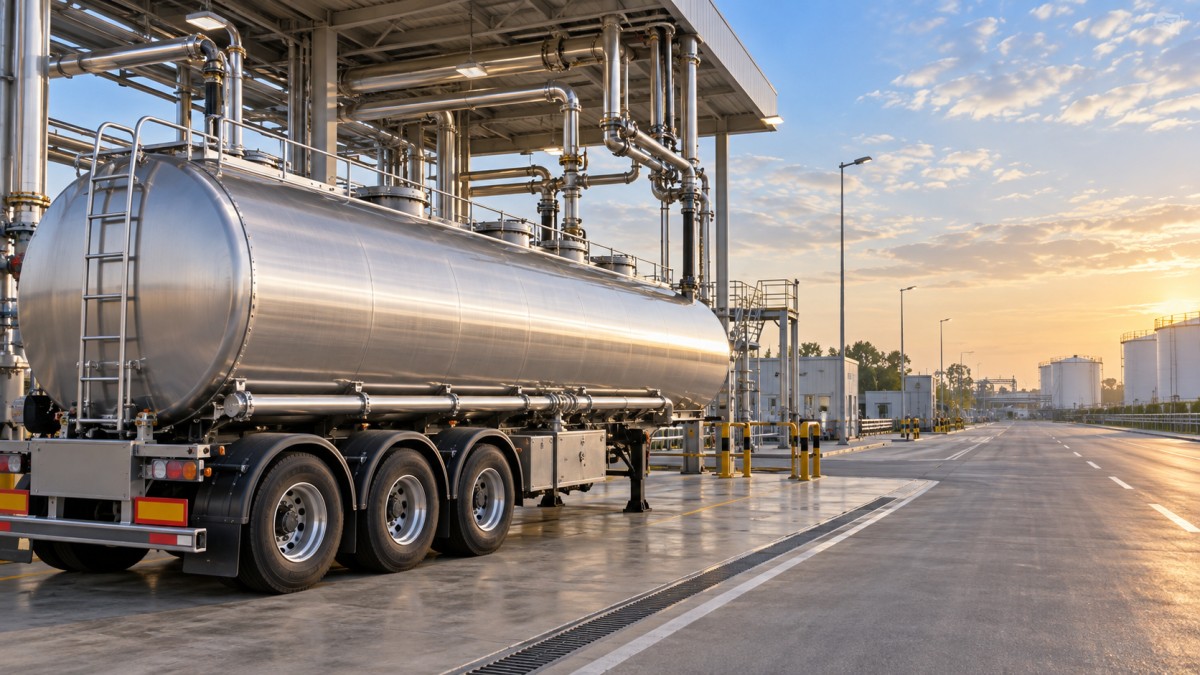
Three Axles Are About Stability, Not Just Capacity
A 3-axle tanker semi-trailer remains a common configuration because it provides a practical balance between carrying capacity, road handling, tyre contact area, and serviceability. For large-volume liquid transport, three axles help spread the trailer load while supporting a stable platform for the tank body. Yet axle count alone says little about actual performance.
Liquid cargo moves. Even with internal baffles, a partly filled compartment can create surge forces during braking, turning, or sudden lane changes. This is why compartment design deserves more attention than many buyers give it. A tanker used for multi-product distribution may need several separate chambers to supply different stations or customers during one run. A fleet focused on bulk delivery to one terminal may prioritize another layout. More compartments create flexibility, but they also add operational discipline: drivers and loading staff must follow filling sequences and avoid cross-contamination.
Suspension selection should match the route rather than follow fashion. Mechanical suspension is widely understood, relatively straightforward to inspect, and often preferred where workshops need practical, familiar components. Air suspension may be appropriate in some operations, but it brings a different maintenance requirement. The better choice depends on road surface conditions, available service support, fleet policies, and the expected duty cycle.
The Aluminium-versus-Carbon-Steel Decision Is Not Always Obvious
A lighter alloy tanker is often attractive for high-frequency routes, but carbon steel remains a sensible choice for many fuel transport applications. It can offer a robust, familiar solution where payload optimization is not the only priority or where local repair resources are more accustomed to steel fabrication. The decision should be made with a full operating-cost view, not only the initial purchase price.
For comparison, a 45 m³ 5-Compartment Carbon Steel Fuel Tanker uses a 4.5 mm carbon-steel tank shell and 5 mm carbon-steel end plates, with a total 45,000 L capacity. Its five compartments suit operators serving multiple delivery points or handling separated fuel grades on a single route. The listed configuration includes three 13-ton-capacity axles, available from ORNN, FUWA, or BPW, along with mechanical suspension and 315/80R22.5 tyres. These are concrete details worth comparing against an alloy specification, because the body material is only one element of a complete tanker design.
A good procurement review should also look at the kingpin, landing gear, brake system specification, tyre availability, and spare-parts strategy. A 90# bolt-on kingpin and linked-operation landing gear may sound like minor line items, but they affect coupling compatibility, daily handling, and service replacement. For cross-border transport, it is wise to confirm what parts can realistically be obtained where the trailer will operate rather than relying on catalogue availability alone.
Questions That Should Be Settled Before the Tanker Is Built
The most costly mistakes usually happen before production starts. A buyer may specify capacity but overlook loading infrastructure, local bridge limits, or the actual turning space at filling stations. These points are worth resolving early:
- What exact liquids will be carried, and is the chosen tank material compatible with them?
- Will the trailer mainly run full loads, mixed compartment loads, or frequent partial deliveries?
- What are the practical axle and gross-weight limits on the intended routes?
- Are the roads, depot entrances, and loading bays suitable for the selected wheelbase and suspension?
- Which axle, landing gear, and tyre brands can the local workshop maintain without long downtime?
- What safety equipment and discharge arrangement are required by the operator and applicable local rules?
It is also sensible to ask how the tanker will be cleaned and inspected. An attractive exterior finish does not reveal the quality of internal workmanship, weld access, manhole arrangement, or compartment separation. These are the areas that influence contamination control, inspection convenience, and long-term operating confidence. Buyers should request a clear technical confirmation for any requirement that affects safety or legal operation in their market.
A Tanker Should Match the Route, the Product, and the Workshop
Shandong ORNN Vehicle Co., Ltd. has worked in semi-trailer and transport equipment manufacturing for 17 years, covering fuel tankers, chemical liquid tankers, dump trailers, flatbeds, and lowbeds. That wider product background matters because tanker decisions rarely sit in isolation. Fleet owners often operate mixed equipment, use the same tractor heads across several trailer types, and need specifications that fit their maintenance capability as much as their transport plan.
For an Aluminum/Alloy 3 Axles Tanker Aluminium Semi Trailer, the right configuration is usually the one that makes daily work less complicated: a tank material appropriate for the cargo, a capacity that fits route limits, compartments sized for the delivery pattern, and components that can be serviced locally. Lightweight construction can be a strong commercial advantage, but it should be selected with the same care given to braking, load distribution, and long-term repair planning. In tanker transport, the best specification is rarely the most elaborate one. It is the one that keeps moving safely and predictably on the roads the fleet actually uses.
Get Quote Form
Please complete the form below, and our product experts will contact you within one business hour. All inquiry details are kept strictly confidential and used solely to provide you with a precise solution.
✅ 24/7 Engineer Online Support | Ready for any technical inquiries.
✅ Full Export Documentation Support | We provide full set of shipping documents to ensure smooth customs clearance.
LOGO
This stunning beach house property is a true oasis, nestled in a serene coastal community with direct access to the beach.
Opening Hours
Monday - Friday : 9AM to 5PM
Sunday: Closed
Closed during holidays
Contact
+18888888888
hezuo@eyingbao.com123 West Street, Melbourne Victoria 3000 Australia
Request a Free Quote Today
Need mainstream models or custom specs? Our engineers are ready.
Contact us today for a lasting partnership!